Rotational Motion Problem with Varying Centripetal Force and Friction

Click For Summary
SUMMARY

The discussion revolves around solving a rotational motion problem from "Problems in General Physics" by IE Irodov, specifically involving varying centripetal force and friction. The initial attempt to equate the work done by friction with the change in kinetic energy led to an incorrect answer. The correct solution incorporates both centripetal force and frictional forces acting on the cylinder, ultimately leading to the formula: \frac{(1+k^2)R (\omega_0)^2}{8 \pi g k(1+k)} . The resolution involved drawing a free body diagram and correctly identifying the forces acting on the cylinder.

PREREQUISITES
  • Understanding of rotational dynamics, specifically torque (τ) and moment of inertia (I).
  • Familiarity with kinetic energy changes in rotational motion.
  • Knowledge of centripetal force and its variations.
  • Ability to analyze free body diagrams in physics problems.
NEXT STEPS
  • Study torque and angular acceleration relationships in rotational dynamics.
  • Learn about centripetal force calculations in varying conditions.
  • Explore frictional forces in rotational motion and their impact on motion.
  • Practice solving problems involving free body diagrams in rotational contexts.
USEFUL FOR

This discussion is beneficial for advanced high school students, physics enthusiasts, and educators focusing on rotational dynamics, particularly those dealing with complex scenarios involving friction and centripetal forces.

Pi-is-3
Messages
49
Reaction score
13
Homework Statement
Find the number of revolutions by the cylinder.
Relevant Equations
$$ \tau = I \alpha $$
Change in Kinetic energy = Work done
Hello, I'm stuck in this rotational motion problem (advanced high school level).
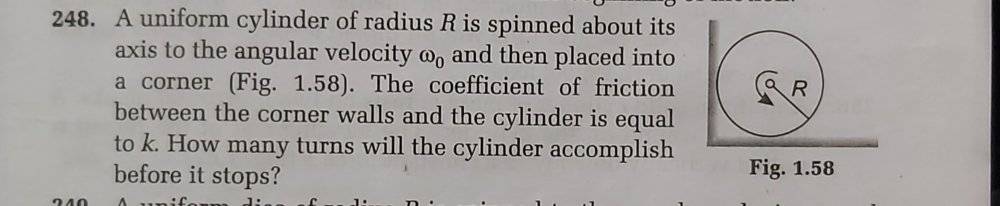
20200209_013940.jpg

Source: Problems in General Physics- IE Irodov

My attempt(s):

First I tried using work done by the moment of friction (mgkR) and equated it with change in KE.

I got the answer as ## \frac{R (\omega_0)^2}{8 \pi g k} ##.

However, the correct answer is ## \frac{(1+k^2)R (\omega_0)^2}{8 \pi g k(1+k)} ## .

The first mistake I thought of is not including centripetal, but the centripetal is varying with ## \omega ## and whenever I solve it that way I am not even getting close to the answer. Using ## \tau=I \alpha ## is getting nowhere either.

Any hint is appreciated. Thank you.
 
Physics news on Phys.org
Pi-is-3 said:
Homework Statement:: Find the number of revolutions by the cylinder.
Relevant Equations:: $$ \tau = I \alpha $$
Change in Kinetic energy = Work done

Hello, I'm stuck in this rotational motion problem (advanced high school level).

View attachment 256836
Source: Problems in General Physics- IE Irodov

My attempt(s):

First I tried using work done by the moment of friction (mgkR) and equated it with change in KE.

I got the answer as ## \frac{R (\omega_0)^2}{8 \pi g k} ##.

However, the correct answer is ## \frac{(1+k^2)R (\omega_0)^2}{8 \pi g k(1+k)} ## .

The first mistake I thought of is not including centripetal, but the centripetal is varying with ## \omega ## and whenever I solve it that way I am not even getting close to the answer. Using ## \tau=I \alpha ## is getting nowhere either.

Any hint is appreciated. Thank you.
Please post your working (and not as an image).
Did you draw a force diagram? If so please post that as an image, or list the forces involved.
Remember, both surfaces have friction.
 
  • Like
Likes   Reactions: etotheipi
You said you tried using work; can you devise an expression relating the number of revolutions to the angular work done by the two frictional forces?
 
etotheipi said:
You said you tried using work; can you devise an expression relating the number of revolutions to the angular work done by the two frictional forces?
I think @Pi-is-3's error is in determining those forces.
 
  • Like
Likes   Reactions: Pi-is-3 and etotheipi
I am unable to find the frictional force on the left wall.
 
Pi-is-3 said:
I am unable to find the frictional force on the left wall.

If you draw a free body diagram of the situation, what equations can you write down involving the normal forces, frictional forces and weight?
 
  • Like
Likes   Reactions: Pi-is-3 and CPW
In determining the reaction force on the cylinder by the wall, consider that there is no translational acceleration of the center of mass of the cylinder.
 
  • Like
Likes   Reactions: Pi-is-3
15811993452328846205678882829423.jpg


Ignore the minus sign behind mgk. Their has to be some involvement of centripetal force in friction, but I am not sure how, because it is directed towards the center, and not towards the ground. I know I have probably done it very wrong. I'm sorry if it's too bad.
 
Oh wait, maybe the normal reaction at ground isn't mg. I have had an idea, let me try it out first.
 
  • Like
Likes   Reactions: etotheipi
  • #10
CPW said:
In determining the reaction force on the cylinder by the wall, consider that there is no translational acceleration of the center of mass of the cylinder.
Got it! Since their is no translational motion, the normal reaction from ground+ frictional on the left wall= mg.

And, friction on ground = Normal reaction from the left wall.

Done!
 
  • #11
Thank you everyone, this problem has been solved.
 

Similar threads

  • · Replies 11 ·
Replies
11
Views
2K
  • · Replies 3 ·
Replies
3
Views
1K
Replies
2
Views
803
  • · Replies 17 ·
Replies
17
Views
1K
  • · Replies 9 ·
Replies
9
Views
2K
  • · Replies 12 ·
Replies
12
Views
1K
Replies
3
Views
1K
  • · Replies 2 ·
Replies
2
Views
892
Replies
2
Views
2K
  • · Replies 28 ·
Replies
28
Views
3K