Safety: Capacitors in Subwoofer

  • Thread starter Thread starter daneb396
  • Start date Start date
  • Tags Tags
    Capacitors Safety
Click For Summary

Discussion Overview

The discussion revolves around troubleshooting a subwoofer, specifically addressing issues related to blown fuses and the safety of discharging capacitors within the device. Participants explore methods for safely handling high-voltage capacitors, testing components, and diagnosing potential faults in the subwoofer's circuitry.

Discussion Character

  • Technical explanation
  • Debate/contested
  • Experimental/applied

Main Points Raised

  • One participant expresses concern about the danger of discharging capacitors and seeks guidance on how to safely do so, noting the high voltage of 200V.
  • Another participant suggests that capacitors will discharge quickly when the circuit is not live and recommends using a domestic voltage meter to check for charge.
  • A correction is made regarding the resistor value for discharging capacitors, with a recommendation of using a 10k ohm resistor instead of 10 ohms, emphasizing safety precautions.
  • Participants discuss testing the speaker by disconnecting wires and using an ohmmeter to check for shorts, as well as the expected resistance range for a functioning speaker.
  • One participant questions the reliability of another's statement about capacitor discharge time, emphasizing the importance of knowing the actual voltage present before proceeding.
  • A suggestion is made to create a discharge jumper with an alligator lead and resistor for safely discharging capacitors.
  • Concerns are raised about the adequacy of a cheap multimeter for testing capacitor charge, with one participant defending their use of such a meter.

Areas of Agreement / Disagreement

There is no consensus on the safety of capacitor discharge timing, with some participants believing that capacitors can hold a charge for a long time, while others suggest they will discharge quickly. Multiple viewpoints on the adequacy of tools and methods for testing and discharging capacitors are presented, indicating ongoing debate.

Contextual Notes

Participants express varying levels of experience with electronics, leading to different assumptions about safety and testing methods. There are unresolved questions regarding the configuration of the capacitors and the specific location of the fuse within the subwoofer.

daneb396
Messages
2
Reaction score
0
I am working on identifying an issue with blown fuses in a subwoofer for a friend. The subwoofer is a Velodyne SPL-R10. The subwoofer has blown several fuses and I am attempting to locate any loose connections that may have caused a short. I am very inexperienced with complex circuits such as amplifiers, so I assume that would be the main cause of a blown fuse, and would also be the only problem I would be able to fix.

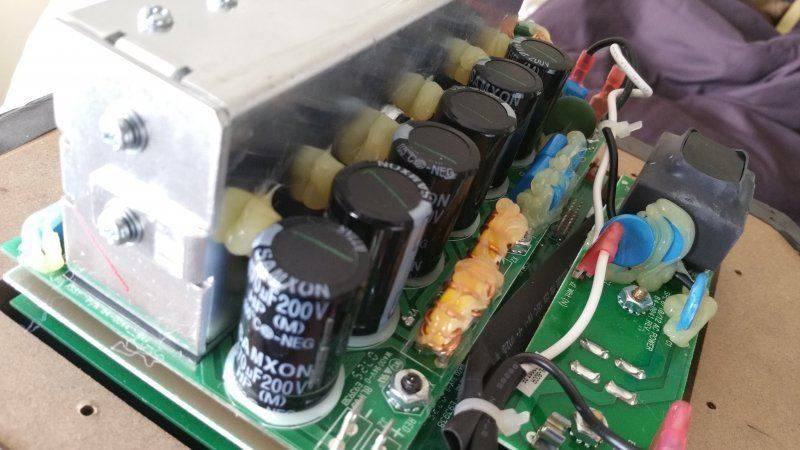
My question is, how do I discharge the capacitors on the circuit board? I opened the panel and see that there are 6 capacitors (all 200V 470uF) and I assumed that it would be dangerous to tinker any further. I know from my little knowledge of electronics that 200V is a substantial amount of voltage, and that the capacitors may still be charged.

Also, how do I tell how much current the capacitors would discharge? I know current (I) equals volts (V) * amps(A), but with a charged capacitor, I am not sure how to calculate it.

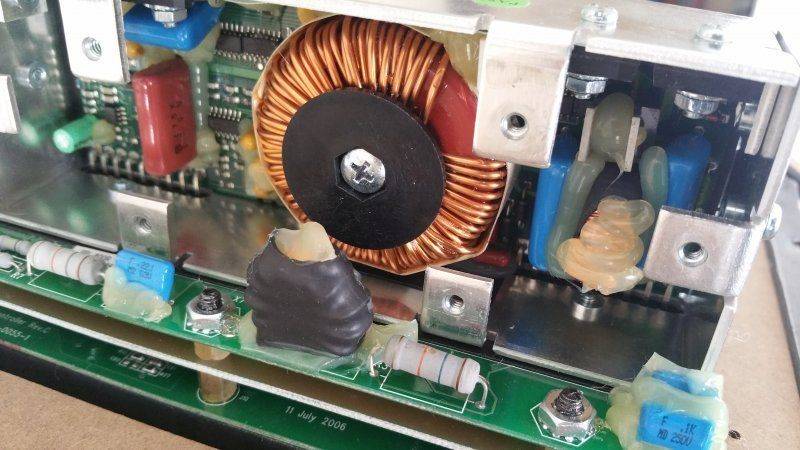
Attached is a picture of the capacitors, if it helps at all. I am not sure if the capacitors are in series, parallel, or even attached to one another in any type of configuration. There is also another picture of a copper coil of some sort. Is that an inductor? What is the purpose of this?

I appreciate any help with this, as I do not want to shock or especially electrocute myself. The grounding of the capacitors is my main concern, but I would also like to learn a few things in the process.
20150405_111228.jpg
20150405_111940.jpg
20150405_111228.jpg
20150405_111940.jpg
Thanks in advance.
 
Engineering news on Phys.org
When the circuit is no longer 'live', I would think the charge stored in the capacitors would leak away to nothing in a relatively short time.
You could test that they are discharged by using a cheap domestic voltage meter across the terminals.
(set in the range for ~200v DC)
 
CORRECTION: not 10 ohms. 10k ohms.
You can use a high watt, low impedance, resister to short out the capacitor leads. 10k ohms will discharge it quickly. Don't be touching the bare resister wires. Don't underestimate how much juice they may have.
 
Last edited:
What happens when a good fuse is installed and the black and white wires are disconnected from the main assembly when you power it up? That would tell you if that Power supply board is ok.
Have you tested the speaker by itself? You can disconnect the red and black wires and connect an Ohmmeter to them and gently and slowly push the speaker cone back and forth while watching the meter to see if there is a short indication. You can also see if the designed resistance of the speaker coil is correct.
Normally the capacitors soon discharge through the circuit they are connected to.
Subwoof.jpg
 
I am not even sure where the fuse is located, and I don't know how to push the speaker come back and forth. How would I tell if there is a short that way?
 
Definitely a good idea to see if the speaker itself is shorted out.
Again you can use a cheap domestic multimeter set to measure resistance.
If the speaker is shorted you will get a reading close to zero.
You should see something more like in the range 4 to 16 ohms if it's good.

You could use a small power source such as an AAA battery to get some amount of movement of the speaker coil.
1.5v won't harm it, but you might see it move and hear a click sound when you put battery across the across the speaker leads.
 
Last edited:
daneb396 said:
I am not even sure where the fuse is located, and I don't know how to push the speaker come back and forth. How would I tell if there is a short that way?
Okay. Forget everything I said.
 
Sorry I missed then this tread started -

First - I have to take particular exception to Rootone's first post " I would think the charge stored in the capacitors would leak away to nothing in a relatively short time." -- Sorry I was a safety coordinator and the language I ALWAYS taught for electrical safety is ... "It is not what you THINK - it is what you KNOW" -- 200V can sit on a capacitor for a long time unless there is a specific discharge circuit built in, or by design. If you do not KNOW it is safe, then it is not safe!

As he later stated I agree - best to Measure with a voltmeter ( 600 V rated, DC ) -- the Safety Process is test the meter on a KNOWN source(something you KNOW has~ 200V), then the capacitor(s) you want to test (they should be well be low 50V before touching) and then back to the KNOWN source. If you do not have such a meter - you should not be dealing with this circuit. ALSO - the Voltage detectors sold in hardware stores are for AC voltages only and do not work on DC (as these caps would have)

A basic discharge jumper can be made with the resistor as noted above - cut an alligator lead in half and solder the resistor in the middle. then you have insulated clips with which to connect across the DC caps. When done put this where you will remember it - so it is always convenient.
 
  • Like
Likes   Reactions: davenn
I apologise if you considered that advice to be not safe, my main point was in the suggestion that a cheap multimeter would be adequate to test whether the capacitors still were holding a charge.
I have such a meter it cost me about 5 euro, it measures both AC and DC, both voltage and current in various ranges + resistance, and even hFe for transistors, though I have not used the latter function so far.
 

Similar threads

  • · Replies 30 ·
2
Replies
30
Views
3K
  • · Replies 4 ·
Replies
4
Views
1K
  • · Replies 3 ·
Replies
3
Views
2K
  • · Replies 15 ·
Replies
15
Views
2K
  • · Replies 2 ·
Replies
2
Views
2K
Replies
5
Views
3K
  • · Replies 4 ·
Replies
4
Views
2K
  • · Replies 12 ·
Replies
12
Views
4K
Replies
3
Views
2K
  • · Replies 28 ·
Replies
28
Views
15K