danonymous
- 1
- 0
Hi!
This is my first time posting here at PF, so forgive me if i am going against any rules.
Homework Statement
I haven been given a problem to design a circuit that takes an input ranging from 0 to 5V, and outputs:
20V (DC) if the input is between 1 and 4V
and
nothing for 0 or 5V.
The attempt at a solution
From what i have learned from class/research, a Shmidt trigger would be a good approach.
i designed one that "kind of" works, but doesn't do what i had intended. it does output a 20V DC signal if the input is between 1 and 4V, but if i go above 4V, i still get a moderately large output (~12V).
below is my circuit and an explanation for my resistor values.
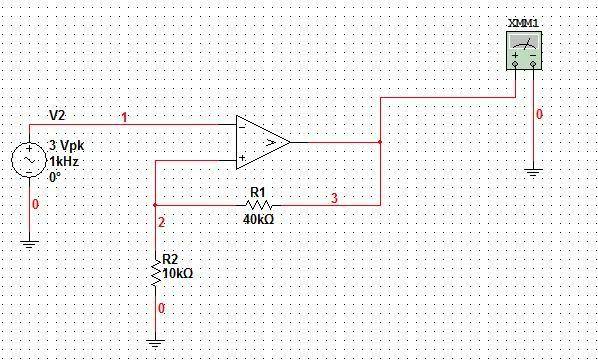
from what i understand, with a Shmidt trigger,
Voutput = +V
until
V1 > +V*R2/(R1+R2)
once greater, Voutput would drop to -V.
i have set the positive and negative supply voltages on my comparator to be 20V and 1mV respectively.
thus, i was expecting Voutput to go to ~1mV when Vin > 4V.
any insight/hints would be greatly appreciated.
This is my first time posting here at PF, so forgive me if i am going against any rules.
Homework Statement
I haven been given a problem to design a circuit that takes an input ranging from 0 to 5V, and outputs:
20V (DC) if the input is between 1 and 4V
and
nothing for 0 or 5V.
The attempt at a solution
From what i have learned from class/research, a Shmidt trigger would be a good approach.
i designed one that "kind of" works, but doesn't do what i had intended. it does output a 20V DC signal if the input is between 1 and 4V, but if i go above 4V, i still get a moderately large output (~12V).
below is my circuit and an explanation for my resistor values.
from what i understand, with a Shmidt trigger,
Voutput = +V
until
V1 > +V*R2/(R1+R2)
once greater, Voutput would drop to -V.
i have set the positive and negative supply voltages on my comparator to be 20V and 1mV respectively.
thus, i was expecting Voutput to go to ~1mV when Vin > 4V.
any insight/hints would be greatly appreciated.