Scleronomic or Rheonomic Mechanical System?

Click For Summary
SUMMARY

The discussion clarifies the distinction between scleronomic and rheonomic mechanical systems. A scleronomic system is characterized by constraints that are fixed over time, as seen in the first pendulum where the constraint is static. In contrast, the second pendulum exemplifies a rheonomic system, where the constraint varies with time. The constraints can be expressed in Pffafian form, confirming the scleronomic nature of the system when only positions of the masses are involved.

PREREQUISITES
  • Understanding of mechanical systems and constraints
  • Familiarity with Pffafian form of constraint equations
  • Knowledge of scleronomic and rheonomic definitions
  • Basic principles of dynamics and motion
NEXT STEPS
  • Study the derivation of Pffafian forms in mechanical systems
  • Explore examples of rheonomic systems, such as rolling disks in 3D
  • Investigate the differences between holonomic and nonholonomic constraints
  • Review applications of scleronomic systems in engineering and physics
USEFUL FOR

Students and professionals in mechanical engineering, physics, and applied mathematics who are studying mechanical systems and their constraints.

sams
Gold Member
Messages
84
Reaction score
2
I would really appreciate if someone could advise me whether the system below is a scleronomic or a rheonomic mechanical system, or a mix of both. If we consider the first pendulum, the constraint is fixed which leads to a scleronomous case while the constraint of the second pendulum is not fixed (varies with time) which leads to a rheonomous case.
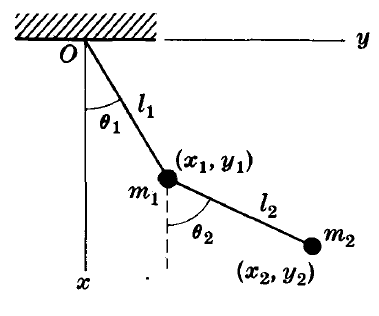
Double Pendulum.PNG

Any advice is much appreciated.
 

Attachments

  • Double Pendulum.PNG
    Double Pendulum.PNG
    3.6 KB · Views: 2,344
Physics news on Phys.org
Is this a schoolwork question?
 
Present equations of constraints as ##f_i(x_1,y_1,x_2,y_2)=0,\quad i=1,2##
 
berkeman said:
Is this a schoolwork question?
No
 
  • Like
Likes   Reactions: berkeman
No, the constraints here are not the pendulums but the rod that connects the pendulum. Now, try to find the equations that describe each constraint (i.e. the constraint equations) in the inertial frame of reference. Put all terms on the LHS (i.e. set RHS equals 0). This is then called the Pffafian form of the constraint. The definition of a scleronomic system is that the constraint equations of the system relate only the positions of the masses in the system, can be arranged into the Pffafian form. Since you can find a Pffafian form of the constraints, you have a scleronomic system. An example of a rheonomic system would be a rolling disk in 3 dimensions, in which the constraint equation relates the positions as well as velocities of the masses of the system, and in particular it cannot be integrated to a constraint equation that only relates the positions of the masses in the system.
 
aldo sebastian said:
An example of a rheonomic system would be a rolling disk in 3 dimensions, in which the constraint equation relates the positions as well as velocities of the masses of the system, and in particular it cannot be integrated to a constraint equation that only relates the positions of the masses in the syst
do not confuse with rheonomic and nonholonomic constraints
 

Similar threads

  • · Replies 5 ·
Replies
5
Views
1K
  • · Replies 25 ·
Replies
25
Views
3K
  • · Replies 12 ·
Replies
12
Views
1K
Replies
5
Views
2K
  • · Replies 9 ·
Replies
9
Views
11K
  • · Replies 2 ·
Replies
2
Views
2K
  • · Replies 5 ·
Replies
5
Views
2K
  • · Replies 376 ·
13
Replies
376
Views
23K
  • · Replies 6 ·
Replies
6
Views
2K
  • · Replies 1 ·
Replies
1
Views
2K