Scleronomic or Rheonomic Mechanical System?

Click For Summary

Discussion Overview

The discussion revolves around the classification of a mechanical system as either scleronomic or rheonomic, focusing on the nature of constraints in a system involving pendulums. Participants explore the definitions and characteristics of these types of systems, including the implications of fixed versus time-varying constraints.

Discussion Character

  • Technical explanation
  • Conceptual clarification
  • Debate/contested

Main Points Raised

  • One participant suggests that the first pendulum represents a scleronomic case due to its fixed constraint, while the second pendulum represents a rheonomic case because its constraint varies with time.
  • Another participant questions whether the original inquiry is related to schoolwork.
  • A later reply emphasizes the importance of the rod connecting the pendulums as the actual constraint, proposing that the system can be described using constraint equations in Pffafian form, which would indicate a scleronomic system.
  • Further clarification is provided that a rheonomic system, such as a rolling disk, involves constraints that relate both positions and velocities of the masses, which cannot be simplified to a position-only relationship.
  • There is a caution against confusing rheonomic constraints with nonholonomic constraints, suggesting a nuanced understanding of different types of mechanical constraints is necessary.

Areas of Agreement / Disagreement

Participants express differing views on the classification of the system, with some supporting the idea of a mixed classification and others focusing on specific definitions of scleronomic and rheonomic systems. The discussion remains unresolved regarding the definitive classification of the system in question.

Contextual Notes

Limitations include the potential ambiguity in the definitions of scleronomic and rheonomic systems, as well as the need for clarity on the specific constraints being analyzed. The discussion also highlights the importance of the frame of reference in formulating constraint equations.

sams
Gold Member
Messages
84
Reaction score
2
I would really appreciate if someone could advise me whether the system below is a scleronomic or a rheonomic mechanical system, or a mix of both. If we consider the first pendulum, the constraint is fixed which leads to a scleronomous case while the constraint of the second pendulum is not fixed (varies with time) which leads to a rheonomous case.
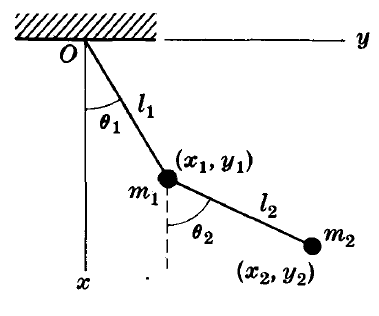
Double Pendulum.PNG

Any advice is much appreciated.
 

Attachments

  • Double Pendulum.PNG
    Double Pendulum.PNG
    3.6 KB · Views: 2,350
Physics news on Phys.org
Is this a schoolwork question?
 
Present equations of constraints as ##f_i(x_1,y_1,x_2,y_2)=0,\quad i=1,2##
 
berkeman said:
Is this a schoolwork question?
No
 
  • Like
Likes   Reactions: berkeman
No, the constraints here are not the pendulums but the rod that connects the pendulum. Now, try to find the equations that describe each constraint (i.e. the constraint equations) in the inertial frame of reference. Put all terms on the LHS (i.e. set RHS equals 0). This is then called the Pffafian form of the constraint. The definition of a scleronomic system is that the constraint equations of the system relate only the positions of the masses in the system, can be arranged into the Pffafian form. Since you can find a Pffafian form of the constraints, you have a scleronomic system. An example of a rheonomic system would be a rolling disk in 3 dimensions, in which the constraint equation relates the positions as well as velocities of the masses of the system, and in particular it cannot be integrated to a constraint equation that only relates the positions of the masses in the system.
 
aldo sebastian said:
An example of a rheonomic system would be a rolling disk in 3 dimensions, in which the constraint equation relates the positions as well as velocities of the masses of the system, and in particular it cannot be integrated to a constraint equation that only relates the positions of the masses in the syst
do not confuse with rheonomic and nonholonomic constraints
 

Similar threads

  • · Replies 5 ·
Replies
5
Views
1K
  • · Replies 25 ·
Replies
25
Views
3K
  • · Replies 12 ·
Replies
12
Views
2K
Replies
5
Views
2K
  • · Replies 9 ·
Replies
9
Views
12K
  • · Replies 2 ·
Replies
2
Views
2K
  • · Replies 5 ·
Replies
5
Views
2K
  • · Replies 376 ·
13
Replies
376
Views
24K
  • · Replies 6 ·
Replies
6
Views
2K
  • · Replies 1 ·
Replies
1
Views
2K