Seeking means of maximizing energy use from LiIon battery

Click For Summary

Discussion Overview

The discussion revolves around finding effective methods to maintain a stable output voltage of 3.2V from a Li-Ion battery as it discharges. Participants explore various voltage regulation techniques suitable for this application, including linear regulators, DC-DC converters, and shunt regulators. The conversation includes considerations of efficiency, simplicity, and the specific requirements of the device in question.

Discussion Character

  • Exploratory
  • Technical explanation
  • Debate/contested
  • Mathematical reasoning

Main Points Raised

  • One participant describes using an LM317AEMPX to regulate voltage but notes that it fails to maintain 3.2V as the battery discharges.
  • Another participant suggests using a SEPIC DC-DC converter as a more suitable solution than a linear regulator for maintaining voltage.
  • A third participant proposes a shunt regulator as a simpler alternative but highlights its inefficiency and potential power wastage when the battery voltage exceeds 3.2V.
  • Some participants discuss the efficiency differences between shunt regulators and SEPIC converters, with one noting that the shunt regulator may be less efficient but simpler.
  • There is a suggestion that existing SMPS type 3.3V regulators could be effective for the application, given the commonality of 3.3V in microcontrollers.
  • Concerns are raised about the lack of specific information from the original poster regarding the device's operational voltage range and current requirements.
  • One participant mentions the potential for finding suitable components in the automotive market for low voltage projects.

Areas of Agreement / Disagreement

Participants express differing opinions on the best approach to voltage regulation, with no consensus reached on a single solution. There is acknowledgment of the trade-offs between efficiency and simplicity in the proposed methods.

Contextual Notes

Participants note the need for more detailed specifications from the original poster, including the operational voltage range of the device and its current requirements, which could influence the choice of regulation method.

Who May Find This Useful

Individuals interested in battery-powered device design, voltage regulation techniques, and those seeking practical solutions for maintaining stable voltage in electronic projects may find this discussion beneficial.

zxcvb
Messages
10
Reaction score
1
Hello all. Thanks for taking up your time to read my post.

I have a device that operates with 3.2 V MAX, and I wish to power it from a standard 3.7 Li-Ion battery. A fully charged battery=4.2V.
I used a simple LM317AEMPX (datasheet )circuit to drop voltage to 3.2V and it worked perfectly.

Now the problem is as the battery starts to drain, the output voltage starts to become lower, so subsequently the LM317 output voltage will be lower as well, for example

batt=3.7V, LM317AEMPX=2.5V
In which this case the voltage is not enough to keep the device up and running.

So what I need is some sort of dynamic regulator to keep the output voltage fixed at 3.2V until the battery voltage drop to 3.2V as well. Advice on good ways to achieve this would be appreciated.
paNxB.png

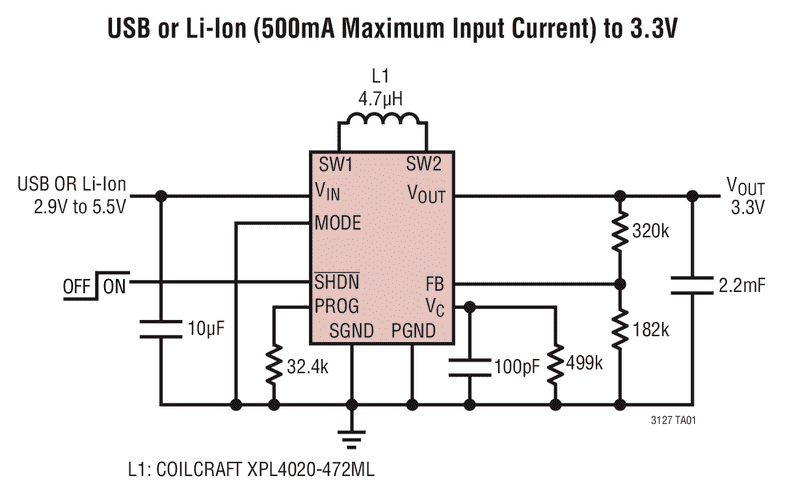
The given diagram shows as follows. I checked the wiring and found that it is correct. But I really don’t know which procedure goes wrong.

Can anyone help me ? I am very puzzled about this question. Any of your ideas would be highly appreciated.
 
Engineering news on Phys.org
You cannot use a linear regulator like the LM317 for this. You need to use a SEPIC DC-DC converter or similar topology converter. As you show in the figure above, these are available as ICs with some external components. What is the part number of the circuit you show above? They probably make small Evaluation Boards with that IC and those components already assembled. Is it from Linear Technology or Maxim?
 
  • Like
Likes   Reactions: donpacino
Another option, which is simple but may not fit your power and battery life requirements is a shunt regulator:

https://www.onsemi.com/pub/Collateral/TLV431A-D.PDF

http://www.mouser.com/ProductDetail...iMZZMuBck1X%2b7j9fKwCDSFP%2b2%2baod8awmT/hqE=

A shunt regulator 'shunts' the excess current to ground to reduce the voltage to the output. So when your battery is down to 3.2V, it draws no current and the entire battery voltage goes to the device.

The downside is that it wastes power when the battery is > 3.2V, shortening the time you can run it on battery. And high current supplies will need high power devices to support this. If that is a problem for you (and it likely is), then the switching regulator that berkeman described is a slightly more complex, but better choice.
 
zxcvb said:
But I really don’t know which procedure goes wrong.

Please photograph the device you built and post it here. Also the part number of the IC.

BoB
 
NTL2009 said:
The downside is that it wastes power when the battery is > 3.2V
The downside is that it wastes power always. What is the difference in efficiency between your proposal and a SEPIC DC-DC?
 
berkeman said:
The downside is that it wastes power always. What is the difference in efficiency between your proposal and a SEPIC DC-DC?
My proposal is almost certainly less efficient. But it can be simpler. Since the OP did not provide any info on battery size and load, I just thought I'd throw it out there, if simplicity was more important than efficiency. And sometimes people forget about shunt regulators as an option. They have their (limited) place.

OP also did not state how far below 3.2 V his device would operate (other than 2.5 V seems too low). A shunt regulator may not waste much power at all in that range (series I*R drop, plus bias currents). It depends.
 
3.2 is effectively 3.3V - 3.3 is a very common uC/ CPU voltage and - the LiPo Voltage rage is pretty common. Point being - I am sure there is an existing and effective SMPS type 3.3 regulator specifically built for LiPo.

Hobby level example.

I am always trying to define specs in the most generic terms possible and then look for the most common and mass produced solutions
 
  • Like
Likes   Reactions: NTL2009 and berkeman
Windadct said:
3.2 is effectively 3.3V - 3.3 is a very common uC/ CPU voltage and - the LiPo Voltage rage is pretty common. Point being - I am sure there is an existing and effective SMPS type 3.3 regulator specifically built for LiPo.

Hobby level example.

I am always trying to define specs in the most generic terms possible and then look for the most common and mass produced solutions

That's a great approach. I'm stunned at the selection of advanced electronics at rock-bottom prices, especially if you don't mind waiting for them on the slow boat to China (to the USA). As you say, the key is to find something other people need, so the market has addressed it. If you can match your design to something commonly available, you can get by super-cheap and easy sometimes.

Though I wish the OP would give us more specs/requirements. All we know is 3.2 V MAX (is that really a max?), and that it doesn't work at 2.5 V. Will it work at 2.60? 2.55? 2.51?

And how much current do we need? For how long? What size battery? I kind of hate to make specific suggestions w/o knowing the envelope.
 
  • Like
Likes   Reactions: Merlin3189
Automotive is also a great "market" to look into for parts. A 12V windshield washer pump is pretty hard to beat for a low voltage / hobby project - as example.
 

Similar threads

  • · Replies 3 ·
Replies
3
Views
3K
  • · Replies 8 ·
Replies
8
Views
3K
  • · Replies 2 ·
Replies
2
Views
2K
  • · Replies 6 ·
Replies
6
Views
3K
Replies
8
Views
2K
  • · Replies 1 ·
Replies
1
Views
1K
  • · Replies 19 ·
Replies
19
Views
2K
  • · Replies 9 ·
Replies
9
Views
3K
  • · Replies 5 ·
Replies
5
Views
2K
Replies
5
Views
2K