Graduate Semicolon notation in component of covariant derivative

Click For Summary
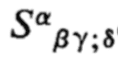
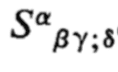
The discussion centers on the use of semicolon notation in the context of covariant derivatives, specifically in the expression S^\alpha{}_{\beta\gamma;\delta} = \nabla_\delta \, S^{\alpha}{}_{\beta\gamma}. Participants clarify that the semicolon indicates a covariant derivative and can be seen as a compact notation for the components of a tensor. The conversation also touches on how any tensor can be expressed as a sum of its components multiplied by basis vectors and co-vectors. Additionally, a user inquires about the method for typing equations, leading to a recommendation to use the site's LaTeX feature. Understanding the semicolon notation is essential for grasping covariant derivatives in tensor calculus.
berlinspeed
Messages
26
Reaction score
4
TL;DR
The use of semicolon notation as covariant derivative
Can someone clarify the use of semicolon in

245677

I know that semicolon can mean covariant derivative, here is it being used in the same way (is
245678
expandable?) Or is
245679
a compact notation solely for the components of
245680
?
 
Physics news on Phys.org
If you're familiar with index or abstract index notation

$$S^\alpha{}_{\beta\gamma;\delta} = \nabla_\delta \, S^{\alpha}{}_{\beta\gamma}$$
 
berlinspeed said:
Can someone clarify the use of semicolon in
View attachment 245677
I know that semicolon can mean covariant derivative, here is it being used in the same way (is View attachment 245678 expandable?) Or isView attachment 245679 a compact notation solely for the components ofView attachment 245680?
Not sure what your confusion is. Any tensor can be written as the sum of each of its components in some basis multiplied by the outer product of the respective basis vectors and co-vectors. Since the covariant derivative of a tensor is still a tensor (but one rank higher), it can also be written this way. Does that clear anything up for you?
 
pervect said:
If you're familiar with index or abstract index notation

$$S^\alpha{}_{\beta\gamma;\delta} = \nabla_\delta \, S^{\alpha}{}_{\beta\gamma}$$
Hello thank you, can you tell me what did you use to type your equations? I'm new to this site and trying to find a good way to generate equations. Much appreciated.
 
  • Like
Likes vanhees71, JD_PM and berkeman
In this video I can see a person walking around lines of curvature on a sphere with an arrow strapped to his waist. His task is to keep the arrow pointed in the same direction How does he do this ? Does he use a reference point like the stars? (that only move very slowly) If that is how he keeps the arrow pointing in the same direction, is that equivalent to saying that he orients the arrow wrt the 3d space that the sphere is embedded in? So ,although one refers to intrinsic curvature...

Similar threads

  • · Replies 2 ·
Replies
2
Views
1K
  • · Replies 4 ·
Replies
4
Views
1K
  • · Replies 124 ·
5
Replies
124
Views
9K
  • · Replies 11 ·
Replies
11
Views
1K
  • · Replies 2 ·
Replies
2
Views
1K
  • · Replies 7 ·
Replies
7
Views
1K
  • · Replies 16 ·
Replies
16
Views
4K
  • · Replies 6 ·
Replies
6
Views
1K
  • · Replies 3 ·
Replies
3
Views
811
  • · Replies 10 ·
Replies
10
Views
3K