Separable Polynomials - Dummit and Foote - Proposition 37

  • Context: Undergrad 
  • Thread starter Thread starter Math Amateur
  • Start date Start date
  • Tags Tags
    Polynomials Separable
Click For Summary
SUMMARY

The discussion centers on Proposition 37 from Dummit and Foote's "Abstract Algebra," specifically regarding the relationship between inseparable polynomials and their representation as polynomials in terms of powers of other polynomials. The assertion that an inseparable polynomial \( p(x) \) can be expressed as \( p(x) = q(x^p) \) for some polynomial \( q(x) \in \mathbb{F}[x] \) is established through the examination of irreducible polynomials and their derivatives. Key insights include the conclusion that only infinite fields with non-zero characteristic can contain irreducible, non-separable polynomials, supported by the criterion that a field of characteristic \( p \) is perfect if every irreducible polynomial is separable.

PREREQUISITES
  • Understanding of polynomial algebra, particularly irreducible polynomials.
  • Familiarity with field theory concepts, including field characteristics.
  • Knowledge of derivatives in the context of polynomials, specifically \( D_xP \).
  • Basic comprehension of separable and inseparable extensions in algebra.
NEXT STEPS
  • Study the proof of Corollary 34 in Dummit and Foote's "Abstract Algebra" for deeper insights into polynomial separability.
  • Explore the concept of perfect fields and their properties, particularly in relation to irreducible polynomials.
  • Investigate examples of inseparable fields, focusing on \( F = F_p(t) \) and its implications.
  • Learn about Galois fields and their relationship to separability in polynomial extensions.
USEFUL FOR

Mathematicians, algebra students, and researchers interested in field theory, polynomial algebra, and the properties of separable and inseparable extensions will benefit from this discussion.

Math Amateur
Gold Member
MHB
Messages
3,920
Reaction score
48
I am reading David S. Dummit and Richard M. Foote : Abstract Algebra ...

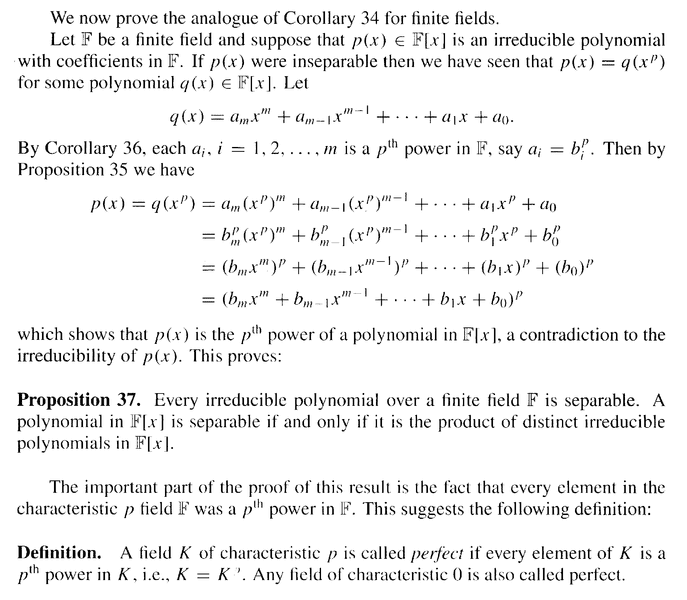
I am trying to understand the proof of Proposition 37 in Section 13.5 Separable and Inseparable Extensions ...The Proposition 37 and its proof (note that the proof comes before the statement of the Proposition) read as follows:
?temp_hash=6dbe83814424bd9e74d92b99c61cd074.png

In the above text by D&F we read the following:

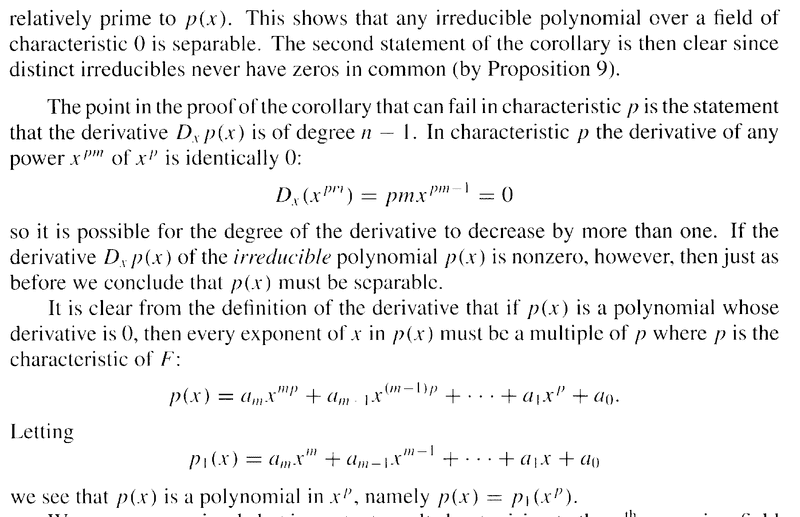
"If ##p(x)## were inseparable then we have seen that ##p(x) = q(x^p)## for some polynomial ##q(x) \in \mathbb{F} [x]##. ... ... "I cannot understand exactly why this is true ...Can someone please explain exactly why, as D&F assert, the following is true ... ...##p(x)## inseparable ## \ \ \Longrightarrow \ \ p(x) = q(x^p)## for some polynomial ##q(x) \in \mathbb{F} [x]##I cannot find where D&F establish exactly this implication ... but maybe there is some idea in the proof of Corollary 34 which reads as follows:
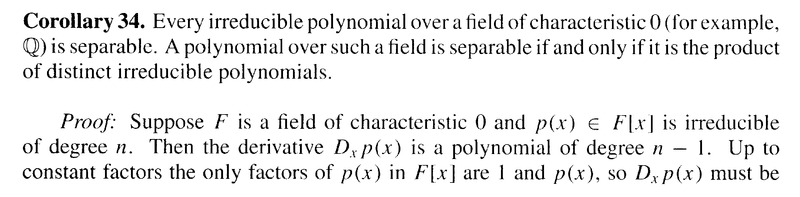
?temp_hash=6dbe83814424bd9e74d92b99c61cd074.png

?temp_hash=6dbe83814424bd9e74d92b99c61cd074.png


Corollary 36 may also be relevant ... so I am providing that as well ... as follows:

?temp_hash=6dbe83814424bd9e74d92b99c61cd074.png


Hope someone can help explain the assertion by D&F mentioned above ..

Peter
 

Attachments

  • D&F - Proposition 37 - Section 13.5 ... ... .png
    D&F - Proposition 37 - Section 13.5 ... ... .png
    42.6 KB · Views: 822
  • D&F - 1 - Corollary 34 - Section 13.5 - PART 1 ... ....png
    D&F - 1 - Corollary 34 - Section 13.5 - PART 1 ... ....png
    25.6 KB · Views: 618
  • D&F - 2 - Corollary 34 - Section 13.5 - PART 2 ... ....png
    D&F - 2 - Corollary 34 - Section 13.5 - PART 2 ... ....png
    42 KB · Views: 572
  • D&F - Corollary 36 - Section 13.5 ... ....png
    D&F - Corollary 36 - Section 13.5 ... ....png
    12.1 KB · Views: 641
Last edited:
Physics news on Phys.org
Call the irreducible polynomial ##P##, to distinguish it from ##p##, the characteristic of ##F##.

Since ##P## is irreducible, it must either be co-prime with ##D_xP##, or else ##D_xP\equiv 0##

If co-prime then by Proposition 9 (quoted in the proof of Corollary 34), ##P## has no roots in common with any of the irreducible factors of ##D_xP##. Hence ##P## has no roots in common with ##D_xP##. Hence ##P## is separable.

So if ##P## is not separable, we must have ##D_xP\equiv 0##, which means that for each natural number ##k##, the ##k##th order coefficient in ##D_xP## must be zero. That coefficient is ##a_{k+1}(k+1)## where ##a_{k+1}## is the ##k##th order coefficient in ##P##. Since ##F## is a field there are no zero divisors, so either ##a_{k+1}=0_F## or ##(k+1)_F=0_F##. I have put subscripts into make clear we are operating in ##F##.

So for every term ##a_rx^r## of ##P## we must either have ##a_r=0## or else ##r=0\mod p##, in other words ##r=ps_r## for some natural number ##s_r##.

But then each nonzero term of ##P## will be of the form ##a_{ps_r}x^{ps_r}## which can be written ##a_{ps_r}(x^p)^s_r##. So ##P## is a finite linear combination of powers of ##x^p##, ie a polynomial in ##x^p##. That new polynomial is the author's ##q##.
 
  • Like
Likes   Reactions: Math Amateur
Thanks Andrew ...

Just reflecting on what you have said ...

Peter
 
An interesting consequence of the above is that the counter-example I gave you a while back, of an irreducible, non-separable polynomial, was wrong!

##x^2+1## is indeed non-separable in ##\mathbb Z_2[x]##, but it is not irreducible, because it can be factorised as ##(x+1)^2##.

Putting together Corollary 34 and Proposition 37, we conclude that the only fields containing irreducible, non-separable polynomials are infinite fields with non-zero characteristic.

I think ##\mathbb Z_p(r)## for ##r## transcendental and ##p## prime, will be such fields, as they will have characteristic ##p>0## but will be infinite-dimensional vector spaces over ##\mathbb Z_p##, with basis ##\{r^k\ :\ r\in\mathbb Z,\ r\geq 0\}##.
 
  • Like
Likes   Reactions: Math Amateur
Oh God ... and I thought I understood that example!

Thanks for pointing this out ...

Must go through the example again tomorrow...

Thanks again for correcting the record ...

Peter
 
andrewkirk said:
Putting together Corollary 34 and Proposition 37, we conclude that the only fields containing irreducible, non-separable polynomials are infinite fields with non-zero characteristic.
I've found the following criterion (van der Waerden):

A field of characteristic ##p## is perfect, i.e. every irreducible polynomial is separable, if and only if for each element there is a the ##p-##th root; or short ##F=F^p##.

This also excludes finite fields (by consideration of ##a \mapsto a^p##). So the easiest example of an inseparable field is ##F=F_p(t)## the field of rational functions (polynomials) in ##t## and ##x^p-t \in F[x]##. Characteristic zero fields, algebraic extensions (esp. the algebraic closure) of separable fields and Galois fields are all separable, so many "interesting" fields are separable.
 

Similar threads

  • · Replies 1 ·
Replies
1
Views
2K
  • · Replies 6 ·
Replies
6
Views
5K
  • · Replies 6 ·
Replies
6
Views
1K
Replies
2
Views
2K
Replies
48
Views
5K
  • · Replies 3 ·
Replies
3
Views
2K
  • · Replies 1 ·
Replies
1
Views
2K
  • · Replies 21 ·
Replies
21
Views
1K
  • · Replies 2 ·
Replies
2
Views
2K
  • · Replies 0 ·
Replies
0
Views
2K