Setting Free variables when finding eigenvectors

Click For Summary
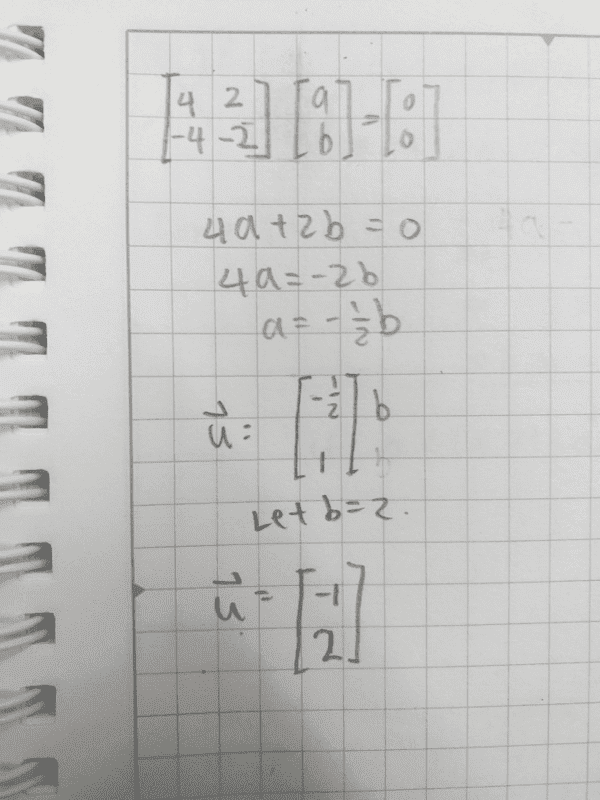
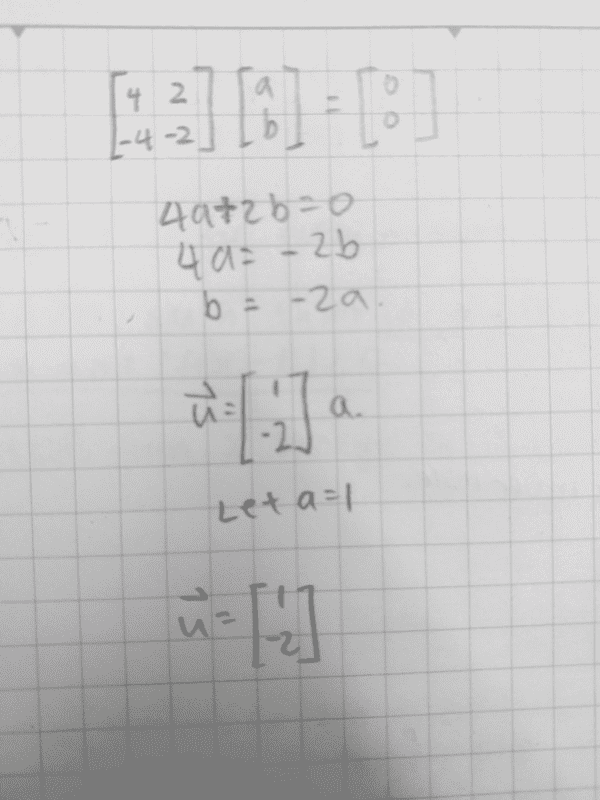
When finding eigenvectors after determining eigenvalues, the choice of free variable can lead to different representations of the same eigenvector. Setting either 'a' or 'b' as a free variable is valid, resulting in eigenvectors that differ only by a scalar multiple, such as sign. It's important to note that if one vector is an eigenvector, any non-zero scalar multiple of it is also an eigenvector for the same eigenvalue. Normalization is often applied to ensure the eigenvector has a length of one. Ultimately, both approaches yield correct eigenvectors, highlighting the flexibility in their representation.
Sunwoo Bae
Messages
60
Reaction score
4
Homework Statement
Confusion in finding eigenvector? (example shown below)
Relevant Equations
matrix multiplication
upon finding the eigenvalues and setting up the equations for eigenvectors, I set up the following equations.

So I took b as a free variable to solve the equation int he following way.
1597304906485.png


But I also realized that it would be possible to take a as a free variable, so I tried taking a as a free variable too.
1597305037416.png


But now I am confused because this results in vectors that is different in sign. Can anyone explain whether I should use a or b as a free variable?
 
Physics news on Phys.org
If ##\vec u## is an eigenvector (corresponding to a certain eigenvalue), then ##-\vec u## is also an eigenvector (corresponding to the same eigenvalue). Both your answers are correct.

In general, ##c \vec u## is also an eigenvector for any number ##c \ne 0##. Often you choose ##c## such that the eigenvector is normalised - i.e. has length ##1##,
 
  • Like
Likes etotheipi and DrClaude
Question: A clock's minute hand has length 4 and its hour hand has length 3. What is the distance between the tips at the moment when it is increasing most rapidly?(Putnam Exam Question) Answer: Making assumption that both the hands moves at constant angular velocities, the answer is ## \sqrt{7} .## But don't you think this assumption is somewhat doubtful and wrong?

Similar threads

Replies
5
Views
2K
  • · Replies 7 ·
Replies
7
Views
2K
Replies
8
Views
2K
  • · Replies 3 ·
Replies
3
Views
2K
  • · Replies 6 ·
Replies
6
Views
2K
  • · Replies 19 ·
Replies
19
Views
4K
  • · Replies 2 ·
Replies
2
Views
2K
Replies
4
Views
2K
  • · Replies 5 ·
Replies
5
Views
14K
  • · Replies 5 ·
Replies
5
Views
2K