Taryn1
- 25
- 0
I feel like this should be a super easy problem, but I'm not understanding something about it.
The graph of y = f(x) passes through the points (0, 1), (1, 2), and (2, 3). Find the corresponding points on he graph y = f(x + 2) - 1. I graphed the (x + 2) - 1, but what does it mean by 'corresponding points'? The three points I named earlier lie on the line, but that's not the right answer (I have the answers in the back of the book). I just don't know how to get there correctly...
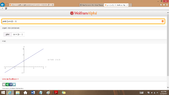
Here's the graph I got:
View attachment 4694
The graph of y = f(x) passes through the points (0, 1), (1, 2), and (2, 3). Find the corresponding points on he graph y = f(x + 2) - 1. I graphed the (x + 2) - 1, but what does it mean by 'corresponding points'? The three points I named earlier lie on the line, but that's not the right answer (I have the answers in the back of the book). I just don't know how to get there correctly...
Here's the graph I got:
View attachment 4694
Attachments