Should the # of atoms in a unit cell be considered to find the % volume change?

Click For Summary
SUMMARY

The discussion centers on the calculation of volume change in unit cells, specifically between body-centered cubic (BCC) and face-centered cubic (FCC) structures. The volume of a unit cell is defined as V=a³, with side lengths aBCC=2R√2 for BCC and aFCC=4√3/3R for FCC. The percentage change in volume is calculated using the formula %change=(VFCC-VBCC)/VBCC. It is concluded that the number of atoms per unit cell (4 for FCC and 2 for BCC) is crucial for determining density changes, which increases by approximately 1.18% rather than just volume change.

PREREQUISITES
  • Understanding of unit cell geometry in crystallography
  • Familiarity with BCC and FCC crystal structures
  • Knowledge of density and its relationship to volume
  • Basic mathematical skills for volume calculations
NEXT STEPS
  • Study the mathematical derivation of unit cell volumes for different crystal structures
  • Learn about the implications of atomic packing in BCC and FCC structures
  • Research the relationship between density and volume in materials science
  • Explore advanced crystallography concepts, such as Bravais lattices
USEFUL FOR

Materials scientists, crystallographers, and students studying solid-state physics who are interested in the relationship between atomic structure and material properties.

catlip
Messages
1
Reaction score
0
Homework Statement
Iron (Fe) undergoes an allotropic transformation at 912°C: upon heating from a BCC (α phase) to an FCC (γ phase). Accompanying this transformation is a change in the atomic radius of Fe—from RBCC = 0.12584 nm to RFCC = 0.12894 nm—and, in addition, a change in density (and volume). Compute the percentage volume change associated with this reaction. Indicate a decreasing volume by a negative number.
Relevant Equations
V=a^3
First of all, I don't think the question was clear enough. Therefore, I had to assume they are referring to the volume of the unit cell.
V=a^3, side length a
aBCC=2R√2, aFCC=4√3/3R
%change=(VFCC-VBCC)/VBCC
I thought this was right until I checked with others who did this:
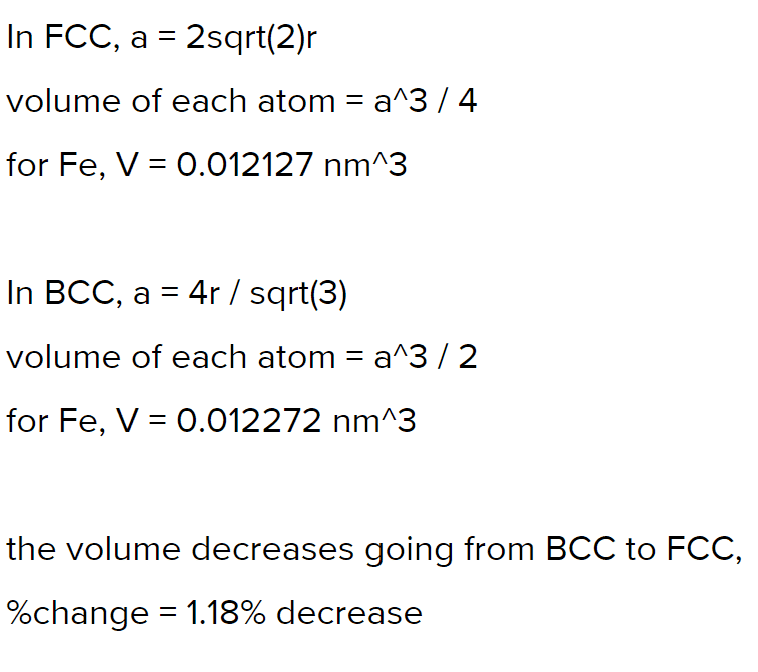
Screenshot 2021-01-30 144735.png

so the only difference is including the number of atoms per unit cell (4 and 2). But wouldn't this actually be the %change in density?
 
Physics news on Phys.org
The question is written a little loosely, but it clearly means the change in volume for the same amount of iron (whether expressed as moles or mass or, as above, volume per atom). This is not the same as the difference in the volume of the unit cell, because the unit cell contains a different number of atoms for the two structures. Density is inversely proportional to volume, so the density increases by (approximately) 1.18%.
 

Similar threads

  • · Replies 4 ·
Replies
4
Views
4K
  • · Replies 1 ·
Replies
1
Views
3K
Replies
2
Views
2K
  • · Replies 2 ·
Replies
2
Views
2K
  • · Replies 2 ·
Replies
2
Views
7K
  • · Replies 3 ·
Replies
3
Views
2K
  • · Replies 56 ·
2
Replies
56
Views
6K
Replies
6
Views
2K
  • · Replies 7 ·
Replies
7
Views
7K
  • · Replies 2 ·
Replies
2
Views
3K