Shouldn't the water have evaporated by now?

  • Thread starter Thread starter JT Smith
  • Start date Start date
  • Tags Tags
    Water
Click For Summary

Discussion Overview

The discussion revolves around the phenomenon of condensation remaining in a decanter after rinsing and drying, despite exposure to sunlight and warm temperatures. Participants explore the reasons for the persistent moisture, including environmental factors, physical properties of air and water vapor, and methods for accelerating evaporation.

Discussion Character

  • Exploratory
  • Technical explanation
  • Debate/contested

Main Points Raised

  • One participant notes that the decanter has been drying for a week in sunlight, questioning why condensation persists.
  • Another participant suggests that local weather conditions, including temperature and dew point, may influence evaporation rates.
  • A participant shares a method involving a microwave and cardboard to create convection currents, proposing that this could help remove moisture.
  • Concerns are raised about the density of water vapor compared to air and the role of temperature distribution within the decanter in causing condensation.
  • Suggestions include laying the decanter on its side or using a fan heater to promote evaporation.
  • One participant describes their experience using a hairdryer and microwave, noting that moisture continued to condense despite heating efforts.
  • Another participant discusses the mechanics of air displacement and the difference between diffusion and physical movement in removing moisture.
  • There is speculation about the cooling of rising moist air and its potential to cause condensation before reaching the top of the decanter.
  • Participants express confusion about the effectiveness of heat in evaporating the remaining moisture, questioning if higher temperatures are necessary.

Areas of Agreement / Disagreement

Participants express a range of views on the mechanisms behind the condensation and evaporation process, with no consensus reached on the primary cause or the most effective solution. The discussion remains unresolved regarding the specific factors contributing to the persistent moisture.

Contextual Notes

Participants acknowledge various assumptions about temperature, humidity, and physical properties of air and water vapor, but these factors remain complex and not fully resolved in the discussion.
JT Smith
Messages
499
Reaction score
670
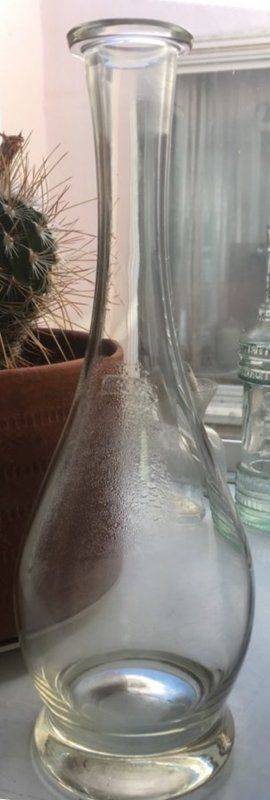
It's a decanter that we used for some wine a week ago. After rinsing it out and letting it drain I set it upright in the window box so that it could dry. The sun hits it every day. It's been a week and still the condensation is there. It's got a narrow opening, sure, but still... shouldn't it have evaporated by now??

decanter.jpg
 
Physics news on Phys.org
You'd think, but what's your weather like? Temperature and dewpoint?
 
I have solved this problem by sticking the bottle in the microwave in "High" for 2 min. Yours may not fit so you may want to use a hair dryer or stick it in a not-too-hot oven to heat it up . Then you set the bottle upright; you might think that the hot air will rise, but that's not quite there yet. You need to establish a convection current and avoid turbulence. You do this by inserting a strip of thin but stiff cardboard snugly across the neck diameter to about 1 inch above the bottom. Air at room temperature will come in one side and moist hot air will exit the other. If you try it, I will be curious to hear how it has worked for you.
 
  • Like
Likes   Reactions: vanhees71 and russ_watters
JT Smith said:
I set it upright in the window box so that it could dry.

This phenomenon is not unusual and it is a nuisance. I've had the same thing trying to dry out a washed olive oil bottle. As @russ_watters suggests, you seem to have a 'microclimate situation' here.
A confusing issue is that water vapour is lower in density than Air (H2O vs O2 and N2) so why doesn't the vapour find its way to the very top by displacement? I think it must be to do with minute droplets of condensing water vapour.- which are more dense.
The temperature distribution within the bottle is probably important. If the neck is only fractionally cooler than the bottom then there will be condensation there and the water will 'rain' down in the form of those tiny droplets. The only mechanism to shift the water out must be actual reciprocating air flow and this may be minimal and slow.

On the basis that trying something different often helps, you could lay it on its side or put it upside down on a pole (like a welly boot store). Laying on its side could promote convection and upside down could allow small particles of condensed water to fall out of the bottom. A fan heater could also solve the problem.
 
The local weather station reported low 70s yesterday afternoon. Sunny. Dew point high 40s. It was warm enough indoors that we ran a fan in a window in the late afternoon.

No visible evidence of condensation/raining in the neck. Perhaps these hypothesized droplets are too small to see. All I see is the water on the side that seems stuck there, like sticky sap. I would have thought it was something else if I hadn't rinsed the thing out myself.

Thanks for the suggestions but I know how to dry it. The microwave or oven or hairdryer. We'll probably pour some more wine into it tonight.

I just think it's weird.
 
  • Like
Likes   Reactions: russ_watters
JT Smith said:
No visible evidence of condensation/raining in the neck.
I'm not sure you would expect to see it. The first droplets would be tiny and you might need a black background / oblique light to see any scattering and even then the glass itself would probably cause as much scatter. They would go back into vapour once they fall lower.
JT Smith said:
I know how to dry it
Of course - sorry; just filling in the story for posterity. :smile:

But it's a common enough effect and there isn't an obvious explanation so it's bread and butter stuff for PF whimsy.
 
So I took a hairdryer to it. After about five minutes I gave up. The moisture would evaporate where the hot air was directed only to condense in a different place. It was like whack-a-mole.

Then I put it in the microwave. After two minutes the glass was so hot that the oven hot pad I set it on was burnt black where it contacted the glass. But there was still condensed moisture inside. It wasn't until I carefully took it out of the microwave and set it upright for a couple of more minutes that the last bit finally escaped.

Maybe we'll just pour the wine into our glasses from the bottle tonight.
 
JT Smith said:
But there was still condensed moisture inside.
The water can only leave when it is displaced by an equivalent volume of air entering. This can easily be achieved by physical movement / pumping. Diffusion involves a timescale very different.
 
sophiecentaur said:
The water can only leave when it is displaced by an equivalent volume of air entering. This can easily be achieved by physical movement / pumping. Diffusion involves a timescale very different.
Weird, because I thought that timescale is of the order of minutes or less, for typical vapors at room temperature -- and he gave it a week. But yeah, obviously the water is not getting out.

The distance scale seems way off for the following, but rising moist air tends to expand and cool. When it cools below the dewpoint, you can get condensation. If that happens before the moist air reaches the top opening, that might explain the visible condensation and lack of evaporation.
 
  • #10
Redbelly98 said:
but rising moist air tends to expand and cool
in the case of air, rising by hundreds of metres of altitude. This is not on a 'weather' scale, I think.
 
  • #11
sophiecentaur said:
in the case of air, rising by hundreds of metres of altitude. This is not on a 'weather' scale, I think.
Yeah. Agreed.
 
  • #12
sophiecentaur said:
The water can only leave when it is displaced by an equivalent volume of air entering. This can easily be achieved by physical movement / pumping. Diffusion involves a timescale very different.

That makes sense but it's still weird to me that the glass (and presumably the water in contact with it) was so hot that it burned an oven mitt but still wasn't hot enough to force all the liquid into the vapor state. Obviously it needed to be hotter! Would the glass melt first? :-)
 

Similar threads

  • · Replies 23 ·
Replies
23
Views
3K
  • · Replies 11 ·
Replies
11
Views
3K
  • · Replies 3 ·
Replies
3
Views
4K
Replies
3
Views
2K
  • · Replies 3 ·
Replies
3
Views
3K
  • · Replies 21 ·
Replies
21
Views
6K
  • · Replies 19 ·
Replies
19
Views
4K
Replies
5
Views
896
Replies
11
Views
5K
  • · Replies 1 ·
Replies
1
Views
1K