Showing that a multivariable limit does not exist

Click For Summary
SUMMARY

The discussion centers on determining the existence of a multivariable limit for the function involving paths x=0, y=0, and y=x^2. The limit approaches 0 along the path x=0, while it is undefined along y=0 due to divisibility by zero, indicating that the limit does not exist (DNE). Additionally, the limit approaches 1 along the path y=x^2, confirming the inconsistency of the limit across different paths. The suggestion to convert the function into polar coordinates highlights the undefined nature of the limit along y=0.

PREREQUISITES
  • Understanding of multivariable calculus concepts, particularly limits.
  • Familiarity with polar coordinates and their application in limits.
  • Knowledge of path-dependent limits and their implications.
  • Basic algebraic manipulation of functions involving limits.
NEXT STEPS
  • Study the concept of path-dependent limits in multivariable calculus.
  • Learn how to convert Cartesian coordinates to polar coordinates for limit evaluation.
  • Research examples of functions with undefined limits along specific paths.
  • Explore the implications of limits that do not exist in multivariable functions.
USEFUL FOR

Students and educators in multivariable calculus, mathematicians analyzing limit behaviors, and anyone interested in understanding the nuances of limit existence in functions of multiple variables.

ek124
Messages
2
Reaction score
0
TL;DR
how to show a multivariable limit does not exist/exist
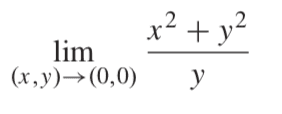
I want to show that the limit of the following exists or does not exist:
245722

When going along the path x=0 the limit will tend to 0 thus if the limit exists it will be approaching the value 0
when going along the path y=0, we get an equation with divisibility by zero. Since this is not possible does this already show that the limit does not exist? Or does it simply mean that there is an asymptote... I would like to know what this means.
Finally when going along the path y=x^2, the limit tends to 1. Since the first and last path give a different outcome the limit DNE however I want to know what the path along y=0 tells us anyway.
 
Physics news on Phys.org
nvm it's solved
 
i.e. does not exist ?
 
  • Like
Likes   Reactions: ek124
ek124 said:
I want to know what the path along y=0 tells us anyway.

I was going to say if you rewrite the function inside the limit as ## \frac {x^2} {y} + y ##, then perhaps that offers a better perspective but I'm not sure.

I think actually seeing that the top has ##x^2 + y^2##, that should immediately strike you as saying that changing the function into its polar equivalent might be helpful for the limit. We know that ##x^2 + y^2 = r^2## and ##y = r * \sin\theta##, and the limit along the line ##y = 0## corresponds to ## \theta = 0## from the right side and ##\theta = \pi ## from the left, hence we have:

##\lim_{(r, \theta) \rightarrow (0,0)} {\frac {r^2} {r*\sin\theta}} = \lim_{(r, \theta) \rightarrow (0,0)} {\frac {r} {\sin\theta}}##

Yeah this seems to lead to the same undefined issue as well.

Even thinking about this numerically leads to the same issues.

So I think if a function is undefined for that entire line of ##y=0##, then we cannot really use the idea of a limit here. I could be wrong, but that's what I got for now.
 

Similar threads

  • · Replies 3 ·
Replies
3
Views
3K
  • · Replies 1 ·
Replies
1
Views
3K
  • · Replies 2 ·
Replies
2
Views
2K
Replies
11
Views
2K
  • · Replies 15 ·
Replies
15
Views
2K
  • · Replies 9 ·
Replies
9
Views
2K
  • · Replies 3 ·
Replies
3
Views
1K
  • · Replies 1 ·
Replies
1
Views
1K
  • · Replies 4 ·
Replies
4
Views
3K
  • · Replies 26 ·
Replies
26
Views
2K