MHB Showing the bessel function is entire

Click For Summary
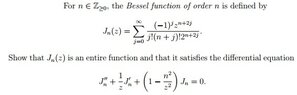
The discussion focuses on demonstrating that the Bessel function \( J_n(z) \) is an entire function by showing its Taylor series converges for all values of \( z \). A key point is that the series can be compared to the known convergent series for \( e^{-(\frac{z}{2})^2} \), confirming that \( J_n(z) \) also converges for any \( z \). The initial poster expresses confusion about using the ratio test due to the absence of a complex variable in the denominator. A comparison of methods suggests that breaking down the Bessel function into a known series may be a more straightforward approach than applying the ratio test. This highlights the importance of understanding series convergence in complex analysis.
nacho-man
Messages
166
Reaction score
0
Hi,
I actually posted this problem a while back on a separate forums:
Showing the bessel function is entire

And got a response, but still cannot seem to figure out how to do this question

Given a ratio test can be used, we must first define a p(z) and q(z)

so we can see if the sum for $$ \frac{p(z)}{q(z)} $$ converges,
but the denominator doesn't even have a complex variable in terms of $z$, so how is this possible?

Any help is much appreciated, this one is wrinkling my brain!

for z = 0 it converges.

for z =/ 0, we convert it to the form

$\frac{a_n+1}{a_n}$ , or do we use j?
thanks!
 

Attachments
  • exercise q.jpg
    exercise q.jpg
    10.6 KB · Views: 112
Last edited:
Physics news on Phys.org
nacho said:
Hi,
I actually posted this problem a while back on a separate forums:
Showing the bessel function is entire

And got a response, but still cannot seem to figure out how to do this question

Given a ratio test can be used, we must first define a p(z) and q(z)

so we can see if the sum for $$ \frac{p(z)}{q(z)} $$ converges,
but the denominator doesn't even have a complex variable in terms of $z$, so how is this possible?

Any help is much appreciated, this one is wrinkling my brain!

for z = 0 it converges.

for z =/ 0, we convert it to the form

$\frac{a_n+1}{a_n}$ , or do we use j?
thanks!

Let's start with the demonstration that $J_{n} (z)$ is an entire function, i.e. its Taylor series converges for any value of z. We have...

$\displaystyle J_{n} (z) = (\frac{z}{2})^{n}\ \sum_{j=0}^{\infty} \frac{(-1)^{j}}{j!\ (n+j)!}\ (\frac{z}{2})^{2 j}\ (1)$

... and if we compare the series in (1) with the series...

$\displaystyle e^{- (\frac{z}{2})^{2}} = \sum_{j=0}^{\infty} \frac{(-1)^{j}}{j!}\ (\frac{z}{2})^{2 j}\ (2)$

... that converges for any z we discover that also the series in (1) converges for any z, i.e. $J_{n} (z)$ is an entire function...

Kind regards

$\chi$ $\sigma$
 
chisigma said:
Let's start with the demonstration that $J_{n} (z)$ is an entire function, i.e. its Taylor series converges for any value of z. We have...

$\displaystyle J_{n} (z) = (\frac{z}{2})^{n}\ \sum_{j=0}^{\infty} \frac{(-1)^{j}}{j!\ (n+j)!}\ (\frac{z}{2})^{2 j}\ (1)$

... and if we compare the series in (1) with the series...

$\displaystyle e^{- (\frac{z}{2})^{2}} = \sum_{j=0}^{\infty} \frac{(-1)^{j}}{j!}\ (\frac{z}{2})^{2 j}\ (2)$

... that converges for any z we discover that also the series in (1) converges for any z, i.e. $J_{n} (z)$ is an entire function...

Kind regards

$\chi$ $\sigma$

What is the name of the second series you are comparing it to? (if it has one)
I see the main method you used here was to break a part the bessel function, so it came in the form of a known convergent series which you previously knew about.

is this a more viable approach/quicker/simpler than what the user in the previous thread opted for? which was to use a ratio test to show its convergence?
 
We all know the definition of n-dimensional topological manifold uses open sets and homeomorphisms onto the image as open set in ##\mathbb R^n##. It should be possible to reformulate the definition of n-dimensional topological manifold using closed sets on the manifold's topology and on ##\mathbb R^n## ? I'm positive for this. Perhaps the definition of smooth manifold would be problematic, though.

Similar threads

  • · Replies 7 ·
Replies
7
Views
2K
  • · Replies 11 ·
Replies
11
Views
2K
  • · Replies 4 ·
Replies
4
Views
3K
  • · Replies 2 ·
Replies
2
Views
2K
  • · Replies 2 ·
Replies
2
Views
3K
  • · Replies 9 ·
Replies
9
Views
3K
  • · Replies 2 ·
Replies
2
Views
2K
  • · Replies 3 ·
Replies
3
Views
2K
Replies
8
Views
2K
  • · Replies 2 ·
Replies
2
Views
2K