Signal to Noise Ratio Calculation in Decibels: How to Simplify with Decibels

Click For Summary

Discussion Overview

The discussion revolves around the calculation of signal-to-noise ratio (SNR) in decibels, specifically addressing a homework problem involving input and output signal levels, noise figures, and the application of decibel mathematics. Participants explore the conversion between voltage and decibel values, as well as the implications of noise figures on SNR calculations.

Discussion Character

  • Homework-related
  • Mathematical reasoning
  • Debate/contested

Main Points Raised

  • One participant calculates the input voltage from a 5 dBmV signal and a noise level of 20 dBμV, arriving at an SNR of 45 dB for the input.
  • Another participant suggests that the output SNR should be 39 dB, indicating that it is 6 dB worse than the input SNR.
  • A participant questions the accuracy of the learning materials regarding the noise figure equation, suggesting a discrepancy in the formula used.
  • Another participant clarifies that the noise figure formula is not stated in decibels and emphasizes that decibel quantities should be treated through addition and subtraction rather than division.
  • Several participants discuss the approach to part (a) of the homework, debating whether to convert dB into voltage or to remain in decibels for calculations.
  • One participant proposes a method to find the input voltage by subtracting the gain from the output level in dB.
  • Another participant explains that the use of decibels simplifies calculations of gains and losses without needing to revert to linear values unless actual voltages or powers are added or subtracted.

Areas of Agreement / Disagreement

There is no consensus on the correct application of the noise figure equation, as participants express differing views on the appropriate method for calculating output SNR. Additionally, there is a mix of opinions on whether to convert to voltage or remain in decibels for the calculations in part (a).

Contextual Notes

Participants express uncertainty regarding the correct interpretation of the noise figure formula and its application in decibels. There are also unresolved discussions about the conversion between dB and voltage, particularly in the context of gain calculations.

Jason-Li
Messages
119
Reaction score
14
Homework Statement
(a) Determine the voltage required on the input of the amplifier to give
the maximum output of 85 dBμV.
(b) If the signal level from the aerial is 5 dBmV and the input noise level
is 20 dBμV, calculate the signal-to-noise ratio on the output of the
amplifier.

Values:
Bandwidth 40–862 MHz
Gain 20 dB
Noise Figure 6 dB
Max. Output 85 dBV
Input Impedance 75Ω
Output Impedance 75Ω
Relevant Equations
SNR=20Log(Vs/Vn)
SNR=10Log(Ps/Pn)
So pretty confident I understand part (a) however for part (b) I'm not sure if I have carried it out correctly if someone could give me a pointer?

(b)
5dBmV Input as a voltage:
5=20Log(V/1mV)
V=105/10
V=1.77827941mV

Then the noise level is 20dbμV so changing to a voltage:
20=20*Log(V/1μV)
V=1020/20
V=10μV

Then I can find the SNR of the input using:
SNRIn=20*Log(Vp/Vn)
SNRIn=20*Log((1.77827941*10-3)/(10*10-6))
SNRIn=45dB

Then as I have the Noise figure from the data as F=6dB I can do the following:
F=SNRIn/SNROut
SNROut=SNRIn/F
SNROut=45*6
SNROut=270dB

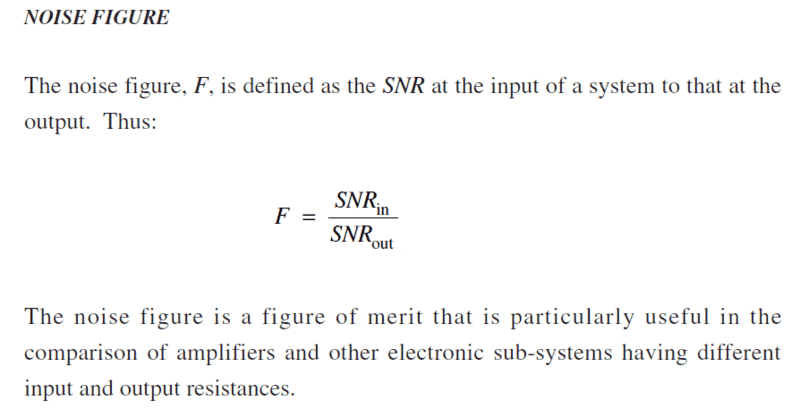
This seems far too high? I have found websites that say the formula is actually F = SNRIn-SNROut however the learning materials say:
1634052792135.png
 
Physics news on Phys.org
I think you are correct as far as part (b). Then you know the SNR at the input, and the SNR at the output will be 6dB worse. So SNRout = 45 - 6 = 39dB.
 
  • Like
Likes   Reactions: Jason-Li
tech99 said:
I think you are correct as far as part (b). Then you know the SNR at the input, and the SNR at the output will be 6dB worse. So SNRout = 45 - 6 = 39dB.
Hi thanks for the reply and assurance, do you have any idea why my learning materials is citing the noise figure equation incorrectly?
 
Yes, the formula for F is not stated in decibels. To divide decibel quantities we subtract, not divide.
 
  • Like
Likes   Reactions: Merlin3189 and Jason-Li
Jason-Li said:
Homework Statement:: (a) Determine the voltage required on the input of the amplifier to give
the maximum output of 85 dBμV.
(b) If the signal level from the aerial is 5 dBmV and the input noise level
is 20 dBμV, calculate the signal-to-noise ratio on the output of the
amplifier.

Values:
Bandwidth 40–862 MHz
Gain 20 dB
Noise Figure 6 dB
Max. Output 85 dBV
Input Impedance 75Ω
Output Impedance 75Ω
Relevant Equations:: SNR=20Log(Vs/Vn)
SNR=10Log(Ps/Pn)

So pretty confident I understand part (a) however for part (b) I'm not sure if I have carried it out correctly if someone could give me a pointer?

(b)
5dBmV Input as a voltage:
5=20Log(V/1mV)
V=105/10
V=1.77827941mV

Then the noise level is 20dbμV so changing to a voltage:
20=20*Log(V/1μV)
V=1020/20
V=10μV

Then I can find the SNR of the input using:
SNRIn=20*Log(Vp/Vn)
SNRIn=20*Log((1.77827941*10-3)/(10*10-6))
SNRIn=45dB

Then as I have the Noise figure from the data as F=6dB I can do the following:
F=SNRIn/SNROut
SNROut=SNRIn/F
SNROut=45*6
SNROut=270dB

This seems far too high? I have found websites that say the formula is actually F = SNRIn-SNROut however the learning materials say:

View attachment 290575

Hi, I am struggling with part A to this question, could you assist? I am not sure where to start.
 
In Part (a) the output of the amplifier is 85 dBuV and the gain of the amplifier is 20 dB. How many dBuV aat the input?
 
Do I need to convert dB into Voltage for both gain and Vo and then just use a transposed ratio for gain to calculate Vi?
 
No you can stay in dB entirely. Do not over think this one!
 
With gain just being a ratio, is it as simple as G = output / input... transformed giving 85 / 20 = Vi (however needing to subtract rather than divide) 85 - 20 = Vi?
 
Last edited:
  • #10
When we multiply or divide quantities using decibels we simply add or subtract. So for instance, if I have a signal of 10 dBV and I amplify it by 6 dB I end up with a signal of 10 + 6 = 16 dBV.
The whole point of decibels is to make gains and losses simple to work out without the need to carry out multiplication or division.
It is only if voltages or powers are actually added or subtracted that we have to come out of the decibel system.
 

Similar threads

  • · Replies 4 ·
Replies
4
Views
2K
  • · Replies 6 ·
Replies
6
Views
2K
  • · Replies 4 ·
Replies
4
Views
3K
Replies
5
Views
3K
  • · Replies 3 ·
Replies
3
Views
3K
  • · Replies 23 ·
Replies
23
Views
3K
Replies
9
Views
4K
  • · Replies 1 ·
Replies
1
Views
2K
Replies
17
Views
6K
  • · Replies 4 ·
Replies
4
Views
2K