Simple Equivalence Problem- help please (First Year Statics)

Click For Summary
The discussion revolves around solving a statics problem involving two forces, F1 and F2, and determining the line of action for the resultant force. The user initially miscalculated the intersection point, arriving at an incorrect value of x = 2.19 instead of the correct answer of x = 2.34. Key advice includes considering the moments about a chosen axis and ensuring all moments are accounted for in the calculations. The user ultimately realized the mistake was due to not summing all the moments correctly. This highlights the importance of thorough moment analysis in statics problems.
lc99
Messages
161
Reaction score
3
<< Mentor Note -- Thread moved from the technical forums, so no Homework Template is shown >>
upload_2018-2-16_22-1-36.png

upload_2018-2-16_22-1-59.png


Okay, so i am having severe problems with figuring out what i did wrong...
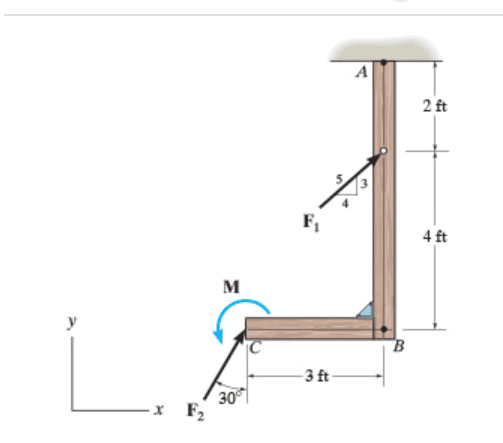
I am given : F1 = 250 and F2 = 90
The correct Force result is = 245 i +228 j with magnitude of 335 .
The moment given is 500 lb*ft.

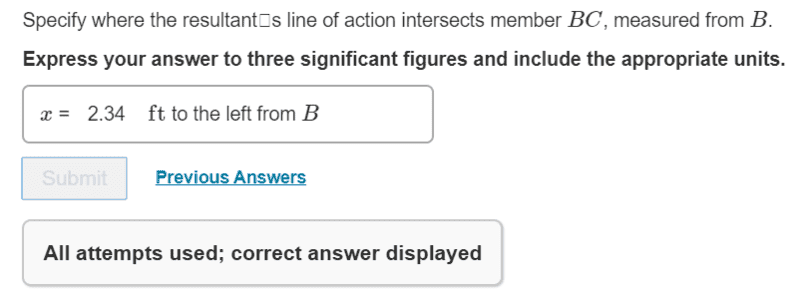
I am trying to find the result's line of action that would intersect member BC measured from B. The correct answer is x = 2.34.

But, i got some other answer. I found the location of intersection with M = Fy * x (Fy because Fx would be 0 along the x-axis).

so , 500 = 228*x --> x = 2.19?? Which is wrong :(
 

Attachments

  • upload_2018-2-16_22-0-10.png
    upload_2018-2-16_22-0-10.png
    23.1 KB · Views: 559
  • upload_2018-2-16_22-1-36.png
    upload_2018-2-16_22-1-36.png
    9.8 KB · Views: 874
  • upload_2018-2-16_22-1-59.png
    upload_2018-2-16_22-1-59.png
    13.7 KB · Views: 855
Last edited by a moderator:
Physics news on Phys.org
lc99 said:
The correct Force result is = 245 i +228 j with magnitude of 335 .
Ok, but that also has, of itself, a line of action. It would pass through the point of intersection of the lines of action of F1 and F2. You have not factored this in.
The safer approach is to pick an axis and find the sum of miments about it from the applied forces. Then find the line of action of the resuktant that yields the same moment.
 
  • Like
Likes lc99
haruspex said:
Ok, but that also has, of itself, a line of action. It would pass through the point of intersection of the lines of action of F1 and F2. You have not factored this in.
The safer approach is to pick an axis and find the sum of miments about it from the applied forces. Then find the line of action of the resuktant that yields the same moment.
Thanks! I figured out that i didn't add up all the moments
 

Similar threads

  • · Replies 1 ·
Replies
1
Views
4K
  • · Replies 10 ·
Replies
10
Views
2K
  • · Replies 11 ·
Replies
11
Views
4K
Replies
3
Views
3K
  • · Replies 1 ·
Replies
1
Views
2K
Replies
1
Views
8K
  • · Replies 2 ·
Replies
2
Views
2K
  • · Replies 5 ·
Replies
5
Views
7K
  • · Replies 6 ·
Replies
6
Views
7K
Replies
25
Views
6K