raniero
- 39
- 0
I am working out statics past papers to prepare myself for my exam which is in 3 days time, I encountered the following problem.
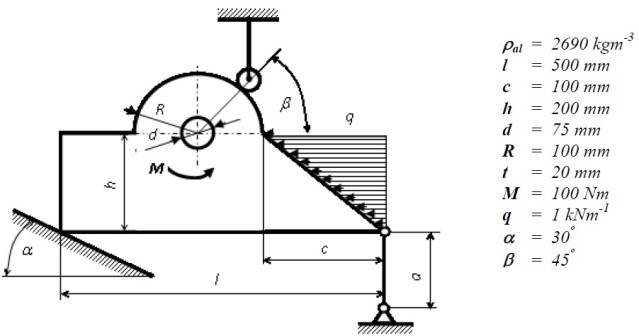
A compound body, supported as shown in Figure 2, consisting of a rectangle, semicircle, and the triangle is made of aluminium, and has a constant thickness t. A circular hole with diameter d = 75 mm is drilled through the body at the position of the semicircle’s centre.
(a) Find the magnitude, position, and orientation of a force that is statically equivalent to the load composed of the body weight, moment M = 100 Nm, and applied linearly distributed load q that acts on the inclined plane in horizontal direction as shown on diagram.
(b) Find the magnitude and direction of the force transmitted to the strut (strut is attached to the body by the pin on the right hand side of the body).
Figure 2:
Density Equation
Equation of the centroid where: [itex]\bar{x} = \frac{\int_A \tilde{x} dA}{\int_A dA}[/itex]
Distributed load equation where the area of the distribution curve is equal to the resultant force.
The centroid of the complex body was found by summing up the moments and then the areas. The total moment and area where divided to find the position at which the resultant weight acts.
The resultant force due to the distributed load was found, and its position is taken to be 1/3 the length of the respective side away from the right angle.
The problem arises now asI do not know how to 'sum up' these forces and find a single force at its position which includes both forces and the moment which was given in the problem.
Hope anybody could help as a question of this type is always asked in the exam, please confirm if up till now I have worked out the problem correctly.
Thanks
Homework Statement
A compound body, supported as shown in Figure 2, consisting of a rectangle, semicircle, and the triangle is made of aluminium, and has a constant thickness t. A circular hole with diameter d = 75 mm is drilled through the body at the position of the semicircle’s centre.
(a) Find the magnitude, position, and orientation of a force that is statically equivalent to the load composed of the body weight, moment M = 100 Nm, and applied linearly distributed load q that acts on the inclined plane in horizontal direction as shown on diagram.
(b) Find the magnitude and direction of the force transmitted to the strut (strut is attached to the body by the pin on the right hand side of the body).
Figure 2:
Homework Equations
Density Equation
Equation of the centroid where: [itex]\bar{x} = \frac{\int_A \tilde{x} dA}{\int_A dA}[/itex]
Distributed load equation where the area of the distribution curve is equal to the resultant force.
The Attempt at a Solution
The centroid of the complex body was found by summing up the moments and then the areas. The total moment and area where divided to find the position at which the resultant weight acts.
The resultant force due to the distributed load was found, and its position is taken to be 1/3 the length of the respective side away from the right angle.
The problem arises now asI do not know how to 'sum up' these forces and find a single force at its position which includes both forces and the moment which was given in the problem.
Hope anybody could help as a question of this type is always asked in the exam, please confirm if up till now I have worked out the problem correctly.
Thanks