Simple Harmonic Motion Question

  • Thread starter Thread starter Sangomans
  • Start date Start date
Join the discussion
Registration is free. Ask a follow-up in this thread, or start your own.
3 replies · 201 views
Sangomans
Messages
1
Reaction score
0
Homework Statement
The motion of a body along a straight line is simple harmonic. When 60 mm
from the mid-point of the motion, the velocity of the body is 12 ms–1 and when
90 mm from the mid-point, its velocity is 4 ms-1. For the motion, calculate the:
(a) Amplitude
(b) Angular Frequency
(c) Frequency
(d) Periodic time
Relevant Equations
v^2 = w^2 (A^2-x ^2)

where:

v = velocity (m/s)
w= angular frequency (rad/s)
A = amplitude (m)
x = displacement from the midpoint (m)
At

1785436154762.webp
,
v1 = 12m/s
12^2 = w^2 (A^2-0.06^2)
144 = w^2 (A^2 - 0.0036)


At

1785436154769.webp
,
v2 = 4 m/s
4^2 = w^2(A^2 - 0.09^2)
16 = w^2 (A^2 - 0.0081)


(b) Angular frequency.

Subtract the second equation from the first:

1785436154790.webp


1785436154801.webp


1785436154808.webp


1785436154820.webp


(a) Amplitude

Substitute
1785436154830.webp
into one of the equations:

1785436154838.webp


1785436154846.webp


1785436154853.webp


1785436154861.webp


1785436154868.webp


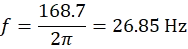
(c) Find the frequency

1785436154876.webp


1785436154882.webp


1785436154888.webp


(d) Periodic time

1785436154896.webp


1785436154902.webp


1785436154918.webp


Do they look alright for the answers?
Does it matter that i have solved them out of order for the question or should that be ok for my tutor ?

Thanks for your help.
 

Attachments

  • 1785436154736.webp
    1785436154736.webp
    366 bytes · Views: 1
  • 1785436154747.webp
    1785436154747.webp
    332 bytes · Views: 1
  • 1785436154710.webp
    1785436154710.webp
    312 bytes · Views: 1
  • 1785436154701.webp
    1785436154701.webp
    1.8 KB · Views: 1
  • 1785436154725.webp
    1785436154725.webp
    384 bytes · Views: 1
  • 1785436154780.webp
    1785436154780.webp
    2.2 KB · Views: 1
Physics news on Phys.org
Your work looks correct, but you might be penalised for quoting too many significant figures in your answers. Given a value like "90mm", you should only assume it is accurate to the nearest mm.
If you use the numeric output of one step as an input to the next, though, you should use the unrounded value as the input. E.g. you could answer 170 rad/s to part b then use your 28444 (as its square) for the next step.

But as a matter of technique, I strongly advise working purely algebraically as far as possible, avoiding plugging in numbers until the end. It has many advantages. For example, it avoids the accumulation of errors that can arise from such chains of calculation. So in part a, you would start again with your base equation and manipulate it eliminate A to get an equation for omega.

I see no need to solve in the same order as the questions are posed.
 
You can write your relevant equation twice, for each of the given pairs ##(x_1,v_1)## and ##(x_2,v_2)## to get a system of 2 equations and 2 unknowns, ##A^2## and ##\omega^2##.

Solve the system the usual way to find the unknowns, the order doesn't matter. I checked your value for ##\omega## and it is correct. I did not check the other values.

I second @haruspex's recommendation to avoid plugging numbers until the very end. Also, if you know how to use a spreadsheet, use it instead of a calculator. It makes troubleshooting your work easier and you can also set it to give the answer in the correct number of significant figures.
 
One of the things you'll need to learn in the real world, after you leave school, is that there usually is no answer key, and there often isn't anyone to ask. Either they don't know how to solve it, or they are too busy doing their own work. They didn't hire you to ask them for the answers, they want you to find the answers. So, being able to look back at the problem and checking your own work is a crucial skill.

This problem is a great example. You aren't really done when you get an answer. You're done when you've verified it for yourself. Asking about the underlying physics, or the correct equations that describe it, makes sense to me. Asking if the numbers are correct seems lazy. If you can find the answer, you can check the answer yourself.