Simple Harmonic Oscillator with Boundary Conditions

Click For Summary
SUMMARY

The discussion focuses on solving for the Amplitude (A) and Phase Constant (ø) of a spring undergoing simple harmonic motion (SHM) with given boundary conditions: (x1,t1)=(0.01, 0) and (x2,t2)=(0.04, 5) at a frequency of 13 Hz. The equations derived from the motion of the spring are x(t1)=Acos(ø) and x(t2)=Acos(408.4+ø). The solution involves using trigonometric identities to eliminate A and solve for ø, which is found to be -77.36 degrees, leading to an amplitude of 0.046. However, inconsistencies in the problem's parameters suggest that the scenario may not be physically valid.

PREREQUISITES
  • Understanding of simple harmonic motion (SHM)
  • Familiarity with trigonometric identities
  • Knowledge of second-order ordinary differential equations (ODEs)
  • Ability to manipulate equations involving cosine and sine functions
NEXT STEPS
  • Study the derivation and application of the equation of motion for SHM
  • Learn about the implications of boundary conditions in differential equations
  • Explore the relationship between frequency, period, and oscillations in SHM
  • Investigate the physical significance of amplitude and phase in oscillatory systems
USEFUL FOR

Students and professionals in physics, particularly those studying mechanics and oscillatory motion, as well as engineers working with systems involving harmonic oscillators.

blizzardof96
Messages
21
Reaction score
0
Moved from a technical forum, no template.
How would you solve for the Amplitude(A) and Phase Constant(ø) of a spring undergoing simple harmonic motion given the following boundary conditions:

(x1,t1)=(0.01, 0)
(x2,t2)=(0.04, 5)
f=13Hz

x values are given in relation to the equilibrium point.

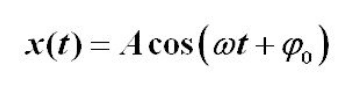
Equation of Motion for a spring undergoing SHM
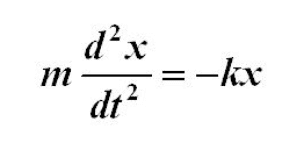
Screen Shot 2018-09-17 at 5.56.47 PM.png
Solution to the 2nd order ODE
Screen Shot 2018-09-17 at 5.56.53 PM.png


Any hints or help would be much appreciated.
 

Attachments

  • Screen Shot 2018-09-17 at 5.56.47 PM.png
    Screen Shot 2018-09-17 at 5.56.47 PM.png
    3.1 KB · Views: 812
  • Screen Shot 2018-09-17 at 5.56.53 PM.png
    Screen Shot 2018-09-17 at 5.56.53 PM.png
    4.1 KB · Views: 698
Physics news on Phys.org
Our rules say that you must show your attempt at a solution before we are allowed to help you. Show us your work.
 
Attempt at a solution
x(t1)=Acos(wt1+ø)

Therefore:
(1) 0.01=Acos(ø)

x(t2)=Acos(wt2+ø)

(2) 0.04=Acos(5w+ø)

w=2pif
w=2pi(13)=81.69

(2) becomes 0.04=Acos(408.4+ø)

This leaves us with the following equations to be solved for A and ø. This is where I am struggling.
(1) 0.01=Acos(ø)
(2) 0.04=Acos(408.4+ø)
 
One way to proceed is to divide the second equation by the first to eliminate A. What do you get? Remember the identities ##\cos(a+b) = \cos a*\cos b - \sin a*\sin b## and ##\sin x = \sqrt{1-\cos^2x}.##
 
Maybe we shouldn't approach just by using the giving equation. Equation 2 in the OP post but deducing the formule from the start. Finding constants in x(t) equation and then proceed. How this sounds ?
 
Arman777 said:
Maybe we shouldn't approach just by using the giving equation. Equation 2 in the OP post but deducing the formule from the start. Finding constants in x(t) equation and then proceed. How this sounds ?
Isn't this what OP is doing by writing down equations (1) and (2)? It's a system of two equations and two unknowns that OP is wondering how to solve.
 
kuruman said:
Isn't this what OP is doing by writing down equations (1) and (2)? It's a system of two equations and two unknowns that OP is wondering how to solve.

I am confused about something and it might be helpful to the OP.

Now we have a second order diff eqn and 2 boundary conditions. So we can see that the solution will have a form of
$$ x(t) =c_1sin(\sqrt (\frac {k} {m})t)+c_2cos(\sqrt (\frac {k} {m})t)$$ (Eq.1)

Since its a boundary condition I derived the conditon from $$m(d^2x/dt^2) + kx = 0$$ then I said, $$(d^2x/dt^2) + (k/m)x = 0$$ where λ=k/m and then we get the above equation.

Now we have 2 boundary conditions so I thought we should put those into the Eq.1 and then try to find c1 and c2. when we do that it seems that they are not both zero. So after that we need to do some calculations to turn it into the like the ##cos(a+b)## thing as you said.
$$x(t) = Acos(ωt+Φ)$$
 
The cos(a+b) identity was helpful. This is how I solved for ø and A.

x(t)=Acos(ωt+ø)

(1) 0.01=Acos(ø)
(2) 0.04=Acos(ωt+ø) where ωt is some constant k
(3) 0.04=Acos(k+ø)

(
3)/(1)
4=cos(k+ø)/cos(ø)

using the identify cos(a+b)=cosa∗cosb−sina∗sinb we can proceed.

(4) 4cos(ø)=cos(k)*cos(ø)-sin(k)*sin(ø)

dividing through by cos(ø)

(5) 4=cos(k)-sin(k)*tan(ø)

(6) Arctan(cos(k)-4)/sin(k))=ø

ø= -77.36 degrees

Subbing back into original equations we get an ampitude(A) of 0.046.
 
Did you check your work? Do you get a displacement of 0.04 when you put your values for A and φ back in the original equation? Your method is correct.

On edit: There is something about this problem that bugs me. If the frequency is 13 Hz, the period is ##T = \frac{1}{13}## s. This means that in time ##t_2 = 5~s## the number of oscillations executed is ##N = t_2/T = 65##. This is an integer which means that the oscillator at ##t_2## must have the same displacement as at time ##t_1 =0##.
 
Last edited:
  • #10
kuruman said:
Did you check your work? Do you get a displacement of 0.04 when you put your values for A and φ back in the original equation? Your method is correct.

On edit: There is something about this problem that bugs me. If the frequency is 13 Hz, the period is ##T = \frac{1}{13}## s. This means that in time ##t_2 = 5~s## the number of oscillations executed is ##N = t_2/T = 65##. This is an integer which means that the oscillator at ##t_2## must have the same displacement as at time ##t_1 =0##.

I checked my work and the solution agreed with initial eqn. The values were arbitrary so its possible that they don't make physical sense.

Thank you for your help.
 
  • #11
blizzardof96 said:
6) Arctan(cos(k)-4)/sin(k))=ø

ø= -77.36 degrees
As @kuruman points out, the problem as stated is inconsistent and has no solution.
What value did you use for k?
 

Similar threads

  • · Replies 11 ·
Replies
11
Views
2K
  • · Replies 13 ·
Replies
13
Views
1K
  • · Replies 51 ·
2
Replies
51
Views
4K
  • · Replies 17 ·
Replies
17
Views
3K
Replies
9
Views
2K
Replies
16
Views
2K
  • · Replies 18 ·
Replies
18
Views
3K
Replies
7
Views
2K
  • · Replies 2 ·
Replies
2
Views
2K
Replies
2
Views
939