Simple pulley system + kinetic friction, find tension

Join the discussion
Ask a follow-up here, or get your own question answered by working scientists, mathematicians and engineers — people, not an autocomplete.
Real named experts · corrections over time · the nuance an AI answer skips
3 replies · 58K views
closer
Messages
18
Reaction score
0
A 9.00 kg hanging weight is connected by a string over a light pulley to a 5.00 kg block that is sliding on a flat table (Fig. P5.8). If the coefficient of kinetic friction is 0.560, find the tension in the string.
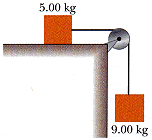
p5-09.gif


fk = µkN, F = ma, N2 = m2g, 5.00 kg mass = m2, 9.00 kg mass = m1

N = (5)(9.8) = 49

sigma f = ma
T + m2g - fk = (m1 + m2)a
T + (9)(9.8) - (µk)(N) = (14)a
T + (9)(9.8) - (.560)(49) = (14)a

I'm lost at this point. Thanks in advance.
 
Last edited:
on Phys.org
closer said:
A 9.00 kg hanging weight is connected by a string over a light pulley to a 5.00 kg block that is sliding on a flat table (Fig. P5.8). If the coefficient of kinetic friction is 0.560, find the tension in the string.

p5-09.gif


fk = µkN, F = ma, N2 = m2g, 5.00 kg mass = m2, 9.00 kg mass = m1

N = (5)(9.8) = 49

sigma f = ma
OK to here
T + m2g - fk = (m1 + m2)a
Where did this equation come from? Always use free body diagrams for each block to identify the forces and net forces acting on each block, before applying Newton's laws to each.
 
T = ma
T = (mass of the system)(acceleration of the system)
m2g matches the direction of the movement, therefore it is positive
fk opposes the movement, therefore it is negative.
T + m2g - fk = (m1 + m2)a
 
closer said:
T = ma
should be F_net =ma
T = (mass of the system)(acceleration of the system)
m2g matches the direction of the movement, therefore it is positive
fk opposes the movement, therefore it is negative.
T there is no T in this equation when you use this approach, but don't use it regardless[/color] + m2g - fk = (m1 + m2)a
It is best in problems of this type to isolate each mass separately, identify the forces acting on each, and use Newton 2 for each. This helps to understand what is going on. Ultimately, you are going to have to do this anyway at least on one mass to solve for T.
For mass m1, the hanging mass, you have the weight down, and the tension up, so it's m1g-T = m1a, and for the other mass, it's T- fk = m2a. Solve for T using these 2 equations with the 2 unknowns.