Simplified imaginary unit to the power of imaginary unit

  • Context: Undergrad 
  • Thread starter Thread starter Leo Authersh
  • Start date Start date
  • Tags Tags
    Imaginary Power Unit
Click For Summary

Discussion Overview

The discussion revolves around the simplification of the imaginary unit raised to the power of the imaginary unit, specifically focusing on the mathematical properties and rules of exponentiation in the context of complex numbers. Participants explore various interpretations and calculations related to this topic, including the implications of parentheses and the use of logarithms.

Discussion Character

  • Technical explanation
  • Debate/contested
  • Mathematical reasoning

Main Points Raised

  • Some participants question the validity of using the formula ##((a)^b)^c = a^{bc}## for complex numbers, suggesting it leads to incorrect results.
  • Others emphasize the importance of parentheses in exponentiation, arguing that exponentiation is not associative and that the order of operations significantly affects the outcome.
  • One participant introduces the expression for ##i^i## using the exponential form, leading to a discussion about the complexities of defining exponentiation for complex numbers.
  • Another participant notes that the complex logarithm is not straightforward, as it is defined only up to multiples of ##2\pi i##, which complicates the evaluation of expressions involving complex exponents.
  • Some participants acknowledge that there are multiple valid interpretations of the problem, particularly regarding the values obtained from purely imaginary exponents of purely imaginary numbers.

Areas of Agreement / Disagreement

Participants express differing views on the application of exponentiation rules in the context of complex numbers, with no consensus reached on the validity of certain simplifications or the interpretation of results.

Contextual Notes

The discussion highlights the limitations in applying standard exponentiation rules to complex numbers, particularly regarding the role of parentheses and the discontinuities in the complex logarithm.

Who May Find This Useful

Readers interested in complex analysis, mathematical reasoning involving exponentiation, and the properties of imaginary numbers may find this discussion relevant.

Leo Authersh
Where is my simplification wrong?
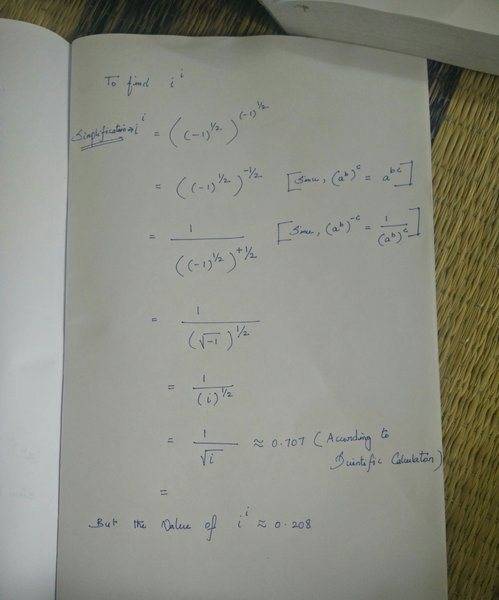
Fotor_150364647772291.jpg
 
Mathematics news on Phys.org
Do I distinguish a ##(-1)^{1/2} = -{1\over 2} ## in the first step ?
 
  • Like
Likes   Reactions: Leo Authersh
BvU said:
Do I distinguish a ##(-1)^{1/2} = -{1\over 2} ## in the first step ?
I wrote it based on the general formula for real numbers that ##((a)^b)^c = a^{bc}##
 
That formula is (a) problematic for complex numbers and (b) doesn't lead to -1/2 even if you apply it.
 
  • Like
Likes   Reactions: Leo Authersh
mfb said:
That formula is (a) problematic for complex numbers and (b) doesn't lead to -1/2 even if you apply it.
##(((64)^{1/2})^{-4})^ {1/2} = (64^{1/2})^{-4/2} = 1/64##
I wrote it on this basis.
 
Last edited by a moderator:
When you replaced ##i^i## with ##{((-1)^{(1/2)})}^{((-1)^{(1/2)})}##, you forgot the parentheses around the "i" in the exponent.

Exponentiation is not associative. ##(a^b)^c## is not, in general, equal to ##a^{(b^c)}##.
 
  • Like
Likes   Reactions: Leo Authersh
jbriggs444 said:
When you replaced ##i^i## with ##{((-1)^{(1/2)})}^{((-1)^{(1/2)})}##, you forgot the parentheses around the "i" in the exponent.

Exponentiation is not associative. ##(a^b)^c## is not, in general, equal to ##a^{(b^c)}##.
Hi,

I think this will make it clearer.

IMG_20170825_160811.jpg
 
Last edited by a moderator:
All of which is irrelevant because your calculation does not have that form.
 
  • Like
Likes   Reactions: Leo Authersh
jbriggs444 said:
When you replaced ##i^i## with ##{((-1)^{(1/2)})}^{((-1)^{(1/2)})}##, you forgot the parentheses around the "i" in the exponent.

Exponentiation is not associative.
jbriggs444 said:
All of which is irrelevant because your calculation does not have that form.

And that is my question. Why the general formula becomes irrelevant when 4096 is replaced with -1.
 
  • #10
Leo Authersh said:
And that is my question. Why the general formula becomes irrelevant when 4096 is replaced with -1.
You misunderstand. It's not the -1 that's the problem. It's the parentheses.

Edit:
##{(a^b)}^c## is equal to ##a^{(bc)}##

But obviously,

##a^{(b^c)}## is not equal to ##a^{(bc)}## [unless ##b^c## just happens to equal ##b \times c## or a just happens to be equal to 1]
 
  • Like
Likes   Reactions: Leo Authersh
  • #11
jbriggs444 said:
You misunderstand. It's not the -1 that's the problem. It's the parentheses.

Edit:
##{(a^b)}^c## is equal to ##a^{(bc)}##

But obviously,

##a^{(b^c)}## is not equal to ##a^{(bc)}## [unless ##b^c## just happens to equal ##b \times c## or a just happens to be equal to 1]
Thank you. Now I understood why exponentials are not left associative. But since apparently they are all right associative, I'm confused because my simplification gives me the deception of being right associative.
 
  • #12
Where do you see something of the type of ##(a^b)^c## in ##(-1)^{1/2}##? What would a,b, and c be?
 
  • Like
Likes   Reactions: Leo Authersh
  • #13
Leo Authersh said:
Thank you. Now I understood why exponentials are not left associative. But since apparently they are all right associative, I'm confused because my simplification gives me the deception of being right associative.
Personally, I can never remember whether a tower of exponents is supposed to be evaluated from left to right or from right to left. I'm pretty sure that I've seen it both ways over the years. But it does not matter. If you are the one writing down the formula, you can use parentheses to be absolutely sure that it evaluates the way you want it to.

So let's step through it slowly.

Start with $$i^i$$
Replace each i with ##({(-1)}^{(1/2)})##. The parentheses are there to ensure proper evaluation order. $${({(-1)}^{(1/2)})}^{({(-1)}^{(1/2)})}$$
Now look at that expression and try to find something with the form of ##{(a^b)}^c##. You originally thought you had something with:
a=##{({(-1)}^{(1/2)})}##
b=##(-1)##
c=##(1/2)##
But the parentheses mess that up. It's not of the right form.
 
  • Like
Likes   Reactions: Leo Authersh
  • #14
mfb said:
Where do you see something of the type of ##(a^b)^c## in ##(-1)^{1/2}##? What would a,b, and c be?
Now, I have understood. Thank you for your answers.
 
  • #15
Messing around with complex numbers - let's see: i=e^{i\frac{\pi}{2}}, so i^{i}=(e^{i\frac{\pi}{2}})^{i}=e^{i\frac{\pi}{2}\cdot i}=e^{i \cdot i\frac{\pi}{2}}=e^{-\frac{\pi}{2}}.
 
  • Like
Likes   Reactions: Leo Authersh and FactChecker
  • #16
Svein said:
Messing around with complex numbers - let's see: i=e^{i\frac{\pi}{2}}, so i^{i}=(e^{i\frac{\pi}{2}})^{i}=e^{i\frac{\pi}{2}\cdot i}=e^{i \cdot i\frac{\pi}{2}}=e^{-\frac{\pi}{2}}.
Conclusion -- When dealing with complex exponents, consider the complex exponential function.
 
  • Like
Likes   Reactions: Leo Authersh
  • #17
Svein said:
Messing around with complex numbers - let's see: i=e^{i\frac{\pi}{2}}, so i^{i}=(e^{i\frac{\pi}{2}})^{i}=e^{i\frac{\pi}{2}\cdot i}=e^{i \cdot i\frac{\pi}{2}}=e^{-\frac{\pi}{2}}.

It's a little bit tricker than this: ##i=e^{\frac{5\pi}{2}i}## is also true and, following your steps, ##i^i=(e^{\frac{5\pi}{2}i})^i=e^{-\frac{5\pi}{2}}##. The issue is that it's hard to define exponentiation for complex numbers. We want to say ##z^w=\exp(w\log(z))## (for ##z\neq 0## of course), but how to define the complex logarithm? For ##z=re^{i\theta}##, we can't have ##\log(z)=\log(r)+i\theta## since ##\theta## is only defined up to a multiple of ##2\pi##, unless we restrict our allowed ##\theta##, say to be in ##[0,2\pi)##. But this makes ##\log## discontinuous and causes exponent rules to fail, as seen above.

Alternatively, you can just give up on ##\log## being a function, and instead have it be defined only up to multiples of ##2\pi i##. But then our exponential ##z^w=\exp(w\log(z))## becomes defined only up to factors of ##\exp(2\pi iw)##. With ##w=i##, we get back to the original problem.

This sort of problem leads to the theory of Riemann surfaces.
 
Last edited:
  • Like
Likes   Reactions: BvU, Leo Authersh, mfb and 1 other person
  • #18
Infrared said:
It's a little bit tricker than this: ##i=e^{\frac{5\pi}{2}i}## is also true and, following your steps, ##i^i=(e^{\frac{5\pi}{2}i})^i=e^{-\frac{5\pi}{2}}##. The issue is that it's hard to define exponentiation for complex numbers. We want to say ##z^w=\exp(w\log(z))## (for ##z\neq 0## of course), but how to define the complex logarithm? For ##z=re^{i\theta}##, we can't have ##\log(z)=\log(r)+i\theta## since ##\theta## is only defined up to a multiple of ##2\pi##, unless we restrict our allowed ##\theta##, say to be in ##[0,2\pi)##. But this makes ##\log## discontinuous and causes exponent rules to fail, as seen above.

Alternatively, you can just give up on ##\log## being a function, and instead have it be defined only up to multiples of ##2\pi i##. But then our exponential ##z^w=\exp(w\log(z))## becomes defined only up to factors of ##\exp(2\pi iw)##. With ##w=i##, we get back to the original problem.

This sort of problem leads to the theory of Riemann surfaces.
Good point. It's true that you need to define a branch of the logarithm. The principle branch being the most standard. So there are more than one answer to the question. But the answer given is definitely one possible answer.
 
  • Like
Likes   Reactions: Leo Authersh
  • #19
Infrared said:
It's a little bit tricker than this: ##i=e^{\frac{5\pi}{2}i}## is also true and, following your steps, ##i^i=(e^{\frac{5\pi}{2}i})^i=e^{-\frac{5\pi}{2}}##. The issue is that it's hard to define exponentiation for complex numbers. We want to say ##z^w=\exp(w\log(z))## (for ##z\neq 0## of course), but how to define the complex logarithm? For ##z=re^{i\theta}##, we can't have ##\log(z)=\log(r)+i\theta## since ##\theta## is only defined up to a multiple of ##2\pi##, unless we restrict our allowed ##\theta##, say to be in ##[0,2\pi)##. But this makes ##\log## discontinuous and causes exponent rules to fail, as seen above.

Alternatively, you can just give up on ##\log## being a function, and instead have it be defined only up to multiples of ##2\pi i##. But then our exponential ##z^w=\exp(w\log(z))## becomes defined only up to factors of ##\exp(2\pi iw)##. With ##w=i##, we get back to the original problem.

This sort of problem leads to the theory of Riemann surfaces.
Yes, of course. But I just wanted to show that a purely imaginary exponent of a purely imaginary number has a real value. What you have done is to show that it has several real values, which is true for a rather large class of complex functions.
 
  • Like
Likes   Reactions: Leo Authersh

Similar threads

  • · Replies 21 ·
Replies
21
Views
2K
  • · Replies 29 ·
Replies
29
Views
4K
  • · Replies 6 ·
Replies
6
Views
2K
  • · Replies 44 ·
2
Replies
44
Views
5K
  • · Replies 6 ·
Replies
6
Views
1K
  • · Replies 2 ·
Replies
2
Views
3K
  • · Replies 7 ·
Replies
7
Views
2K
  • · Replies 35 ·
2
Replies
35
Views
5K
  • · Replies 2 ·
Replies
2
Views
2K
  • · Replies 36 ·
2
Replies
36
Views
7K