Simplify this expression for the period

Click For Summary
The discussion revolves around simplifying the expression T = 2πLsinθ / √(Lgsinθtanθ). The user initially struggles with the simplification process despite reviewing their math notes. A suggestion to square the denominator and incorporate it into the radical leads to a successful simplification. The user expresses gratitude for the help and inquires about the rule used in the simplification. The response clarifies that this technique is known as "taking the square root" or "squaring."
crememars
Messages
15
Reaction score
2
Homework Statement
A bob of mass m is suspended from a fixed point with a massless string of length L. You are to investigate the motion in which the string moves in a cone with half-angle, 𝜃. Express your answers in terms of some or all of the variables m, L, and 𝜃, and g.

v = √Lgsin𝜃tan𝜃

How long does it take the bob to make one full revolution (one complete trip around the circle)?
Relevant Equations
T = 2πr / v
r = Lsin𝜃
hi ! I'm having a lot of trouble simplifying my expression for one of my homework questions. I know someone asked about this homework problem already, but the answers didn't really help me figure out how to simplify it.. I really have no idea what steps to take, and I've even consulted all my math notes too.

my expression for T is:

T = 2πLsinθ / √(Lgsinθtanθ)
T = 2πLsinθ * √(Lgsinθtanθ) / Lgsinθtanθ
T = 2π * √(Lgsinθtanθ) / gtanθ

final answer

[ 2π * √(Lgsinθtanθ) ] / gtanθ

the correct answer should be:

2π * √( Lcosθ / g )thank you in advance
 

Attachments
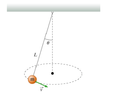
  • Screen Shot 2022-10-12 at 4.43.27 PM.png
    Screen Shot 2022-10-12 at 4.43.27 PM.png
    6.7 KB · Views: 136
Physics news on Phys.org
Hi,

How about the forces that act on the bob ? Can you draw a diagram ?

##\ ##
 
If you square the denominator, you can put it inside the radical. What do you get?
 
kuruman said:
If you square the denominator, you can put it inside the radical. What do you get?
tried that, and it worked, thank u ! what is that rule called though? I don't remember learning it
 
crememars said:
tried that, and it worked, thank u ! what is that rule called though? I don't remember learning it
It's called "taking the square root" or "squaring". You can go back and forth in what is shown below.
$$\sqrt{\frac{A}{B^2}}=\frac{\sqrt{A}}{\sqrt{B^2}}=\frac{\sqrt{A}}{B}$$
 
Thread 'Correct statement about size of wire to produce larger extension'
The answer is (B) but I don't really understand why. Based on formula of Young Modulus: $$x=\frac{FL}{AE}$$ The second wire made of the same material so it means they have same Young Modulus. Larger extension means larger value of ##x## so to get larger value of ##x## we can increase ##F## and ##L## and decrease ##A## I am not sure whether there is change in ##F## for first and second wire so I will just assume ##F## does not change. It leaves (B) and (C) as possible options so why is (C)...

Similar threads

  • · Replies 5 ·
Replies
5
Views
2K
  • · Replies 1 ·
Replies
1
Views
2K
  • · Replies 2 ·
Replies
2
Views
2K
  • · Replies 17 ·
Replies
17
Views
1K
  • · Replies 14 ·
Replies
14
Views
2K
Replies
8
Views
1K
  • · Replies 1 ·
Replies
1
Views
5K
  • · Replies 4 ·
Replies
4
Views
1K
  • · Replies 8 ·
Replies
8
Views
3K
  • · Replies 13 ·
Replies
13
Views
3K