Simplifying Trigonometric Antiderivative using Right Triangles?

Click For Summary

Discussion Overview

The discussion revolves around the theoretical aspects of simplifying trigonometric antiderivatives, particularly through the use of right triangles and trigonometric identities. Participants explore the application of various trigonometric formulas and identities in the context of integrals.

Discussion Character

  • Exploratory, Technical explanation, Homework-related

Main Points Raised

  • One participant questions the validity of a specific trigonometric identity and its application to the problem at hand.
  • Another participant suggests applying the identities ##cos^2x + sin^2x = 1## and ##tan(x) = \frac{sin(x)}{cos(x)}## to aid in the solution.
  • A later reply proposes demonstrating the equality of two integrands by showing that ##\sin^2(\arctan(x)) = \frac{x^2}{x^2 + 1} + C##, recommending the use of a right triangle to find ##sin(\theta)##.

Areas of Agreement / Disagreement

Participants express differing views on the applicability of certain trigonometric identities, and the discussion does not reach a consensus on the best approach to the problem.

Contextual Notes

Some participants note limitations in their understanding of how certain identities relate to arctan, indicating potential gaps in assumptions or definitions that remain unresolved.

OmniNewton
Messages
105
Reaction score
5
Mod note: Moved from a homework section
1. Homework Statement

Hello my question more has to do with theory that perhaps deals with algebra.

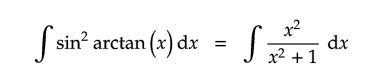
Why is the following true?
7b9324fbb148a9401897d88800b7d547.png


Homework Equations


N/A

The Attempt at a Solution


N/A[/B]
 
Last edited by a moderator:
Physics news on Phys.org
Have you tried to apply the formulas ##cos^2x + sin^2x = 1## and ##tan (x)=\frac{sin (x)}{cos (x)}##?
 
fresh_42 said:
Have you tried to apply the formulas ##cos^2x + sin^2x = 1## and ##tan (x)=\frac{sin (x)}{cos (x)}##?
Hello, fresh_42

Thank you for the reply I have attempted to apply the identity cos^2x + sin^2x = 1 and could not figure out an algebraic means to have this work out. As for the reciprocal identity tanx = sinx/cosx. I do not see how this identity applies to arctanx since arctanx does not equal arcsinx/arccosx

Regards,

OmniNewton
 
Because you have integrals on both sides, you can instead show that the two integrands are equal (plus possibly a constant). IOW, just show that ##\sin^2(\arctan(x)) = \frac{x^2}{x^2 + 1} + C##

The best way to do this, IMO, is to draw a right triangle, and label an acute angle ##\theta##, with the opposite as x and the adjacent side as 1. The ##\tan(\theta) = \frac x 1##. Now find ##sin(\theta)##.
 

Similar threads

  • · Replies 4 ·
Replies
4
Views
1K
  • · Replies 6 ·
Replies
6
Views
2K
  • · Replies 8 ·
Replies
8
Views
2K
  • · Replies 4 ·
Replies
4
Views
1K
  • · Replies 8 ·
Replies
8
Views
2K
  • · Replies 7 ·
Replies
7
Views
2K
  • · Replies 19 ·
Replies
19
Views
5K
  • · Replies 2 ·
Replies
2
Views
1K
  • · Replies 19 ·
Replies
19
Views
3K
  • · Replies 11 ·
Replies
11
Views
3K