Simultaneous events separated by distance and time

  • Thread starter Thread starter member 731016
  • Start date Start date
  • Tags Tags
    distance Events
Join the discussion
Ask a follow-up here, or get your own question answered by working scientists, mathematicians and engineers — people, not an autocomplete.
Real named experts · corrections over time · the nuance an AI answer skips
5 replies · 867 views
member 731016
Homework Statement
Please see below
Relevant Equations
Please see below
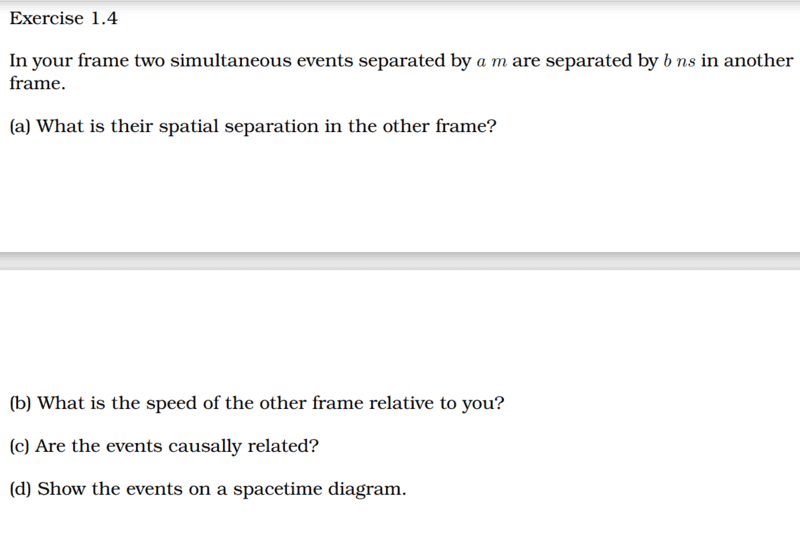
For this problem,
1715731097106.png

Does anybody please know how events can be separated by time in one frame and distance in another? This notation does not seem physically correct to me.

Thanks!
 
on Phys.org
ChiralSuperfields said:
Homework Statement: Please see below
Relevant Equations: Please see below

For this problem,
View attachment 345259
Does anybody please know how events can be separated by time in one frame and distance in another? This notation does not seem physically correct to me.

Thanks!
Here is a version of the problem with numbers in it. However, my confusion about events in still the same (that is, how can the events can be separated by time in one frame and distance in another). Thanks for any help!
1715753391609.png
 
ChiralSuperfields said:
However, my confusion about events in still the same (that is, how can the events can be separated by time in one frame and distance in another
They are separated by distance in both frames, but simultaneous in just one frame. You might find it helpful to think about what the answer to part #d will look like fr this to be possible.
 
Reply
  • Love
Likes   Reactions: member 731016
They have a distance separation and a time separation in both frames. You are given that the distance separation in your frame is a and the time separation in your frame is 0 (because they are simultaneous in your frame). You are given that the time separation in the other frame is b, and asked to find the distance separation in the other frame.
 
Reply
  • Love
Likes   Reactions: member 731016
Thank you for your replies @Nugatory and @phyzguy !

Sorry I'm still confused. My working is,

(a) ##\Delta s^2 = \Delta (s')^2##

##\Delta x^2 - (c \Delta t)^2 = \Delta (x')^2 - (c \Delta t')^2##

Subing in the numbers gives,

##\sqrt{9^2 - 9} = \Delta x'##

##\sqrt{72} = \Delta x'##

(b) ##x' = γ(x - vt)##
##\Delta x' = γ(\Delta x - v \Delta t)## we know ##\Delta t = 0##, thus plugging in values from (a),
##\frac{9}{\sqrt{72}} = \sqrt{1 - \frac{v^2}{c^2}}##
##\sqrt{-c^2 (\frac{9}{\sqrt{72}})^2 - 1} = v##

(c) Events cannot be causally related since ##\Delta (s')^2 = \Delta s^2 > 0## so ##|\Delta x| > |c\Delta t|##

However, I don't know how to draw the spacetime diagram. I think we have to draw the events such that ##(\Delta x, c \Delta t) = (9,0)## and ##(\Delta x', c \Delta t') = (\sqrt{72}, 1 \times 10^{-8} c)##
1715819173280.png

Thanks!
 
Last edited by a moderator:
ChiralSuperfields said:
Thank you for your replies @Nugatory and @phyzguy !

Sorry I'm still confused. My working is,

(a) ##\Delta s^2 = \Delta (s')^2##

##\Delta x^2 - (c \Delta t)^2 = \Delta (x')^2 - (c \Delta t')^2##

Subing in the numbers gives,

##\sqrt{9^2 - 9} = \Delta x'##

##\sqrt{72} = \Delta x'##

(b) ##x' = γ(x - vt)##
##\Delta x' = γ(\Delta x - v \Delta t)## we know ##\Delta t = 0##, thus plugging in values from (a),
##\frac{9}{\sqrt{72}} = \sqrt{1 - \frac{v^2}{c^2}}##
##\sqrt{-c^2 (\frac{9}{\sqrt{72}})^2 - 1} = v##

(c) Events cannot be causally related since ##\Delta (s')^2 = \Delta s^2 > 0## so ##|\Delta x| > |c\Delta t|##

However, I don't know how to draw the spacetime diagram. I think we have to draw the events such that ##(\Delta x, c \Delta t) = (9,0)## and ##(\Delta x', c \Delta t') = (\sqrt{72}, 1 \times 10^{-8} c)##
View attachment 345328
Thanks!
Update: I made some silly algebraic mistakes in the last post. I have fixed them now and have go have solved (a), (b) and (c). However, I'm just stuck on finding the spacetime diagram now. I'm not sure where to plot the events.

My thinking is that we can plot the events anywhere as long as the spacetime interval is satisfied from (a). This is similar to trying to plot points on a Cartesian x and y plane given the Pythagorean distance.

Thanks!