Solid angles and particle velocities

Click For Summary
SUMMARY

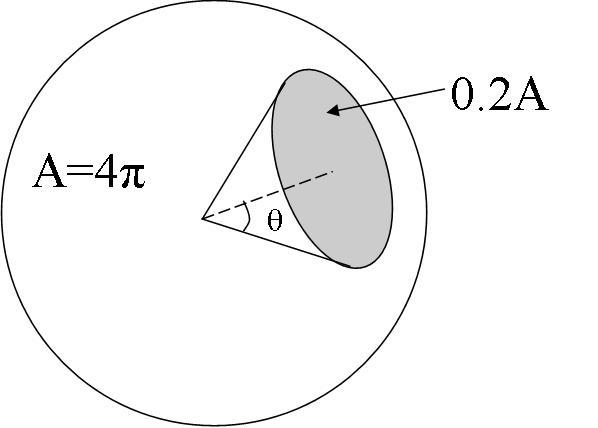
The discussion focuses on calculating the fraction of particles in a gas that have velocities uniformly distributed over solid angles. The key concept involves determining the angular range corresponding to a specific fraction of the sphere's surface area, represented as a cap of a sphere. Participants mention the need for integration to derive the area formula for the spherical cap, which is essential for finding the angle theta (θ) that corresponds to the shaded area representing 20% of the sphere's total surface area.

PREREQUISITES
  • Understanding of solid angles and their distribution
  • Familiarity with spherical geometry
  • Basic knowledge of integration techniques
  • Concept of spherical caps and their properties
NEXT STEPS
  • Study the formula for the area of a spherical cap
  • Learn about solid angle calculations in three-dimensional space
  • Explore integration methods for geometric applications
  • Investigate particle velocity distributions in statistical mechanics
USEFUL FOR

Students and professionals in physics, particularly those studying gas dynamics, statistical mechanics, or geometric applications in three-dimensional space.

quarky2001
Messages
31
Reaction score
0
This should be a simple question, but I haven't found a clear explanation anywhere yet.

Suppose that there are a bunch of particles in a gas, with their velocities "uniformly distributed over solid angles", and I want to find out what fraction of particles are traveling with velocities in a certain angular range.

Conceptually, I know what this means. I'm just not sure how to do it - I drew a diagram.

Suppose the shaded area represents 20% of the sphere's total surface area. How do find the angle theta?
attachment.php?attachmentid=31859&stc=1&d=1296657266.jpg
 

Attachments

  • Solidangle.jpg
    Solidangle.jpg
    13.8 KB · Views: 629
Physics news on Phys.org
hi quarky2001! :smile:

(have a theta: θ :wink:)

that's called a cap of a sphere of radius θ …

i can't remember the formula for its area :redface:, but it's fairly easy to find by integration :wink:
 

Similar threads

  • · Replies 9 ·
Replies
9
Views
4K
  • · Replies 3 ·
Replies
3
Views
1K
Replies
5
Views
2K
  • · Replies 6 ·
Replies
6
Views
1K
  • · Replies 32 ·
2
Replies
32
Views
3K
  • · Replies 15 ·
Replies
15
Views
1K
  • · Replies 1 ·
Replies
1
Views
2K
  • · Replies 6 ·
Replies
6
Views
3K
  • · Replies 39 ·
2
Replies
39
Views
3K
  • · Replies 7 ·
Replies
7
Views
3K