Solid Mechanics Question - Help

Click For Summary

Discussion Overview

The discussion revolves around a solid mechanics problem involving a round beam glued at a joint, focusing on shear strain and the conditions under which glue failure occurs. Participants explore the relationship between applied loads, shear stress, and the geometry of the beam, with an emphasis on understanding the mechanics involved in the problem.

Discussion Character

  • Exploratory
  • Technical explanation
  • Debate/contested
  • Mathematical reasoning
  • Homework-related

Main Points Raised

  • One participant describes a beam with a glued joint and asks for the range of an applied load (q0) that would prevent glue failure based on shear strain limits.
  • Another participant suggests using free-body diagrams and static equilibrium equations to approach the problem.
  • There is a discussion about whether q0 should be treated as a force or a stress, with some participants leaning towards it being a distributed load.
  • Participants express confusion about calculating shear stress and the cross-sectional area of the beam, with one noting that the area may be elliptical.
  • One participant proposes a relationship involving shear stress and axial load, but questions arise about the angles involved in the calculations.
  • There is a suggestion to consider the maximum moment the beam can tolerate and how it relates to the glue failure at the joint.
  • Participants discuss the implications of different angles on the shear stress distribution and the potential failure points of the glue joint.
  • One participant realizes that the angle in question is not 30 degrees but rather 53.1 degrees, prompting further inquiry into the correctness of their solution.
  • There is a mention of needing to draw free-body diagrams to understand the distribution of forces when a moment is applied.

Areas of Agreement / Disagreement

Participants do not reach a consensus on several aspects of the problem, including the interpretation of q0, the correct angles to use in calculations, and the implications of the moment applied to the beam. Multiple competing views remain regarding the approach to solving the problem.

Contextual Notes

Participants express uncertainty about the definitions of terms such as shear strain and load, and there are unresolved questions about the geometry of the beam and the calculations required to determine the shear stress and potential failure points.

Who May Find This Useful

This discussion may be useful for students studying solid mechanics, particularly those dealing with problems involving shear stress, glue joints, and the mechanics of beams under load.

dislect
Messages
163
Reaction score
0
hi all :biggrin:

i apologize in advance for the poor englsih, the question is translated from another language.

A round beam (radius R) is harnessed on the left side to a wall.
The beam is made up of two parts glued together by a thin layer of glue - the attachment plane is described in the picture as AB.
A 'glue fail' happens when the SIZE of the shear strain on plane AB is bigger the Sigma0 (some unkown value).
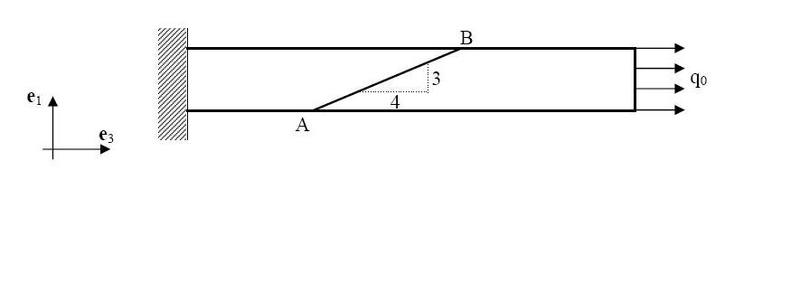
wjdqzozzcnyl.jpg


On the right side of the beam there's an equaly spred strain q=q0*e3 (note that q0 might be negetive as well).

What is the allowed value range of q0 so that there won't be a glue failure? (express your answer by using R and Sigma0)

this question was given as a challenge, and is a part of a course called solid mechanics 2 that deals more with shear strain and strain matrices. I really don't even have a clue of how to begin, i can't see how the radius R plays a part in the answer..

help, please?
 
Physics news on Phys.org
Hi dislect, welcome to PF. Do you know the relationship between force, area, and stress, and can you draw a free-body diagram and write the static equilibrium equations? These would go a long way in helping you solve the problem.

The translation looks pretty good, but "strain" should probably be "load" (or "force"), "distributed load," or "stress." Is is possible to find out which, since they imply different loading configurations?
 
Hi Mapes, thanks!

yhtthznmdhnj.jpg


It's weird but I think they actually ment strain and not force. Well, that's the word they chose to describe it as. In the first course (Solid mechanics 1) we dealt a lot with forces and free-body diagrams. Now its more about strain tensors on different planes, and that's the part that bugs me because I know that the solution as something to do with it..

* I copied the parameter they signed for the maximum sheer strain that AB plane can tolerate (AKA Sigma0)
 
OK, great. Now using the tangential force on AB, calculate the shear stress at the joint and compare this to \sigma_0 (\sigma is almost universally used to denote stress, not strain).
 
Well that's the part I'm stuck in :)
How do I do that? how does the momentum take place if i don't know any distances on the beam?
Whem I'm summing all the forces do i count q0 as is or as q0*pi*R^2, and how do I get a range of values of q0 in such way?
 
dislect said:
how does the momentum take place if i don't know any distances on the beam?

Moments? Don't worry about the moments; you just want to turn the tangential force v into a shear stress by dividing it by the cross-sectional area (which is not a circle!).

dislect said:
Whem I'm summing all the forces do i count q0 as is or as q0*pi*R^2, and how do I get a range of values of q0 in such way?

There's no way to tell without knowing what q0 is (e.g., a force, a stress...). I'm quite sure it's not a strain, despite the translation. I would assume it's a force.
 
If I translate it "as is" then q0 is said to be an equaly devided 'load' (that might be negetive as well)

Hmm.. about the sheer stress that's steping back to trigonometrics :)
How do I find that cross-sectional area? its sort of eliptic.
 
dislect said:
How do I find that cross-sectional area? its sort of eliptic.

You got it!
 
So the cross-sectional area is 2*Pi*(R^2)
I still don't really get the question. It's like I'm solving it with you in baby steps and can't see the all picture :-(
 
  • #10
In the problem, you're pulling or pushing on a beam with circular cross section. There's an angled, glued joint within the beam that can only sustain a certain amount of shear stress. Your job is to calculate how hard you can pull or push on the beam without making the joint fail. So you need to connect the axial load q_0 to the rupture shear stress \sigma_0. Does this help?
 
  • #11
So its something like V*2*pi*(R^2)*sin(30) = q0*pi*(R^2) ?
 
  • #12
dislect said:
So its something like V*2*pi*(R^2)*sin(30) = q0*pi*(R^2) ?

I'm not sure where this is coming from. Are you summing the forces in the e_3 direction? There's no 30° angle in this problem.
 
  • #13
Mapes said:
I'm not sure where this is coming from. Are you summing the forces in the e_3 direction? There's no 30° angle in this problem.

That what I tried.. casting V on e3
 
  • #14
Mapes, could you help me with the static equilibrium part?
I fell like I'm getting lost in this question, and I have no other examples to rely on (its the first 'challenge question' that the lecturer gave). Plus, It's just the first part of the question :) in the second part they change q0 to pure moment.
 
  • #15
I think you need to find the relationship between V and q0. I'm not sure where sin(30) comes in. A couple hints I can give are that (1) V is smaller in magnitude than q0 (assuming q0 is the axial force applied to the beam end) and that (2) V equals q0 when the cut is horizontal but is zero when the cut is vertical. Does this help figure out the trigonometry part?
 
  • #16
Good morning Mapes!
Me and a friend are going to sit and do our best with the question, and later on today i'll upload our solution trial for your confirmation :-)

thanks for all the patience, I really appreciate it!

btw, just today we realized that q0 is an already spread force, meaning we don't have to divide it by A and the same goes for the V(sheer)!
 
  • #17
Ok, so as I said q0 is an already spread force and therefor -< the strain ( no need to divide by A).

This is what we did:

lltocjtywyzr.jpg


* Is our assumption correct about AC? if so, how can we justify it?
* Is our solution correct? :-)

Thanks Mapes!
 
  • #18
Right away, let me reiterate that a 3-4-5 right triangle does not contain any 30° angles.

It looks like you're getting closer.

EDIT: Try solving it for an arbitrary angle \theta. Think about how the answer must change as the angle approaches 0° or 90°.
 
  • #19
Hmm I'm not sure I understand why its not a 30 degree angle..
and if its not, what does the 3-4-5 triangle give me and how do i express the n vector of plane AB?
 
  • #20
Ok I'll organize my questions:

*Why does this triangle don't have a 30 degree angle? i thought that any 3-4-5 triangle has 30-60-90 degrees in it.
*The overall solution for the question is right? I mean besides the angle part
*In the second part of the question that change the strain q0 into pure moment T. Out of curiosity, where would the glue fail first on plane AB (while applying moment T)? My intuition says that it should fail all over the edges of plane AB simultaneously but I can't really explain it. Is it true? and if so, how can I justify my saying?

Once again, I'ts important for me to emphasize how much I appreciate your help Mapes :-)
 
  • #21
Sorry for spamming but I just got it.. its 53.1 degrees!
now given that i corrected the degree, is the solution ok?
(my other questions are still relevant :) )
 
  • #22
What is your revised answer? (Try solving for an arbitrary angle \theta, then you can plug in the correct angle. This makes your solution more general and also let's you check the extreme cases of \theta =0^\circ and \theta =90^\circ.)

For the case of the moment, try drawing a free-body diagram and looking at what the distribution of forces will be at the joint. (It won't just be a single force any more.)
 
  • #23
Last edited by a moderator:
  • #24
That looks a lot better.

dislect said:
and after looking at the free-body diagram for the moment i think that the first place to fail is the exact middle of the AB plane.

Really? It seems like this point lies on the neutral axis, where bending stresses are zero.
 
  • #25
Ok i'll take one step back and see first if I got the moment instead of q0 part right :shy:
This is what I did the find the max pure moment T that the beam can tolerate on the glued part AB:

http://up185.siz.co.il/up1/ynzt4hdyjoxn.jpg

(notice the * I got a bit confused there..)

Now according the the moment formula it depends on R so the first to break point on plane AB should probably be A or B. The thing is, I can't find any formula that connects the distance from the applyied moment to a certain point and that's why I first thought that A and B would fail together but it contradicts my intuition :rolleyes:
 
Last edited by a moderator:
  • #26
You have got to distinguish between stress and strain. Stress is load per unit area and has units of pressure. Strain is normalized deformation and is unitless. Mixing these up is such a big deal that I tend to stop reading at this point. It signals major confusion.

It would be easier to follow your solution if you solved for an arbitrary joint angle \theta.
 
  • #27
You got to understand that its just translation problems. I just tryed to stay unified in my choice of word (strain=stress).
I can't really see a reason to choose an arbitrary joint angle for the transformation, its not such a long solution.
 
  • #28
Mapes, I need to submit this question by tommorow.
Could you please help me with one last push?
Given that the solution is for Stress and not strain, is it correct?
And more importat, where on plane AB would the glue fail first? is it on point B because its closer to where the moment is applyied?
 
  • #29
OK, I just took a look at your solution, substituting "stress" for "strain." Your answer looks like it's in the right ballpark. Did you check whether the shear would be higher at the midpoint of the joint at the surface?
 
  • #30
Last edited by a moderator:

Similar threads

  • · Replies 48 ·
2
Replies
48
Views
6K
  • · Replies 46 ·
2
Replies
46
Views
15K
  • · Replies 2 ·
Replies
2
Views
5K
  • · Replies 9 ·
Replies
9
Views
4K
  • · Replies 3 ·
Replies
3
Views
2K
Replies
20
Views
14K
Replies
1
Views
2K
Replies
2
Views
9K
Replies
1
Views
2K
  • · Replies 2 ·
Replies
2
Views
3K