Solution To Photon Trajectory Equation

Join the discussion
Ask a follow-up here, or get your own question answered by working scientists, mathematicians and engineers — people, not an autocomplete.
Real named experts · corrections over time · the nuance an AI answer skips
10 replies · 2K views
LazyPhysicist1
Messages
7
Reaction score
0
TL;DR
I need help solving the nonlinear photon trajectory diffeq near a mass as derived by the Schwarzschild metric.
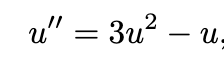
Using the null geodesic and the Schwarzschild metric, this differential equation for photon trajectory near a mass can be derived, where u is r_s /2r:

View attachment 349924

Though this nonlinear ode is fairly easy to approximate (which I already have), I'm looking for an analytic solution or an approximate analytic solution. No online calculators work, except Wolfram (for which I don't have pro), which gives me an unusably complicated solution; https://www.wolframalpha.com/input?i=y''+=+3y^2-y

Is there a way I can better solve this differential equation/approximate an analytical solution? Thanks.
 

Attachments
  • Screenshot 2024-08-15 at 09.55.10.png
    Screenshot 2024-08-15 at 09.55.10.png
    1.4 KB · Views: 97
Physics news on Phys.org
Without the gravitational term, the equation of motion is ##u'' + u = 0## i.e. ##u \sim \sin{\phi}##, which is to say that the trajectory is a straight line (specifically ##u = \tfrac{1}{b} \sin{\phi}## if the impact parameter is ##b##).

Putting in the gravitational term so that ##u'' + u = 3u^2## (with ##M=1##), you take a perturbative expansion around the previous straight line solution with expansion parameter ##1/b##. So to linear order,

##u = \frac{1}{b} \sin{\phi} + \frac{1}{b} \epsilon := u_0 + \frac{1}{b} \epsilon##

which you can plug back in (and use ##u_0'' + u_0 = 0##) to get

##\epsilon'' + \epsilon = \frac{3}{b} \frac{1-\cos{2\phi}}{2}##

This is now a classic second order ODE for ##\epsilon(\phi)## that you can solve by finding a homogeneous and particular solution. I'll leave you to try and work out the intermediate and remaining steps.
 
Reply
  • Like
Likes   Reactions: LazyPhysicist1
ergospherical said:
Without the gravitational term, the equation of motion is ##u'' + u = 0## i.e. ##u \sim \sin{\phi}##, which is to say that the trajectory is a straight line (specifically ##u = \tfrac{1}{b} \sin{\phi}## if the impact parameter is ##b##).

Putting in the gravitational term so that ##u'' + u = 3u^2## (with ##M=1##), you take a perturbative expansion around the previous straight line solution with expansion parameter ##1/b##. So to linear order,

##u = \frac{1}{b} \sin{\phi} + \frac{1}{b} \epsilon := u_0 + \frac{1}{b} \epsilon##

which you can plug back in (and use ##u_0'' + u_0 = 0##) to get

##\epsilon'' + \epsilon = \frac{3}{b} \frac{1-\cos{2\phi}}{2}##

This is now a classic second order ODE for ##\epsilon(\phi)## that you can solve by finding a homogeneous and particular solution. I'll leave you to try and work out the intermediate and remaining steps.
Thank you! I get ##\epsilon = \frac{\cos{2\phi}+3}{2b} + c(\sin{\phi} + \cos{\phi})## thus giving me a solution of

##u(\phi) = \frac{(\frac{\cos{\phi}+3}{2b} + c(\sin{\phi} + \cos{\phi}) + \sin{\phi})}{b}##, where ##b=\frac{r^2 \sin ^2 \theta}{1-\frac{2 M}{r}} \frac{d \phi}{d t}##

How do I know what c is? Also, how did you get ##u = \tfrac{1}{b} \sin{\phi}## from ##u = c \sin{\phi}##?
 
LazyPhysicist1 said:
Also, how did you get ##u = \tfrac{1}{b} \sin{\phi}## from ##u = c \sin{\phi}##?

The zero order straight line solution is ##u = \tfrac{1}{b} \sin{\phi}## because geometrically ##u = 1/r##, so that's equivalent to ##b = r\sin{\phi}## (draw a sketch).

LazyPhysicist1 said:
I get ##\epsilon = \frac{\cos{2\phi}+3}{2b} + c(\sin{\phi} + \cos{\phi})##

Almost, but the homogeneous solution can be any linear combination of sin and cos, so they need separate coefficients. It's useful to write these in the form ##C/b## and ##D/b## so that we can explicitly keep track of the perturbative order.

##\epsilon = \frac{1}{2b} (\cos{2\phi} + 3) + \frac{C}{b} \cos{\phi} + \frac{D}{b}\sin{\phi}##

and

##u = \frac{1}{b} \sin{\phi} + \frac{1}{2b^2} (\cos{2\phi} + 3) + \frac{C}{b^2} \cos{\phi} + \frac{D}{b^2}\sin{\phi}##

Choosing ##C## and ##D## amounts to specifying the orientation of the orbit. If you want the photon to fall in from the left (##x \rightarrow -\infty##), then you want ##y \rightarrow 0## as ##\phi \rightarrow \pi## and ##r \rightarrow \infty##. In this case you find ##C = 2##, for example.
 
Reply
  • Like
Likes   Reactions: LazyPhysicist1
ergospherical said:
The zero order straight line solution is ##u = \tfrac{1}{b} \sin{\phi}## because geometrically ##u = 1/r##, so that's equivalent to ##b = r\sin{\phi}## (draw a sketch).


Almost, but the homogeneous solution can be any linear combination of sin and cos, so they need separate coefficients. It's useful to write these in the form ##C/b## and ##D/b## so that we can explicitly keep track of the perturbative order.

##\epsilon = \frac{1}{2b} (\cos{2\phi} + 3) + \frac{C}{b} \cos{\phi} + \frac{D}{b}\sin{\phi}##

and

##u = \frac{1}{b} \sin{\phi} + \frac{1}{2b^2} (\cos{2\phi} + 3) + \frac{C}{b^2} \cos{\phi} + \frac{D}{b^2}\sin{\phi}##

Choosing ##C## and ##D## amounts to specifying the orientation of the orbit. If you want the photon to fall in from the left (##x \rightarrow -\infty##), then you want ##y \rightarrow 0## as ##\phi \rightarrow \pi## and ##r \rightarrow \infty##. In this case you find ##C = 2##, for example.
Got it! Thanks a lot!
 
ergospherical said:
The zero order straight line solution is ##u = \tfrac{1}{b} \sin{\phi}## because geometrically ##u = 1/r##, so that's equivalent to ##b = r\sin{\phi}## (draw a sketch).


Almost, but the homogeneous solution can be any linear combination of sin and cos, so they need separate coefficients. It's useful to write these in the form ##C/b## and ##D/b## so that we can explicitly keep track of the perturbative order.

##\epsilon = \frac{1}{2b} (\cos{2\phi} + 3) + \frac{C}{b} \cos{\phi} + \frac{D}{b}\sin{\phi}##

and

##u = \frac{1}{b} \sin{\phi} + \frac{1}{2b^2} (\cos{2\phi} + 3) + \frac{C}{b^2} \cos{\phi} + \frac{D}{b^2}\sin{\phi}##

Choosing ##C## and ##D## amounts to specifying the orientation of the orbit. If you want the photon to fall in from the left (##x \rightarrow -\infty##), then you want ##y \rightarrow 0## as ##\phi \rightarrow \pi## and ##r \rightarrow \infty##. In this case you find ##C = 2##, for example.
How do I solve for D?
 
Could you be a little more specific as to how I would determine D given initial photon direction angle a/initial gradient of light ray? I already incorporated angle a into the impact parameter.
 
Got it, I solved for the coefficents. One last thing; do I take b as the impact parameter rsin(theta) from the nongravitational case, or ##b=\frac{r^2 \sin ^2 \theta}{1-\frac{2 M}{r}} \frac{d \phi}{d t}##, which is the impact parameter in schwarzachild spacetime. Also, I take it to be the parameter for the initial condition right? Not the parameter for each point.
 
ergospherical said:
You need to fix your trajectory to whatever initial conditions you want, i.e. specify a point (or a limit, e.g. infinity from the left) and a derivative along the trajectory at this point e.g. ##dy/dx## (e.g. to zero).
LazyPhysicist1 said:
Got it, I solved for the coefficents. One last thing; do I take b as the impact parameter rsin(theta) from the nongravitational case, or ##b=\frac{r^2 \sin ^2 \theta}{1-\frac{2 M}{r}} \frac{d \phi}{d t}##, which is the impact parameter in schwarzachild spacetime. Also, I take it to be the parameter for the initial condition right? Not the parameter for each point.