Solve for ##x## in an equation involving surds

  • Thread starter Thread starter chwala
  • Start date Start date
Click For Summary
SUMMARY

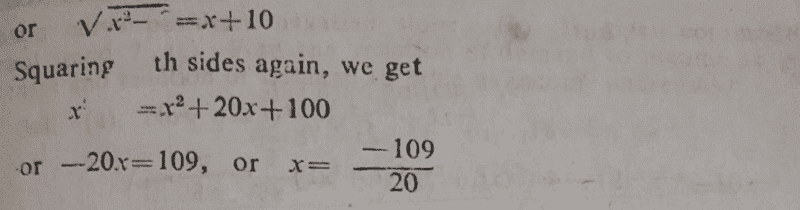
The discussion centers on solving the equation involving surds: $$\sqrt{x + 3} + \sqrt{x - 3} = 2\sqrt{x + 5}$$. Participants conclude that for real solutions, the domain must be restricted to $$x \geq 3$$, as any value less than 3 leads to complex solutions. The proposed solution $$x = -\frac{109}{20}$$ is deemed incorrect for real solutions, as it does not satisfy the original equation. The conversation emphasizes the importance of checking solutions against the original equation, particularly when squaring both sides, which can introduce extraneous solutions.

PREREQUISITES
  • Understanding of surds and square roots
  • Knowledge of real and complex numbers
  • Familiarity with algebraic manipulation and solving equations
  • Basic concepts of function domains
NEXT STEPS
  • Study the implications of squaring both sides of an equation in algebra
  • Learn about the properties of square roots and their domains
  • Explore complex numbers and their applications in solving equations
  • Investigate methods for verifying solutions to algebraic equations
USEFUL FOR

Mathematics students, educators, and anyone interested in solving equations involving surds and understanding the implications of domain restrictions in algebra.

chwala
Gold Member
Messages
2,828
Reaction score
420
Homework Statement
see attached
Relevant Equations
quadratic/cubic equations
Kindly see the questions and its mark scheme below;
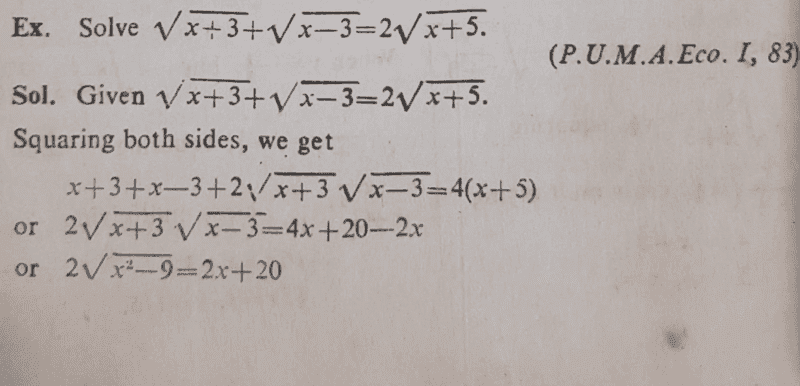
1638094995468.png

1638095029077.png


This is well understood. I was trying to look at the problem from a different perspective. (see attached below my attempt);
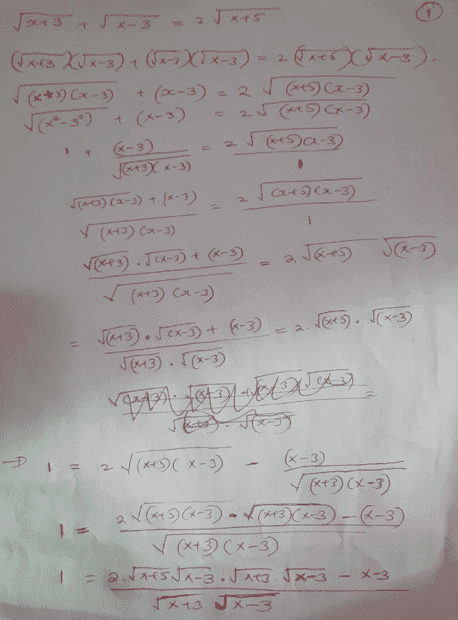
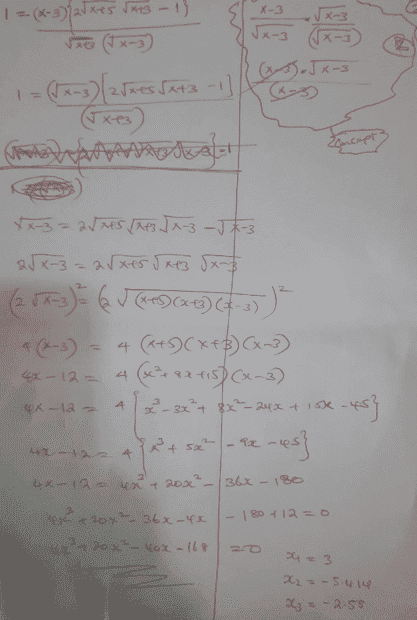
1638095130844.png


1638095234320.png

Makes any sense? cheers...

ok i can see some mistake...i will amend it later...let me amend it first then you guys can chime in later..

...I seem to be going round in circles...looks like squaring both sides would realize what we want...
 
Last edited:
Physics news on Phys.org
Assuming we are looking for real solutions, we have:
$$\sqrt{x + 3} < \sqrt {x + 5} \ \text{and} \ \sqrt{x - 3} < \sqrt {x + 5}$$ $$\sqrt {x + 3} + \sqrt {x - 3} < 2\sqrt{x + 5}$$Hence, there are no real solutions.

The proposed solution ##x = -\frac{109}{20}## leads to the equation:
$$\sqrt{-49} + \sqrt{-169} = 2\sqrt{-9}$$ Which only works if we take:
$$\sqrt{-49} = -7i, \ \sqrt{-169} = 13i, \ \sqrt{-9} = 3i$$
 
  • Like
Likes   Reactions: chwala
PeroK said:
Assuming we are looking for real solutions, we have:
$$\sqrt{x + 3} < \sqrt {x + 5} \ \text{and} \ \sqrt{x - 3} < \sqrt {x + 5}$$ $$\sqrt {x + 3} + \sqrt {x - 3} < 2\sqrt{x + 5}$$Hence, there are no real solutions.

The proposed solution ##x = -\frac{109}{20}## leads to the equation:
$$\sqrt{-49} + \sqrt{-169} = 2\sqrt{-9}$$ Which only works if we take:
$$\sqrt{-49} = -7i, \ \sqrt{-169} = 13i, \ \sqrt{-9} = 3i$$
##√(-49=±7i## & ##√(-69)=±13i##...in this case do we only consider the values that satisfy the equation, like you have rightly indicated?
 
chwala said:
##√(-49=±7i## & ##√(-69)=±13i##...in this case do we only consider the values that satisfy the equation, like you have rightly indicated?
No, square roots are uniquely defined. The solution in the book is wrong. What they showed was that IF the equation has a solution, then that solution is ##-\frac{109}{20}##. But, they didn't check that really is a solution. Note that squaring both sides of an equation gives a one-way implication, as a solution of the squared equation may not be a solution of the original equation.

If you are considering real numbers, then any solution must be ##\ge 3## in any case.

You could patch up the origin equation by changing it to:$$-\sqrt {z + 3} + \sqrt {z - 3} = 2\sqrt{z + 5}$$And then ##z = -\frac{109}{20}## is a solution.
 
  • Like
Likes   Reactions: chwala
PeroK said:
No, square roots are uniquely defined. The solution in the book is wrong. What they showed was that IF the equation has a solution, then that solution is ##-\frac{109}{20}##. But, they didn't check that really is a solution. Note that squaring both sides of an equation gives a one-way implication, as a solution of the squared equation may not be a solution of the original equation.

If you are considering real numbers, then any solution must be ##\ge 3## in any case.

You could patch up the origin equation by changing it to:$$-\sqrt {z + 3} + \sqrt {z - 3} = 2\sqrt{z + 5}$$And then ##z = -\frac{109}{20}## is a solution.
that's true, the equation can only have real roots with ##x ## being in the domain, ##x≥3##
 
chwala said:
that's true, the equation can only have real roots with ##x ## being in the domain, ##x≥3##
If the equation referred to above is
(1)##\qquad–~\sqrt {z + 3}~+ \sqrt {z - 3} = 2\sqrt {z + 5}~##
that could have only real roots ##~z = x~\geq~3~##, then why does ##~z = x = 4~\gt~3~##give for the left-hand side of (1)
##\qquad{~~~~}–~\sqrt {4 + 3}~+ \sqrt {4 - 3} = –\sqrt 7 + 1 = –2.6 + 1 = –1.6##
whereas from the right-hand side, we find
##\qquad{~~~~}2\sqrt {4 + 5} = 2\sqrt 9~= 6~\ne~–1.6##
Since the equality in (1) is not satisfied, then ##~x≥3~## does not give the roots of (1) rewritten in the form
(2)##\qquad\sqrt {z + 3}~- \sqrt {z - 3}~+ 2\sqrt {z + 5} = 0##
The only root of (2) is ##~\frac {–~109}{20}~## which has zero imaginary part so there's really no need to use a complex variable but simply write (1) as
##\qquad{~~~~}–~\sqrt {x + 3}~+ \sqrt {x - 3} = 2\sqrt {x + 5}~##.
 
I do not know whether we are talking on the same problem, Looking at the problem; Solve
##√(x+3) +√(x-3)=2√(x+5)##, then ##x## can only be defined in the domain ##x≥3##, that's what i meant. Any other value less than ##3## would realize a complex form of solution...of course if i did not get it right then do correct me...

...you slightly altered the original equation, hence use of the term 'if'
 
chwala said:
I do not know whether we are talking on the same problem ...
There's a subtlety here. If we write $$f(x) = \sqrt {x - 3}$$then this could mean one of two functions:
$$f: [3, \infty) \rightarrow \mathbb R$$Or:
$$f: \mathbb R \rightarrow \mathbb C$$Strictly speaking, therefore, we cannot allow ##x < 3## without admitting complex numbers at least implicitly. Although, it's true that we could retain the real numbers as the domain of our function.
 
  • Like
Likes   Reactions: chwala
If the problem is to find a real root of the equation
(1)##\qquad~\sqrt {x+3} + \sqrt {x-3} - 2√(x+5) = 0##
then clearly, ##~x~\geq~3##. But if the aim is to find the general root of (1), not just the real root, then obviously complex roots must be admissible..
 
  • Like
Likes   Reactions: chwala

Similar threads

  • · Replies 30 ·
2
Replies
30
Views
3K
Replies
3
Views
1K
  • · Replies 22 ·
Replies
22
Views
4K
  • · Replies 17 ·
Replies
17
Views
3K
  • · Replies 1 ·
Replies
1
Views
2K
  • · Replies 17 ·
Replies
17
Views
2K
Replies
3
Views
2K
  • · Replies 49 ·
2
Replies
49
Views
5K
  • · Replies 8 ·
Replies
8
Views
2K
  • · Replies 39 ·
2
Replies
39
Views
4K