Solve RC Circuit Problem 1: V=IR, Q=CV

Click For Summary
SUMMARY

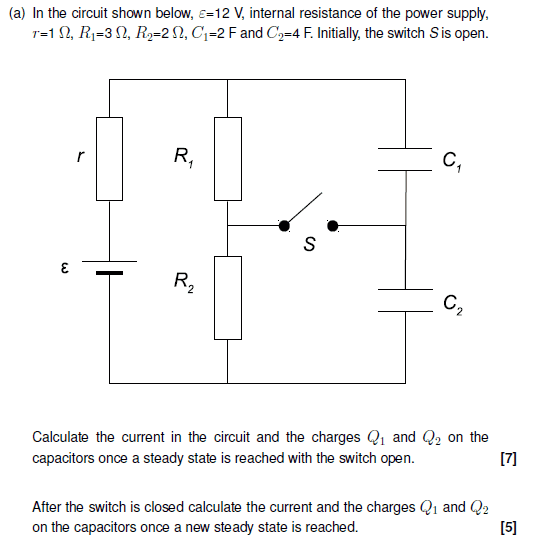
The discussion focuses on analyzing an RC circuit using the formulas V=IR and Q=CV. When the switch is open, the current is calculated as 2 A, leading to a voltage drop of 2 V across resistor r and 10 V across the capacitors. In steady state with the switch closed, while the current through the capacitors remains zero, the charges differ due to the change in configuration from series to parallel. The final charges on the capacitors are determined to be Q1 = 12 C and Q2 = 16 C based on their respective capacitances and voltages.

PREREQUISITES
  • Understanding of Ohm's Law (V=IR)
  • Knowledge of capacitor charging and discharging principles
  • Familiarity with series and parallel circuit configurations
  • Basic proficiency in calculating charge (Q=CV) and voltage across capacitors
NEXT STEPS
  • Study the behavior of capacitors in series and parallel circuits
  • Learn about transient analysis in RC circuits
  • Explore the impact of different resistor and capacitor values on circuit behavior
  • Investigate the use of simulation tools like LTspice for circuit analysis
USEFUL FOR

Electrical engineering students, circuit designers, and anyone interested in understanding RC circuit dynamics and capacitor behavior in various configurations.

subzero0137
Messages
91
Reaction score
4
1.
8JyKFKJ.png
2. V=IR, Q=CV3.
To calculate the current in the circuit in the case when the switch is open and steady state is reached, I assumed that no current will flow "across" the capacitors and so the current I will simply be emf/(r+R1+R2) = 12 V/(1+3+2) = 2 A. The voltage drop across r would be V=IR=2 A * 1 ohms = 2 V, therefore the voltage across the capacitors would be 10 V. Since C1 and C2 are in series, Q1=Q2=CV where C is the combined capacitance equal to (4/3)F and V=10V. Therefore Q1=Q2=(40/3) C. Is this correct so far?

I'm not sure how to analyze the circuit when the switch closes.
 
Physics news on Phys.org
How much current goes through C1 in steady state? What about C2? Now with the switch closed, C1 and R1 are parallel. What can you say about the voltage on components in parallel? Take a look at C2 and R2, as well.
Edit: and yes, you were on the right track for your analysis of the open switch.
 
subzero0137 said:
I'm not sure how to analyze the circuit when the switch closes.
What is the current through the capacitors in the new steady state?
 
cnh1995 said:
I don't see where scott said that.
Sorry I misread it, I deleted the post.
 
ehild said:
Sorry I misread it, I deleted the post.
I'll delete mine.
 
scottdave said:
How much current goes through C1 in steady state? What about C2? Now with the switch closed, C1 and R1 are parallel. What can you say about the voltage on components in parallel? Take a look at C2 and R2, as well.
Edit: and yes, you were on the right track for your analysis of the open switch.

Thanks for the reply. I'm not sure how much current goes through the capacitors in steady state. I thought no current can flow through the capacitors in steady state? I can see how C1 and R1 are parallel so the voltage across both will be the same. But again I thought currents can't flow through capacitors in steady state.
 
cnh1995 said:
What is the current through the capacitors in the new steady state?

Wouldn't it be zero again?
 
subzero0137 said:
Wouldn't it be zero again?
Yes.
 
cnh1995 said:
Yes.

So the answer is the same as before? Or am I missing something again?
 
  • #10
subzero0137 said:
So the answer is the same as before? Or am I missing something again?
The same currents, the same charges?
The currents are the same, zero at steady state, but the charges of the capacitors are different in both cases. When the switch was open, the capacitors were in series, having the same charge. What are the voltages across the capacitors when the switch is closed? What are the charges?
 
  • Like
Likes scottdave
  • #11
ehild said:
The same currents, the same charges?
The currents are the same, zero at steady state, but the charges of the capacitors are different in the two cases. When the switch was open, the capacitors were in series, having the same charge. What are the voltages across the capacitors when the switch is closed? What are the charges?

The voltage across C1 would be the same as the voltage across R1, and the voltage across C2 would be the same as the voltage across R2. So Q1 = 2F*6V = 12C and Q2=4F*4V=16C?
 
  • Like
Likes scottdave
  • #12
subzero0137 said:
The voltage across C1 would be the same as the voltage across R1, and the voltage across C2 would be the same as the voltage across R2. So Q1 = 2F*6V = 12C and Q2=4F*4V=16C?
Yes.
 

Similar threads

  • · Replies 4 ·
Replies
4
Views
2K
  • · Replies 3 ·
Replies
3
Views
2K
  • · Replies 15 ·
Replies
15
Views
888
  • · Replies 21 ·
Replies
21
Views
1K
  • · Replies 3 ·
Replies
3
Views
2K
  • · Replies 3 ·
Replies
3
Views
3K
  • · Replies 4 ·
Replies
4
Views
3K
  • · Replies 8 ·
Replies
8
Views
2K
  • · Replies 5 ·
Replies
5
Views
7K
Replies
2
Views
920