Solved: Spark Transmitter Circuit Connection

  • Thread starter Thread starter DemoNibs
  • Start date Start date
  • Tags Tags
    Spark Transmitter
Click For Summary

Homework Help Overview

The discussion revolves around the construction of a spark transmitter circuit, specifically focusing on the connection and function of coils labeled Lp, La, and Lr within the circuit. Participants explore the principles of mutual induction and the characteristics of transformers in this context.

Discussion Character

  • Exploratory, Conceptual clarification, Problem interpretation

Approaches and Questions Raised

  • Participants discuss the nature of the coils, questioning whether they function as transformers and how to determine their ratios. There are inquiries about the legality of operating a spark gap transmitter and sourcing components like transistors and carbon microphones.

Discussion Status

The conversation includes various interpretations of the circuit components, with some participants expressing uncertainty about the role of Lr. While one participant claims to have resolved their issue, others continue to seek clarification on the transformer ratios and the overall circuit design.

Contextual Notes

Participants mention constraints such as the availability of specific components and the complexity of understanding the circuit for those with limited experience. The discussion reflects a mix of practical concerns and theoretical exploration regarding the circuit's functionality.

DemoNibs
Messages
10
Reaction score
0
[SOLVED] Spark transmitter

1. Hello, I am making this project ( a spark transmitter and a receiver), my problem are those coils below ( Lp, La, Lr). How are they connected to the circuit.
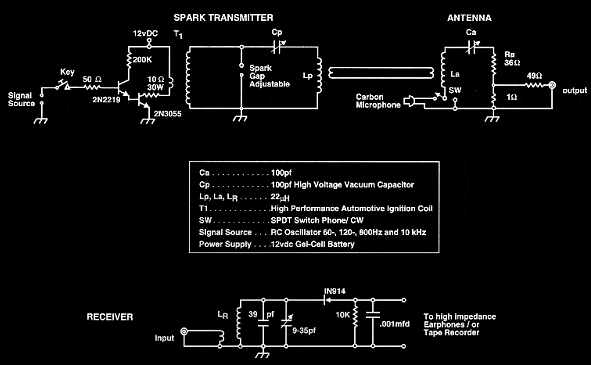
fig2.GIF


three images are attached for the detail

please help me

thanks
 

Attachments

  • here.GIF
    here.GIF
    21.6 KB · Views: 548
  • 1.GIF
    1.GIF
    2.3 KB · Views: 511
  • 2.GIF
    2.GIF
    2.2 KB · Views: 468
Physics news on Phys.org
Lp and La are most likely transformers, and it isn't a connection, rather it works on the principle of mutual induction.

I'm not really sure what is going on with L_R.

From the looks of it, this circuit will probably be relatively expensive to make. Do you have to know how it works?? That could also be hard for someone without much circuit experience. That's a strange transistor configuration, and I myself would have to work it out more.
 
Cool project! Assuming you manage to assemble this dinosaur, can you legally operate a spark gap transmitter? I suppose the frequency is low enough it's not going to interfere with anyones iPhone. Can you still get a 2N2219 transistor? And where do you get carbon microphones? Where did you find it?
 
Dick said:
Cool project! Assuming you manage to assemble this dinosaur, can you legally operate a spark gap transmitter? I suppose the frequency is low enough it's not going to interfere with anyones iPhone. Can you still get a 2N2219 transistor? And where do you get carbon microphones? Where did you find it?

The transistors aren't problem because I can buy some from the electronics store ( I already asked if they have some, they cost not even a dollar). Getting the carbon mic is not a problem too. The only problems are those coils I marked above and the 100pf high voltage capacitor, 'ALfa electronic'(store) has 100pf capacitor but low voltage. And Mindscrape, what do you think, what's the ratio between those coils if they are transformers. In the chart about those coils (La, Lp, Lr) is typed 22 microHenries ( henries is measurement for inductors and maybe transformers, but maybe). About the T1, it clearly says it's a transformer ( automotive ignition coil, it's ratio is 1:100 ).
 
what's the ratio of the transformers?
 
Sorry I didn't get back to you. I could be wrong about the La, Lp, and Lr being transformers. Lr is definitely confusing. If they are, in fact, transformers you could presumably figure out their ratios by working backwards from the definition of inductance.

Berkman might know better, he is pretty good with circuits. If you still haven't figured it out, and need help really bad I could ask some people I personally know.
 
Mindscrape, I'm so thankful for your attempts to help, anyway, I solved this problem already, and if you are interested I would upload the solution here. La, Lp, and Lr are some kind of transformers as you said, their primary and secondary windings are one above the other with a thin insulator between them and no core ( like in the Tesla coil, you should wind it by hand usually).
 

Similar threads

  • · Replies 1 ·
Replies
1
Views
3K
  • · Replies 35 ·
2
Replies
35
Views
5K
  • · Replies 6 ·
Replies
6
Views
2K
  • · Replies 1 ·
Replies
1
Views
2K
  • · Replies 19 ·
Replies
19
Views
2K
  • · Replies 18 ·
Replies
18
Views
2K
  • · Replies 10 ·
Replies
10
Views
2K
  • · Replies 0 ·
Replies
0
Views
2K
  • · Replies 10 ·
Replies
10
Views
2K
  • · Replies 14 ·
Replies
14
Views
5K