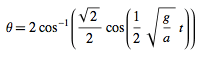
Solving a Cycloid Equation: Finding θ(t)

  • Thread starter Thread starter thomas91
  • Start date Start date
Click For Summary
SUMMARY

The discussion focuses on solving a cycloid equation for a bead sliding on a frictionless wire, represented by the equations x = a(θ - sin θ) and y = a(1 + cos θ) for θ in the range of 0 to 2π. Participants assist in transforming the variable using u = cos(θ/2) to derive a linear equation for u(t) and subsequently find θ(t) under initial conditions. The final solution for the oscillation period is established as T = 4π√(a/g), confirming the relationship between the parameters involved.

PREREQUISITES
  • Understanding of differential equations and their solutions
  • Familiarity with cycloid geometry and its equations
  • Knowledge of variable substitution techniques in calculus
  • Basic physics concepts, particularly those related to motion and oscillation
NEXT STEPS
  • Study the derivation of solutions for second-order differential equations
  • Learn about the properties of cycloids and their applications in physics
  • Explore variable substitution methods in calculus for solving complex equations
  • Investigate the principles of oscillation and period calculation in mechanical systems
USEFUL FOR

Students of physics and mathematics, particularly those studying mechanics, differential equations, and oscillatory motion, will benefit from this discussion.

  • #31
Orodruin said:
Yes.So now you can insert this into your solution and solve for theta to get ...?

Sorry but... If I know
proxy.php?image=http%3A%2F%2Fi.imgur.com%2FhrPNb6A.png
and I know B = 0. What I need to get?
 
Physics news on Phys.org
  • #32
You still need to solve for ##\theta(t)##. Your solution was for \cos(\theta)##...
 
  • #33
Orodruin said:
You still need to solve for ##\theta(t)##. Your solution was for \cos(\theta)##...

Then...
dfgslvm.png

zQqZrRb.png
PHmdjzD.png

5OxTaE5.png


Is correct? Thanks!
 
  • #34
No, theta is a function of time.
 
  • #35
Then... Recapitulating
2nd condition = > θ' = 0 and t = 0 (rest position)
So I obtained B setting θ' (t = 0) = 0; so B = 0

And now, knowing A and B I have the solution for cos(θ/2)
 
  • #36
thomas91 said:
And now, knowing A and B I have the solution for cos(θ/2)
So theta becomes ...?
 
  • #37
Hello!

¿
vz0R0jK.png
?

Thanks!
 
  • #38
thomas91 said:
Hello!

¿
vz0R0jK.png
?

Thanks!
There we go!
 
  • #39
Finally! How can I calculate the oscillation period of the bean?
 
  • #40
How long does it take until it returns to the original position?
 
  • #41
It will be
WLpKf4Q.png
?

Simplified:
6vODwyt.png


Thanks!
 
  • #42
Bingo!

Or even simpler
$$
T= 4\pi \sqrt{\frac{a}{g}}
$$
 
  • #43
Thanks for everything Orodruin! Have a nice day :D
 

Similar threads

  • · Replies 29 ·
Replies
29
Views
2K
  • · Replies 26 ·
Replies
26
Views
3K
  • · Replies 3 ·
Replies
3
Views
2K
  • · Replies 2 ·
Replies
2
Views
2K
  • · Replies 3 ·
Replies
3
Views
2K
  • · Replies 4 ·
Replies
4
Views
3K
Replies
4
Views
3K
  • · Replies 4 ·
Replies
4
Views
1K
Replies
6
Views
4K
  • · Replies 2 ·
Replies
2
Views
2K