High School What Happens When You Connect Different Voltage Batteries in Parallel?

Click For Summary
SUMMARY

The discussion centers on the implications of connecting a 6V cell and a 4V cell with negligible internal resistance in parallel, highlighting the contradictions that arise when applying Kirchhoff's Voltage Law (KVL). Participants agree that such a scenario leads to self-contradictory results, emphasizing that valid circuit analysis cannot yield infinite voltages or currents. The necessity of specifying internal resistances for real-world components is underscored, as ideal circuit analysis often fails to account for practical limitations. The conversation concludes that idealized models can lead to nonsensical conclusions if not properly contextualized.

PREREQUISITES
  • Understanding of Kirchhoff's Voltage Law (KVL)
  • Familiarity with ideal voltage sources and their limitations
  • Knowledge of circuit analysis and lumped element models
  • Basic concepts of electrical components, including resistors and batteries
NEXT STEPS
  • Study the implications of internal resistance in batteries
  • Learn about the limitations of ideal circuit components in practical applications
  • Explore network theory and its paradoxes, particularly regarding voltage and current sources
  • Investigate real-world circuit modeling techniques and their accuracy
USEFUL FOR

Electrical engineers, physics students, and anyone interested in circuit analysis and the practical applications of electrical theory will benefit from this discussion.

Amaterasu21
Messages
64
Reaction score
17
Hi all,
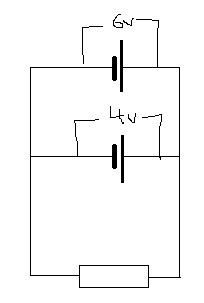
I've been thinking about a hypothetical circuit with (say) a 6V cell of negligible internal resistance, a 4V cell of negligible internal resistance, and a resistor in parallel with each other, and I can't figure out what the potential difference across the resistor would be. I've tried to apply Kirchoff's voltage rule about the emfs and p.d.s around a closed loop, but I can't see how to apply it without contradictory answers. Any help?
1645042666311.png
 
Physics news on Phys.org
The circuit theory assumptions have to break down for this circuit, for if the wires are truly resistance-free then KVL applied around the upper loop implies ##6-4 = 0##. There must be some impedance lumped with the cells (be it in the wires or the cells themselves).
 
  • Like
Likes Nugatory and DaveE
Amaterasu21 said:
I can't see how to apply it without contradictory answers.
That is correct. It is a self contradictory scenario and therefore all you can get is contradictory answers.
 
You can conceive of several other contradictions leading to seeming paradoxes.

For example, a short circuit across an ideal voltage source. Or an open circuited ideal current source.

They can all be resolved by remembering that valid circuit analysis should never result in infinite voltage or infinite currents. If your scenario leads to such an infinity, then circuit analysis rules do not apply.
 
Amaterasu21 said:
... a 6V cell of negligible internal resistance, a 4V cell of negligible internal resistance, and a resistor in parallel with each other, ...
That circuit definition contains a KVL contradiction.
You must specify the internal resistance of both cells before solving the circuit.
 
An important point to remember here is that Kirchoff's Voltage and Current laws are only applicable for circuit analysis. Circuit analysis is a highly abstract method of modelling the real world using ideal components. These are generally restricted to resistors, capacitors, inductors, voltage sources, and current sources (there are a few others that you rarely see). These aren't the same as real voltage sources, inductors, etc. Think of it as a graphical version of simple mathematical equations. One consequence of this is that you can construct circuits that don't make sense. Like a 4V battery in parallel with a 6V battery. This is equivalent to the algebraic problem x=4 and x=6, find the value of x.

So, for real world electrical components we will use these simple ideal circuit elements to model the real component as a small network. For example, batteries may be shown as a voltage source with one (or more) resistors. How you choose to model your components allows you to decide how accurate (and difficult) your solutions are.

There are a lot of really well educated people that don't understand this. Including a rather famous MIT physics professor. It's not that they don't know physics, it's that they don't know how EEs talk about network analysis with "lumped element" models (also, they may not know about the problems with voltage and/or current probes in the lab).

If you study network theory, you'll learn of two subtle, but impossible scenarios*. The first is any circuit loop that includes only voltage sources and/or capacitors. The second is any circuit node that only has current sources and/or inductors connected to it. Your network has the former.

* There is a trivial solution where all of the initial conditions match perfectly.
 
In sci-fi when an author is talking about space travellers or describing the movement of galaxies they will say something like “movement in space only means anything in relation to another object”. Examples of this would be, a space ship moving away from earth at 100 km/s, or 2 galaxies moving towards each other at one light year per century. I think it would make it easier to describe movement in space if we had three axis that we all agree on and we used 0 km/s relative to the speed of...

Similar threads

Replies
7
Views
4K
  • · Replies 19 ·
Replies
19
Views
3K
  • · Replies 19 ·
Replies
19
Views
3K
Replies
7
Views
1K
  • · Replies 3 ·
Replies
3
Views
2K
  • · Replies 10 ·
Replies
10
Views
2K
Replies
4
Views
2K
  • · Replies 17 ·
Replies
17
Views
3K
Replies
2
Views
2K
  • · Replies 2 ·
Replies
2
Views
2K