Solving an Equation: Overcoming the r's

  • Context: Graduate 
  • Thread starter Thread starter mhirschb
  • Start date Start date
Join the discussion
Registration is free. Ask a follow-up in this thread, or start your own.
2 replies · 3K views
mhirschb
Messages
3
Reaction score
0
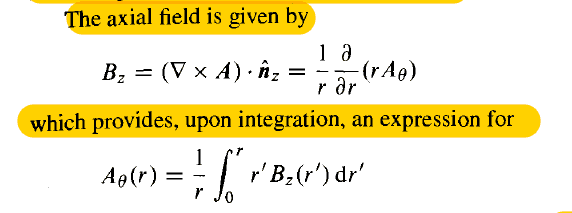
I feel silly but I've been looking at this equation for a while and I don't fully understand the individual steps taken to go from the top line to the bottom line:
MVP theta component.png


I think I am getting caught up with all the r's in the equation. I recognize that on the second line "r" describes the point at which we are evaluating the MVP, and r' is the domain of r that we're integrating over.
I'm confused because it looks like they've taken the 1/r and changed it to r' on the other side.
 
Physics news on Phys.org
The first equation obtains [itex]B_z[/itex] from [itex]A_\theta[/itex] bythe following steps:
  • Multiply by [itex]r[/itex].
  • Differentiate with respect to [itex]r[/itex].
  • Divide by [itex]r[/itex].

Therefore [itex]A_\theta[/itex] is obtained from [itex]B_z[/itex] by reversing these steps:
  • Multiply by [itex]r[/itex].
  • Integrate with respect to [itex]r[/itex]. This is done as a definite integral with lower limit 0, because any other choice of lower limit would make [itex]A_\theta[/itex] potentially infinite at [itex]r = 0[/itex]. This definite integration requires the introduction of [itex]r'[/itex] as a dummy variable of integration, because it is bad practise to use [itex]r[/itex] as both a limit of the integral and the dummy variable of integration.
  • Divide by [itex]r[/itex].
 
Reply
  • Like
Likes   Reactions: mhirschb
pasmith said:
The first equation obtains [itex]B_z[/itex] from [itex]A_\theta[/itex] bythe following steps:
  • Multiply by [itex]r[/itex].
  • Differentiate with respect to [itex]r[/itex].
  • Divide by [itex]r[/itex].

Therefore [itex]A_\theta[/itex] is obtained from [itex]B_z[/itex] by reversing these steps:
  • Multiply by [itex]r[/itex].
  • Integrate with respect to [itex]r[/itex]. This is done as a definite integral with lower limit 0, because any other choice of lower limit would make [itex]A_\theta[/itex] potentially infinite at [itex]r = 0[/itex]. This definite integration requires the introduction of [itex]r'[/itex] as a dummy variable of integration, because it is bad practise to use [itex]r[/itex] as both a limit of the integral and the dummy variable of integration.
  • Divide by [itex]r[/itex].
Ah! It makes so much sense now I wanna facepalm!

Thank you for the explanation. It became clear when I needed to introduce the dummy variable r'.