Solving an ODE with the Laplace transform

Click For Summary
The discussion focuses on solving the second-order ordinary differential equation y''(t) + 2y'(t) + 10y(t) = 0 with the initial condition y(0⁻) = 4 using the Laplace transform. Participants highlight the importance of having two initial conditions for such equations and identify errors in completing the square and applying the Laplace transform. The correct transformation yields Y(s) = (4s + 8) / (s² + 2s + 10), and discrepancies between methods are addressed. Additionally, the concept of poles and zeros in transfer functions is explored, with a conclusion that the transfer function has a zero at infinity.
PainterGuy
Messages
938
Reaction score
73
Moved from a technical forum, so homework template missing
Hi again,

The previous problem was done using y′′(t)+2y′(t)+10y(t)=10 with with intial condition y(0⁻)=0.

In the following case, I'm using an initial condition and setting the right hand side equal to zero.

Find y(t) for the following differential equation with intial condition y(0⁻)=4.
y′′(t)+2y′(t)+10y(t)=0

Using the following formulas.
ℒy(t)=Y(s)
ℒ{y′(t)}=sY(s)-f(0⁻)=sY(s)-4
ℒ{y′′(t)}=ℒ{(sY(s)-4)′}=ℒ{(sY(s)′-4′)}=ℒ{(sY(s)′)}=s²Y(s)-4s

y′′(t)+2y′(t)+10y(t)=0
⇒{s²Y(s)-4s}+2{sY(s)-4}+10Y(s)=0
⇒s²Y(s)-4s+2sY(s)-8+10Y(s)=0
⇒s²Y(s)+2sY(s)+10Y(s)-4s-8=0
⇒s²Y(s)+2sY(s)+10Y(s)=4s+8
⇒Y(s){s²+2s+10}=4s+8
⇒Y(s) = (4s+8) / (s²+2s+10)

Now finding the inverse Laplace transform.

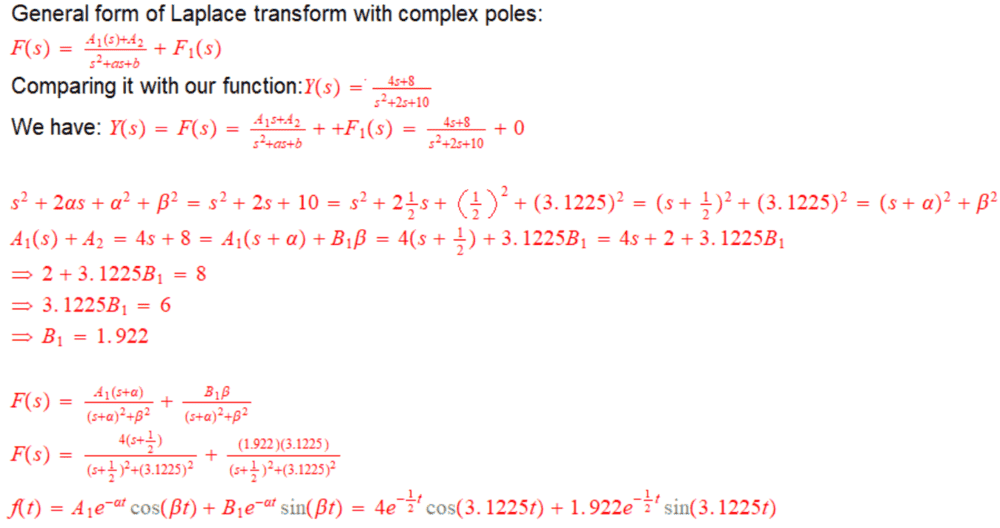
Method 1:
https://www.physicsforums.com/attac...261154/?hash=ab39a4f0474f3384a6a5c37cdc441e05
1587534843424.png


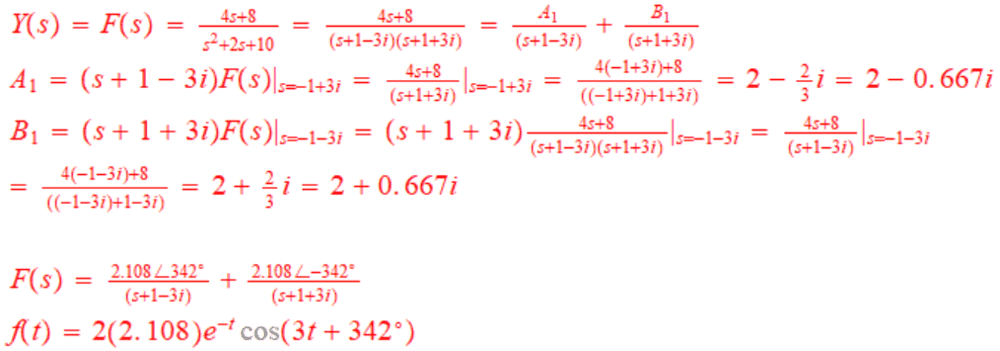
Method 2:

This method I found from this video.
1587534952010.png
1587534990407.png


Question:

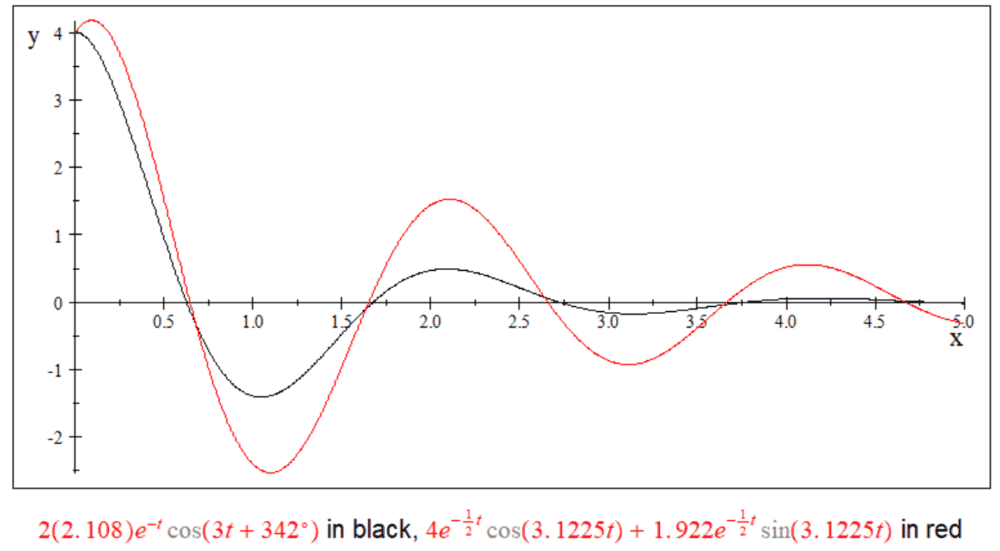
You can see that I'm getting different functions, f(t), for the mentioned methods. Where am I going wrong? Which f(t) is correct? Thank you for the help.
 

Attachments

  • sadiku_laplace_1.jpg
    sadiku_laplace_1.jpg
    87.8 KB · Views: 396
Physics news on Phys.org
For a 2nd-order DE, you need two initial conditions, typically f(0) and f'(0).
This formula from above isn't correct:
ℒ{y′′(t)}=ℒ{(sY(s)-4)′}=ℒ{(sY(s)′-4′)}=ℒ{(sY(s)′)}=s²Y(s)-4s

See #36 in this table: http://tutorial.math.lamar.edu/pdf/Laplace_Table.pdf
 
  • Like
Likes PainterGuy
In your first attempt, you complete the square incorrectly: ##s^2+2s+10 = (s+1)^2+9##.
 
  • Like
Likes PainterGuy
Mark44 said:
For a 2nd-order DE, you need two initial conditions, typically f(0) and f'(0).
This formula from above isn't correct:

Thank you. Yes, sorry, I didn't realize it at that time.

The previous problem was done using y′′(t)+2y′(t)+10y(t)=10 with with intial condition y(0⁻)=0. If y(t) represents displacement then its first derivative would be velocity function, v(t). As an initial condition it is assumed that y'(0⁻)=v(0⁻)=0. Now we have two initial conditions, i.e. two pieces of information about the system just a moment before it's analytically observed.

1587593819767.png


vela said:
In your first attempt, you complete the square incorrectly: ##s^2+2s+10 = (s+1)^2+9##.

I have corrected Method 1 below. Now the results from both Methods agree. But I have a related question which is below the plot.

1587594029421.png


1587594066709.png


Question:
Apparently I completed the square wrongly but overall my completed square agrees with the original expression s²+2s+10. So, does completing a square method require that no fractions or decimals should be used, or what else is wrong with my method? Please guide me.

s²+2αs+α²+β²=s²+2s+10=s²+2(1/2)s+(1/2)²+(3.1225)²={s+(1/2)}²+3.1225²=(s+α)²+β²
 
PainterGuy said:
s²+2(1/2)s+(1/2)²+(3.1225)²
Without assuming what the answer is, try simplifying that expression. I guarantee you do not get what you started with.
 
  • Like
Likes PainterGuy
Let's try it: s²+2(1/2)s+(1/2)²+(3.1225)² =s²+(2/2)s+(1/4)+9.750=s²+s+0.25+9.750=s²+s+10

original expression: s²+2s+10

s²+2s+10 ≠ s²+s+10

Sorry! :sorry:
 
  • Like
Likes vela
Hi,

I read somewhere that for a transfer function, the number of poles (roots of denominator) and zeros (roots of numerator) is equal. The transfer function from post #1, Y(s)=(4s+8) / (s²+2s+10), has poles at -1±3i and a zero at -2. Where is the second zero located? Thank you for the help!
 
Could someone please comment on my previous post?
 
Original expression: Y(s)=(4s+8) / (s²+2s+10)

I think we could divide both numerator and denominator by "s²".

(1/s²)(4s+8) / (1/s²)(s²+2s+10) = (4/s+8/s²) / (1+2/s+10/s²)

As s→∞ (4/s+8/s²) / (1+2/s+10/s²) = 0/1 = 0

I think it gives us a zero at infinity.
 

Similar threads

Replies
2
Views
2K
  • · Replies 7 ·
Replies
7
Views
2K
  • · Replies 8 ·
Replies
8
Views
1K
  • · Replies 14 ·
Replies
14
Views
3K
  • · Replies 1 ·
Replies
1
Views
1K
Replies
9
Views
2K
  • · Replies 4 ·
Replies
4
Views
2K
  • · Replies 4 ·
Replies
4
Views
3K
  • · Replies 10 ·
Replies
10
Views
2K
  • · Replies 4 ·
Replies
4
Views
3K