Solving CycloHexane Isomerism: Find Total # Possible Isomers

Click For Summary

Discussion Overview

The discussion revolves around determining the total number of possible isomers for the molecular formula C6H12 that includes a cyclobutane ring. The focus is on the identification of isomers, including considerations of optical and geometrical isomerism.

Discussion Character

  • Debate/contested

Main Points Raised

  • One participant initially claims there are 8 isomers based on their calculations involving optical and geometrical isomerism in various compounds.
  • Another participant questions the count for Compound 3, suggesting that it should have three isomers instead of four due to the symmetry of the cis form negating optical isomerism.
  • A subsequent reply agrees with the revised count for Compound 3, supporting the idea that it should be counted as three isomers.
  • There is a mention of a discrepancy with a book stating there are only 7 isomers, prompting the request for verification.

Areas of Agreement / Disagreement

Participants express disagreement regarding the count of isomers for Compound 3, with some suggesting it should be three instead of four. The overall total number of isomers remains unresolved, as the initial claim of 8 is contested but not definitively settled.

Contextual Notes

The discussion highlights potential limitations in the initial assumptions regarding isomer counts, particularly concerning the treatment of optical and geometrical isomerism in Compound 3.

phoenixXL
Messages
49
Reaction score
4
Question
Find out the total number of possible isomers with molecular formula C6H12 that contain a cyclobutane ring.

Attempted Solution
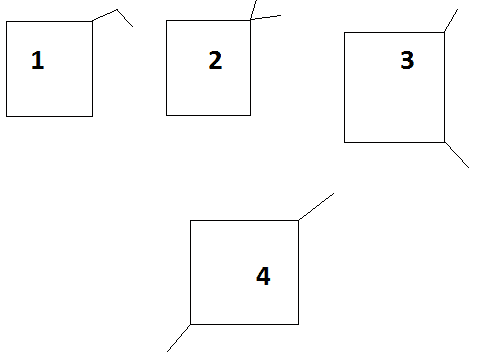
Untitled.png

In Compound 3, Optical Isomerism is possible (geometrical isomerism is also possible but is neglected due to presence of optical isomerism) about both the branches, hence it will be counted as 4 isomers

In Compound 4, Geometrical Isomerism is possible about the two branches, therefore it will be counted as 2 isomers

Counting All
: 1 + 1 + 4 + 2 = 8

Hence there are 8 isomers possible

Problem
The book where I found this question says that it consists only of 7 isomers.

Please help me out. Thanks for your time.
 
Chemistry news on Phys.org
Check 3rd.
 
Yes, I was suspecting the argument with compound 3.

Please Verify
Compound 3 will have cis & trans forms. The cis form due to symmetry would not have optical isomers whereas the trans form would have optical isomers. As a result there would be three isomers (rather than 4).
 
Yes, 3 not 4.
 
thank you for your time :)
 

Similar threads

  • · Replies 4 ·
Replies
4
Views
2K
  • · Replies 8 ·
Replies
8
Views
3K
  • · Replies 3 ·
Replies
3
Views
5K
Replies
2
Views
2K
  • · Replies 1 ·
Replies
1
Views
6K
  • · Replies 31 ·
2
Replies
31
Views
5K
  • · Replies 9 ·
Replies
9
Views
3K
  • · Replies 2 ·
Replies
2
Views
2K
  • · Replies 5 ·
Replies
5
Views
2K
Replies
1
Views
2K