Solving Diode Bridge Current with AC-to-DC Circuit

  • Thread starter Thread starter apc3161
  • Start date Start date
  • Tags Tags
    Bridge Diode
Click For Summary

Discussion Overview

The discussion revolves around calculating the current through each phase of a diode bridge circuit used for converting AC to DC, particularly in the context of a generator powered by an AC motor. Participants explore the relationship between the output DC current and the phase currents in a 3-phase system.

Discussion Character

  • Technical explanation
  • Mathematical reasoning
  • Debate/contested

Main Points Raised

  • One participant questions how to determine the current through each phase given a specific DC current, suggesting an initial assumption of 0.33 A_rms per phase for a 1 A DC output.
  • Another participant challenges the output voltage claim, stating it cannot be 5VDC unless the AC source is a transformer with a specific peak voltage.
  • Clarifications are made regarding the source of power being an AC motor acting as a generator, which produces the observed 5 VDC output.
  • Participants discuss using Ohm's law to relate the load current to the current supplied by the windings, noting that only one phase supplies current at any given moment in a 3-phase system.
  • There is a suggestion that during operation, two phases do not supply current while one phase provides the entire load current, leading to a discussion about current sinking and sourcing behavior in a sinusoidal waveform.
  • A participant proposes that over a cycle, a single phase experiences an average of 2/3 of the DC amperage, based on the observed behavior of the phases during operation.
  • Another participant mentions the possibility of using simulation software (like SPICE) for further analysis of the circuit behavior.

Areas of Agreement / Disagreement

Participants express differing views on the specifics of current distribution among the phases, with some suggesting that only one phase supplies current at a time while others discuss the oscillating nature of current flow. The discussion remains unresolved regarding the exact current values and their implications.

Contextual Notes

There are assumptions about the nature of the load and the characteristics of the AC source that are not fully detailed, which may affect the calculations and conclusions drawn by participants.

apc3161
Messages
20
Reaction score
0
Hello,

I made a circuit to convert AC to DC. It looks like this.

http://openbookproject.net/electricCircuits/Semi/03267.png

My output DC voltage is around 5 volts. Could someone please explain to me how I could figure out the current running through each of the phases at a given time given a certain DC current (For example let's say 1 A DC)?

I'm tempted to say that each phase would have 0.33 A_rms going through it (assuming 1 A DC), but I'm not sure if that is right.

An equation or any help would be most helpful. Thanks

-edit, I've also though that, given the following picture, maybe only 1 phase at any given time has current going through it, and it it is equal to the DC current. This seems like a better solution, but I'm not sure.
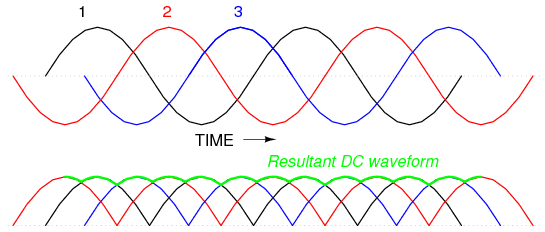
03269.png
 
Last edited by a moderator:
Engineering news on Phys.org
Yeah, your output is not going to be 5VDC, unless that 3-phase AC source is actually a transformer or 3 (plugged into your 3-phase mains) with a 5.6 Vpk.
 
MATLABdude said:
Yeah, your output is not going to be 5VDC, unless that 3-phase AC source is actually a transformer with a 5.6 Vpk.

Oh sorry, our power is coming from an AC motor being run as a generator, not from the wall. During tests we were getting 5 VDC from our circuit. Basically, I know the thermal current that the motor windings can handle, which is why I want to figure out how much current is going through each phase, so I can determine how much load I can put across the generator without frying it.
 
apc3161 said:
Oh sorry, our power is coming from an AC motor being run as a generator, not from the wall. During tests we were getting 5 VDC from our circuit. Basically, I know the thermal current that the motor windings can handle, which is why I want to figure out how much current is going through each phase, so I can determine how much load I can put across the generator without frying it.

Ah, well that being the case, you can use Ohm's law, as you suggest and find the current going through your load, which will be the same as the current supplied by each of the windings at their peak output. Remember that in a 3-phase supply, only one leg / phase primarily supplies the current at any given moment. That being said, in your example, each phase would be supplying approximately 1A at its peak. Remember that Vpk = sqrt(2) * Vrms.

If you *don't* have a simple resistive load, I'd suggest hooking the device up to your bench power supply (set at 5VDC) and seeing how much current it draws as a maximum and/or on average (which number is more important depends on how often the maxima occur, and how high they get).

EDIT: There's probably a formula you can find in any circuit analysis textbook relating I_pk supplied to the load to the I_pk supplied by any given phase, but using V_pk supplied should give you a pretty close number.
 
Last edited:
MATLABdude said:
Ah, well that being the case, you can use Ohm's law, as you suggest and find the current going through your load, which will be the same as the current supplied by each of the windings at their peak output. Remember that in a 3-phase supply, only one leg / phase primarily supplies the current at any given moment.

If you *don't* have a simple resistive load, I'd suggest hooking the device up to your bench power supply (set at 5VDC) and seeing how much current it draws as a maximum and/or on average (which number is more important depends on how often the maxima occur, and how high they get).

Ok, so more or less the current going through any 1 phase at a given time is either 0 or the current being pulled from DC. At any given time, 2 phases are supplying no current while the other is supplying all the current. Is that correct for the most part?
 
apc3161 said:
Ok, so more or less the current going through any 1 phase at a given time is either 0 or the current being pulled from DC. At any given time, 2 phases are supplying no current while the other is supplying all the current. Is that correct for the most part?

At peak, the other coils are sinking current (as your circuit is drawn, current has to flow in loops!) But since it's a sinusoid, each phase oscillates between supplying most of the current, and sinking most of the current, and in a continuous fashion (i.e. not supplying all the current half the time, and then sinking all the current the other half).
 
MATLABdude said:
At peak, the other coils are sinking current (as your circuit is drawn, current has to flow in loops!) But since it's a sinusoid, each phase oscillates between supplying most of the current, and sinking most of the current, and in a continuous fashion (i.e. not supplying all the current half the time, and then sinking all the current the other half).

great thanks! Ok, so basically by looking at the 2nd graph I provided, it seems that when one phase is supplying all the current, the other two are sinking about half of that current. So for 1/3 of the time, any phase is sourcing all the current, and for the other 2/3 of the time, it is sinking half the current. If you average that over an entire cycle, a single phase see 2/3 of the DC amperage going through it I think.
 
Last edited:
apc3161 said:
great thanks! Ok, so basically by looking at the 2nd graph I provided, it seems that when one phase is supplying all the current, the other two are sinking about half of that current. So for 1/3 of the time, any phase is sourcing all the current, and for the other 2/3 of the time, it is sinking half the current. If you average that over an entire cycle, a single phase see 2/3 of the DC amperage going through it I think.

Something like that. You could just use all the DC current as a worst-case maximum, and/or to give yourself some margin. (You just need to put a less than, or greater than sign in front of whatever answer you get in the end, as appropriate)
 
This is a great thing you can do on spice :)
 

Similar threads

  • · Replies 39 ·
2
Replies
39
Views
5K
  • · Replies 10 ·
Replies
10
Views
4K
Replies
13
Views
3K
Replies
21
Views
2K
  • · Replies 2 ·
Replies
2
Views
2K
  • · Replies 6 ·
Replies
6
Views
3K
Replies
1
Views
2K
  • · Replies 7 ·
Replies
7
Views
4K
  • · Replies 15 ·
Replies
15
Views
2K
  • · Replies 9 ·
Replies
9
Views
4K