Bridge Rectifiers: How Do They Work?

Click For Summary

Discussion Overview

The discussion revolves around the operation of full-wave bridge rectifiers, focusing on the interpretation of a circuit diagram and the functionality of the rectifier when connected to an AC power source. Participants explore theoretical concepts, practical applications, and clarify misunderstandings related to circuit behavior.

Discussion Character

  • Exploratory
  • Technical explanation
  • Conceptual clarification
  • Debate/contested
  • Homework-related

Main Points Raised

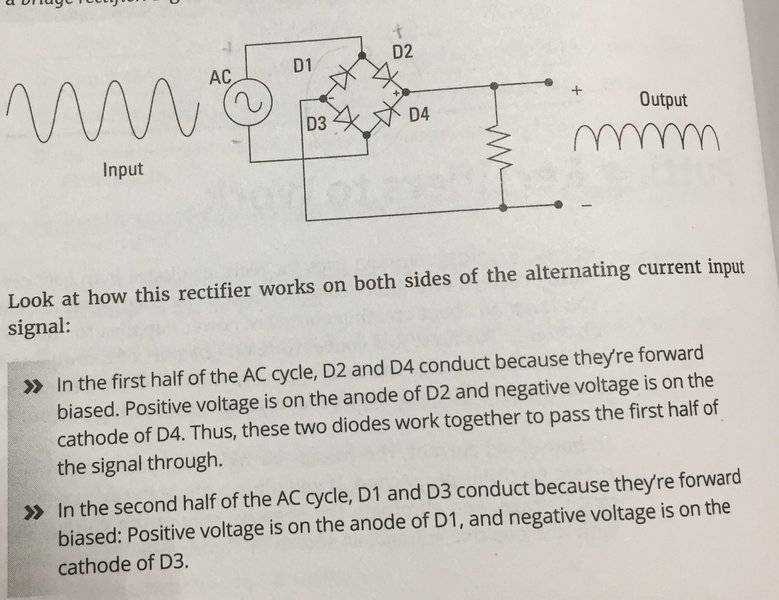
  • One participant questions the labeling of diodes in the circuit diagram, suggesting that D2 and D3 should be forward biased during the up cycle, while D1 and D4 should be forward biased during the down cycle.
  • Another participant agrees with the initial query and suggests that the book's diagram is confusing, proposing that the labels for D3 and D4 need to be swapped for clarity.
  • A participant expresses confusion about how current flows in the absence of a load, questioning the completeness of the circuit without a resistor connecting the outputs.
  • One participant uses an analogy comparing current flow to water flow to explain the concept of current needing a path to return to the source.
  • Another participant confirms that without a load, the circuit is indeed incomplete, reiterating that the participant has grasped the concepts discussed.

Areas of Agreement / Disagreement

Participants generally agree on the confusion surrounding the circuit diagram and the need for clarity regarding the labeling of diodes. However, there remains uncertainty about the implications of having no load in the circuit and how that affects current flow.

Contextual Notes

There are limitations in the discussion regarding the assumptions made about current flow and circuit completion, as well as the potential for miscommunication in the diagram's representation. The discussion does not resolve these uncertainties.

Who May Find This Useful

This discussion may be useful for individuals learning about electronics, particularly those interested in understanding bridge rectifiers and the practical implications of circuit design and operation.

Alex Hughes
Messages
54
Reaction score
13
Ok so I've been reading a book on electronics and I got to a section that talks about full-wave bridge rectifiers. This is the diagram the author gives:
IMG_0119 (2).jpg

In this diagram he says the D2 and D4 diode are forward biased. But, doesn't the current flow through D2, goes through the resistor, and then flows through D3 meaning that D2 and D3 are the ones that are foward bias in the up cycle and D1 and D4 are forward bias in the down cycle? Is this a typo or am I just misinterpreting the diagram.

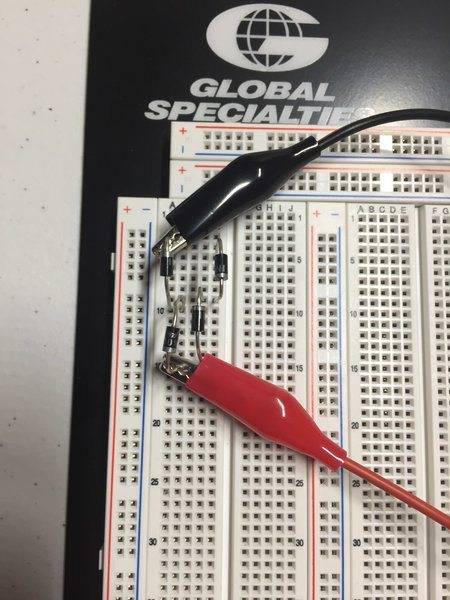
My next question was for when I actually built the bridge rectifier on a breadboard. I used a 9v AC power adapter and it works. I used my multimeter and got an accurate DC reading so I'm confident I hooked the circuit up correctly. I'm just confused on how it works. Here is the circuit:
Breadboard_diagram.jpg

The circuit uses 4 diodes. The two alligator clips you see are attached to the leads of my 9v AC power adapter. To me it seems that when the positive current goes through the red alligator clip, it can't go through the diode which has its cathode (silver stripe) connected to B15 since it's reverse bias, instead it can only travel through the diode next to it, the one with its anode at D15. However, once it travels through it I see no place for the current to go. The diode whose cathode is connected to E9 is reverse bias, and the diode next to it is on a different row (cathode connected to A10 not A9). How does this bridge rectifier work? Can somebody please explain it to me I'm very confused. Thanks.
 

Attachments

  • IMG_0119 (2).jpg
    IMG_0119 (2).jpg
    57 KB · Views: 1,073
  • Breadboard_diagram.jpg
    Breadboard_diagram.jpg
    49.7 KB · Views: 1,271
Last edited:
Engineering news on Phys.org
You are right.
Row 9 is the Positive, or +, output of the bridge.
Row 10 is the Negative, or -, output of the bridge.

The load (the resistor in the book) would connect from Row 9 to Row 10.

The book got it rather confused. The person writing the text and the person drawing the diagram didn't talk to each other and the editor didn't catch it.
In the drawing, you need to swap the D3 and D4 labels, then it all works out.
(The writer probably labeled the diodes going clockwise around the circuit, while the draftsman automatically considered the labelling as text and started a new line for the lower diodes.)

By the way, what book and what author is that. We like to be aware of such things so we can pay close attention to those publications in future questions. (when we remember!)

Cheers,
Tom
 
  • Like
Likes   Reactions: jim hardy, Averagesupernova, anorlunda and 1 other person
Tom.G said:
You are right.
Row 9 is the Positive, or +, output of the bridge.
Row 10 is the Negative, or -, output of the bridge.

The load (the resistor in the book) would connect from Row 9 to Row 10.

The book got it rather confused. The person writing the text and the person drawing the diagram didn't talk to each other and the editor didn't catch it.
In the drawing, you need to swap the D3 and D4 labels, then it all works out.
(The writer probably labeled the diodes going clockwise around the circuit, while the draftsman automatically considered the labelling as text and started a new line for the lower diodes.)

By the way, what book and what author is that. We like to be aware of such things so we can pay close attention to those publications in future questions. (when we remember!)

Cheers,
Tom
Thanks a bunch Tom, that helped a lot. But, if the circuit doesn't have a load (such as a resistor connecting row 9 to row 10, then how does the current get back to the AC source. Doesn't current have to get back to the source in order to complete the circuit? In the diagram the book gave, if you removed the resistor that connected the positive and negative end of the bridge, it would be an incomplete circuit would it not? How does this differ than the circuit I created on my breadboard.
 
Also, the book I'm reading is Electronics for Dummies by Doug Lowe
 
Alex Hughes said:
if the circuit doesn't have a load (such as a resistor connecting row 9 to row 10, then how does the current get back to the AC source.
Without a load there is no current leaving the circuit, so there is none to get back to the circuit.

Here is a not-very-good description, but it often helps when first trying to get your brain wrapped around the initial concepts. If you turn off a water faucet no water comes out so there is no water to go down the drain to be recycled. There is still pressure in the pipe though (similar to voltage in the circuit). As you get deeper into Electronics and Physics you will get much more detailed, and sometimes confusing, approaches to "what is really happenning."

Enjoy the journey!
Tom
 
  • Like
Likes   Reactions: jim hardy and Alex Hughes
Alex Hughes said:
In the diagram the book gave, if you removed the resistor that connected the positive and negative end of the bridge, it would be an incomplete circuit would it not?
Yes it would be an incomplete, aka "open" , circuit.

Alex Hughes said:
How does this differ than the circuit I created on my breadboard.
It doesn't. You appear to have grasped the concepts .

Keep up the good work !
 
  • Like
Likes   Reactions: Alex Hughes

Similar threads

  • · Replies 10 ·
Replies
10
Views
5K
  • · Replies 7 ·
Replies
7
Views
2K
  • · Replies 8 ·
Replies
8
Views
2K
  • · Replies 15 ·
Replies
15
Views
2K
  • · Replies 37 ·
2
Replies
37
Views
8K
  • · Replies 21 ·
Replies
21
Views
7K
Replies
11
Views
2K
Replies
12
Views
3K
  • · Replies 15 ·
Replies
15
Views
3K
  • · Replies 9 ·
Replies
9
Views
5K