billybomb
- 9
- 0
Ok, I'm doing Mechanical Engineering so my assumption was to post in here?
I'm doing a dynamics module and revising for an up and coming exam. One of the 'revision' questions doesn't have the answer to work through, and typically I am finding it very difficult to get my head around it.
The question:
The two uniform thin discs shown in the figure below rest on a horizontal plane
and are connected through frictionless pin-joints at A and B by a rigid rod AB of
negligible mass which remains horizontal. The mass of disc A is 15 kg and that of
disc B is 25 kg. The static coefficients of friction between the plane and disc A and
B are 0.2 and 0.55, respectively, and the dynamic coefficients of friction are 0.15
and 0.45, respectively. At the instant shown, a counter-clockwise moment
T = 125 Nm. is applied to disc B. You are required to
Marks
(a) identify the type of ensuing motion of the discs,
(b) draw the free-body, kinematic and kinetic diagrams of the discs,
(c) write down the appropriate kinetic and kinematic relationships with
respect to a global reference axes system, indicating any assumption
made and
(d) determine the magnitudes and senses of the angular accelerations of
the discs and force developed, if any, in the rod AB.
(e) If slipping is anticipated, indicate with supporting arguments, whether
one of the discs will first slip or both will slip at the same time.
You must clearly show details of the analysis you have carried out using
equations in part (c) above to arrive at the results in part (d) in a reasonably
logical way.
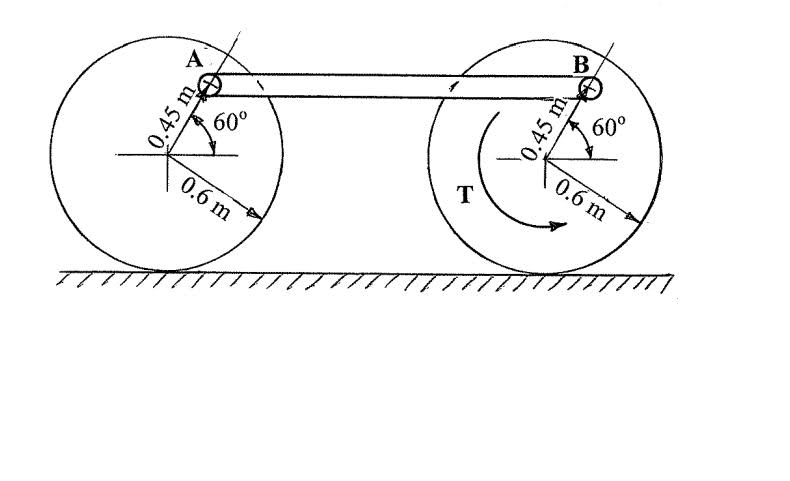
a) I am assuming its Rotational? But it moves position, so maybe circular motion?
b) Do i break down each component and do the FBD etc on each bit? Or do it as one big chunk? This is as far as i am...
I'm doing a dynamics module and revising for an up and coming exam. One of the 'revision' questions doesn't have the answer to work through, and typically I am finding it very difficult to get my head around it.
The question:
The two uniform thin discs shown in the figure below rest on a horizontal plane
and are connected through frictionless pin-joints at A and B by a rigid rod AB of
negligible mass which remains horizontal. The mass of disc A is 15 kg and that of
disc B is 25 kg. The static coefficients of friction between the plane and disc A and
B are 0.2 and 0.55, respectively, and the dynamic coefficients of friction are 0.15
and 0.45, respectively. At the instant shown, a counter-clockwise moment
T = 125 Nm. is applied to disc B. You are required to
Marks
(a) identify the type of ensuing motion of the discs,
(b) draw the free-body, kinematic and kinetic diagrams of the discs,
(c) write down the appropriate kinetic and kinematic relationships with
respect to a global reference axes system, indicating any assumption
made and
(d) determine the magnitudes and senses of the angular accelerations of
the discs and force developed, if any, in the rod AB.
(e) If slipping is anticipated, indicate with supporting arguments, whether
one of the discs will first slip or both will slip at the same time.
You must clearly show details of the analysis you have carried out using
equations in part (c) above to arrive at the results in part (d) in a reasonably
logical way.
a) I am assuming its Rotational? But it moves position, so maybe circular motion?
b) Do i break down each component and do the FBD etc on each bit? Or do it as one big chunk? This is as far as i am...