VinnyCee
- 486
- 0
Find [itex]v_1,\,v_2,\,and\,v_3[/itex] in the circuit below using nodal analysis:
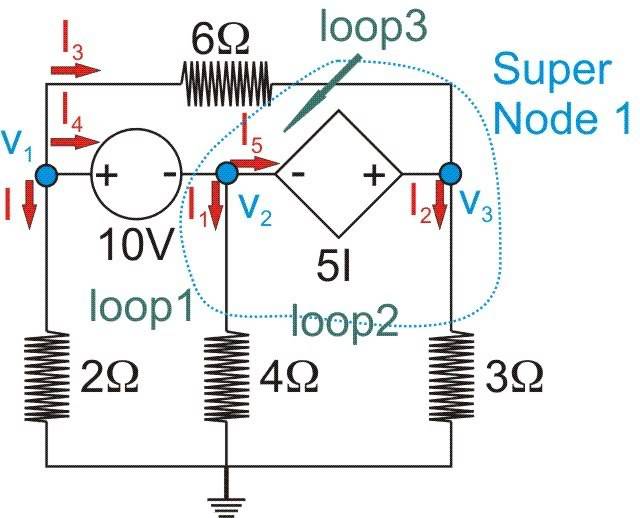
My work so far:
[tex]I\,=\,\frac{v_1}{2\Omega},\,\,I_1\,=\,\frac{v_2}{4\Omega},\,\,I_2\,=\,\frac{v_3}{3\Omega},\,\,I_3\,=\,\frac{v_1\,-\,v_3}{6\Omega}[/tex]
KVL @ loop1 => [tex]-I\,(2\Omega)\,+\,10\,V\,+\,I_1(4\Omega)\,=\,0[/tex]
Which equals:
[tex]-\left(\frac{v_1}{2\Omega}\right)(2\Omega)\,+\,10\,V\,+\,\left(\frac{v_2}{4\Omega}\right)(4\Omega)\,=\,0[/tex]
Which equals:
[tex]-v_1\,+\,10\,V\,+\,v_2\,=\,0[/tex]
KVL @ loop2 => [tex]-v_2\,-\,5\,I\,+\,v_3\,=\,0[/tex]
KVL @ loop3 => [tex]-10\,V\,+\,v_1\,-\,v_3\,+\,5\,I\,=\,0[/tex]
KCL @ v1 => [tex]I\,+\,I_3\,+\,I_4\,=\,0[/tex]
KCL @ v2 => [tex]I_4\,=\,I_1\,+\,I_5[/tex]
KCL @ v3 => [tex]I_2\,=\,I_5\,+\,I_3[/tex]
KCL @ Super Node 1 => [tex]I_4\,+\,I_3\,=\,I_1\,+\,I_2[/tex]
When I combine these equations to get 4 equations with 4 variables, I get the following matrix:
[tex]\left[\begin{array}{cccc|c}<br /> -1 & 1 & 0 & 0 & -10 \\<br /> 0 & -1 & 1 & -5 & 0 \\<br /> 1 & 0 & -1 & 5 & 10 \\<br /> \frac{1}{2} & \frac{1}{4} & \frac{1}{3} & 0 & 0<br /> \end{array}\right][/tex]
The columns go like this: v1, v2, v3, I, constant
But this matrix has infinite solutions! How do I solve?
My work so far:
[tex]I\,=\,\frac{v_1}{2\Omega},\,\,I_1\,=\,\frac{v_2}{4\Omega},\,\,I_2\,=\,\frac{v_3}{3\Omega},\,\,I_3\,=\,\frac{v_1\,-\,v_3}{6\Omega}[/tex]
KVL @ loop1 => [tex]-I\,(2\Omega)\,+\,10\,V\,+\,I_1(4\Omega)\,=\,0[/tex]
Which equals:
[tex]-\left(\frac{v_1}{2\Omega}\right)(2\Omega)\,+\,10\,V\,+\,\left(\frac{v_2}{4\Omega}\right)(4\Omega)\,=\,0[/tex]
Which equals:
[tex]-v_1\,+\,10\,V\,+\,v_2\,=\,0[/tex]
KVL @ loop2 => [tex]-v_2\,-\,5\,I\,+\,v_3\,=\,0[/tex]
KVL @ loop3 => [tex]-10\,V\,+\,v_1\,-\,v_3\,+\,5\,I\,=\,0[/tex]
KCL @ v1 => [tex]I\,+\,I_3\,+\,I_4\,=\,0[/tex]
KCL @ v2 => [tex]I_4\,=\,I_1\,+\,I_5[/tex]
KCL @ v3 => [tex]I_2\,=\,I_5\,+\,I_3[/tex]
KCL @ Super Node 1 => [tex]I_4\,+\,I_3\,=\,I_1\,+\,I_2[/tex]
When I combine these equations to get 4 equations with 4 variables, I get the following matrix:
[tex]\left[\begin{array}{cccc|c}<br /> -1 & 1 & 0 & 0 & -10 \\<br /> 0 & -1 & 1 & -5 & 0 \\<br /> 1 & 0 & -1 & 5 & 10 \\<br /> \frac{1}{2} & \frac{1}{4} & \frac{1}{3} & 0 & 0<br /> \end{array}\right][/tex]
The columns go like this: v1, v2, v3, I, constant
But this matrix has infinite solutions! How do I solve?
Last edited: