Solving for y in A(total)*y(horz centroidal axis): Where Did I Go Wrong?

  • Thread starter Thread starter smr101
  • Start date Start date
  • Tags Tags
    Axis
Click For Summary
SUMMARY

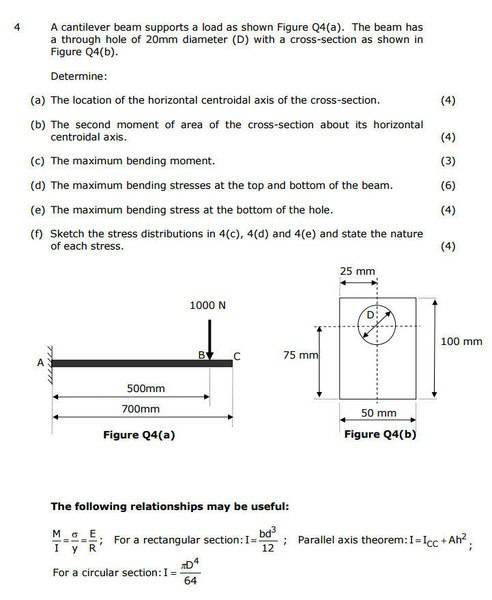
The discussion focuses on calculating the horizontal centroidal axis for a composite shape involving a rectangle and a circular hole. The user initially calculated the areas A1 and A2 for the rectangle and the circular hole, respectively, and attempted to find the centroid using the formula A(total)*y(horz centroidal axis) = A1y1 + A2y2. However, the correct centroid value is 48.32 mm, indicating an error in the calculation of the centroid of the semicircle, which was not included in the user's formula list. The recommended approach is to calculate the area and centroid of the entire rectangular piece and then subtract the area and centroid of the circular hole.

PREREQUISITES
  • Understanding of centroid calculations for composite shapes
  • Familiarity with area calculations for rectangles and circles
  • Knowledge of semicircle centroid properties
  • Basic algebra for manipulating equations
NEXT STEPS
  • Learn how to calculate the centroid of a semicircle
  • Study composite area calculations in engineering mechanics
  • Explore the principles of centroid determination for various geometric shapes
  • Review the application of the parallel axis theorem in centroid calculations
USEFUL FOR

Engineering students, mechanical designers, and anyone involved in structural analysis or composite shape calculations will benefit from this discussion.

smr101
Messages
72
Reaction score
0
Hi, having problems with (a) here, I'll show my attempt:

A1 = (0.025 * 0.05) - ((pi*0.01^2)/ 2)
1.093 x10^-3 m^2

A2 = (0.075 * 0.05) - ((pi*0.01^2)/2)
= 3.593 x10^-3 m^2

A(total)*y(horz centroidal axis) = A1y1 + A2y2

y = 1.093 x10^-3 * 0.0875 + 3.593x10^-3 * 0.0375 /(4.686x10^-3)
= 49.19 mm

Correct answer is 48.32 mm, any idea where I've gone wrong?

Thanks.
kgH1n.jpg
 
Physics news on Phys.org
smr101 said:
Hi, having problems with (a) here, I'll show my attempt:

A1 = (0.025 * 0.05) - ((pi*0.01^2)/ 2)
1.093 x10^-3 m^2

A2 = (0.075 * 0.05) - ((pi*0.01^2)/2)
= 3.593 x10^-3 m^2

A(total)*y(horz centroidal axis) = A1y1 + A2y2

y = 1.093 x10^-3 * 0.0875 + 3.593x10^-3 * 0.0375 /(4.686x10^-3)
= 49.19 mm

Correct answer is 48.32 mm, any idea where I've gone wrong?

Thanks.
kgH1n.jpg
You would be better off calculating the area and centroid of the entire rectangular piece and subtracting from that the area and centroid of the circular hole.
The centroid of a circle is easy: it's the center.

The way you did the moments originally, you need to know the centroid of a semicircle, which is not given in your formula list.
 
SteamKing said:
You would be better off calculating the area and centroid of the entire rectangular piece and subtracting from that the area and centroid of the circular hole.
The centroid of a circle is easy: it's the center.

The way you did the moments originally, you need to know the centroid of a semicircle, which is not given in your formula list.

Right, so the centroid, y, of the circle is just 75mm?
 
smr101 said:
Right, so the centroid, y, of the circle is just 75mm?
Yes. The dashed lines on the figure are just there to locate the center of the circle relative to other parts of the cross section.

The centroids of simple figures like circles and rectangles should be learned, not least because they are pretty obvious.
 

Similar threads

  • · Replies 8 ·
Replies
8
Views
1K
Replies
13
Views
2K
  • · Replies 9 ·
Replies
9
Views
3K
Replies
21
Views
3K
Replies
2
Views
3K
  • · Replies 4 ·
Replies
4
Views
2K
Replies
2
Views
3K
  • · Replies 5 ·
Replies
5
Views
6K
  • · Replies 1 ·
Replies
1
Views
3K
  • · Replies 7 ·
Replies
7
Views
18K