Solving Kinetic Energy Lab in Online Physics Class

Click For Summary
SUMMARY

The discussion focuses on solving a physics lab related to kinetic energy and kinematic equations. The participant is struggling with calculating kinematic velocity and kinetic energy using a small object, specifically a pecan in its shell. Key equations mentioned include kinematic velocity (v0 + acceleration*time) and kinetic energy (½mv² = mgh). Clarifications provided indicate that mass does not affect the kinetic energy calculation in this context, simplifying the process to using the formula for velocity derived from gravitational potential energy.

PREREQUISITES
  • Understanding of basic physics concepts, specifically kinematics and energy.
  • Familiarity with the equations of motion, particularly kinematic equations.
  • Knowledge of gravitational acceleration (g) and its application in physics problems.
  • Ability to convert units between feet and meters for accurate calculations.
NEXT STEPS
  • Study the derivation and application of kinematic equations in physics.
  • Learn about gravitational potential energy and its relationship to kinetic energy.
  • Practice unit conversion techniques, especially between imperial and metric systems.
  • Explore examples of experiments involving free fall and energy conservation principles.
USEFUL FOR

This discussion is beneficial for students in introductory physics courses, particularly those working on labs involving kinematics and energy calculations. It is also useful for educators seeking to clarify common misconceptions about these concepts.

McSara
Messages
1
Reaction score
0
I'm having some difficulty in an online class.
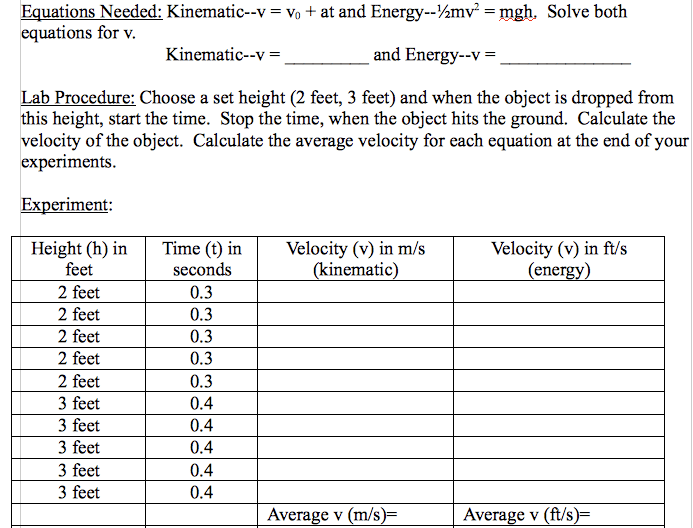
Here is a screen shot for reference:
Picture1-12.png


Homework Statement

:
I'm doing a physics lab (screen shot is available above). The procedure says:
Choose a set height (2 feet, 3 feet) and when the object is dropped from this height, start the time. Stop the time, when the object hits the ground. Calculate the velocity of the object. Calculate the average velocity for each equation at the end of your experiments.
The small object I'm using is a small pecan in it's shell.
As you can see from the screen shot I have already recorded the time column from the experiment.
I'm having a difficult time with kinematic velocity (because I don't understand the equation) and the kinetic energy (because the KE formula asks for mass and I do not know the mass of the almond. This lab was not specific to mass, only specific of using a small object. More specifically it says: to use a "small object (thread spool, small ball)")


Homework Equations

:
Kinematic velocity = v0 + acceleration*time
Kinetic Energy = ½mv^2 = mgh


The Attempt at a Solution

:
I don't know how to go about either one of these. I'm sorry. The book is confusing me, too.
 
Physics news on Phys.org
Welcome to PF.

One thing should make it easier for you.

The kinetic energy V doesn't depend on mass. If you will note it cancels out of both sides of the equation.

Hence your kinetic V is (2*g*h)1/2
Your kinematic V is simpler and is just g*t

Be careful of your units. 1 column is m/s. The other is ft/s.
 
Welcome to PF!

McSara said:
I'm having a difficult time with kinematic velocity (because I don't understand the equation) and the kinetic energy (because the KE formula asks for mass and I do not know the mass of the almond. This lab was not specific to mass, only specific of using a small object. More specifically it says: to use a "small object (thread spool, small ball)")

Kinematic velocity = v0 + acceleration*time
Kinetic Energy = ½mv^2 = mgh

Hi McSara! Welcome to PF! :smile:

It isn't kinematic velocity, it's a kinematic equation.

v is just ordinary velocity. :wink:
 

Similar threads

  • · Replies 6 ·
Replies
6
Views
2K
  • · Replies 33 ·
2
Replies
33
Views
3K
Replies
1
Views
2K
  • · Replies 8 ·
Replies
8
Views
2K
  • · Replies 9 ·
Replies
9
Views
993
Replies
55
Views
6K
  • · Replies 3 ·
Replies
3
Views
2K
Replies
1
Views
1K
Replies
5
Views
9K
  • · Replies 1 ·
Replies
1
Views
3K