Solving Limits with L'Hopital's Rule

Click For Summary

Homework Help Overview

The discussion revolves around evaluating limits using L'Hopital's Rule, particularly in the context of expressions that approach infinity. Participants are exploring the application of this rule to specific terms in their limit calculations.

Discussion Character

  • Exploratory, Assumption checking, Mathematical reasoning

Approaches and Questions Raised

  • Participants are questioning how to identify when L'Hopital's Rule is applicable, particularly in cases where limits yield undefined forms. There are discussions about the behavior of exponential functions as variables approach infinity and the need to express limits in indeterminate forms.

Discussion Status

There is an ongoing exploration of how to properly apply L'Hopital's Rule to various terms in the limit expressions. Some participants have provided guidance on recognizing indeterminate forms and the necessity of rewriting expressions to fit these criteria. Multiple interpretations of the problem are being considered, particularly regarding the limits of individual terms.

Contextual Notes

Participants are addressing potential confusion regarding the limits of specific terms and the conditions under which L'Hopital's Rule can be applied. There is mention of constraints related to the values of variables and the forms of expressions being evaluated.

Jeff12341234
Messages
179
Reaction score
0
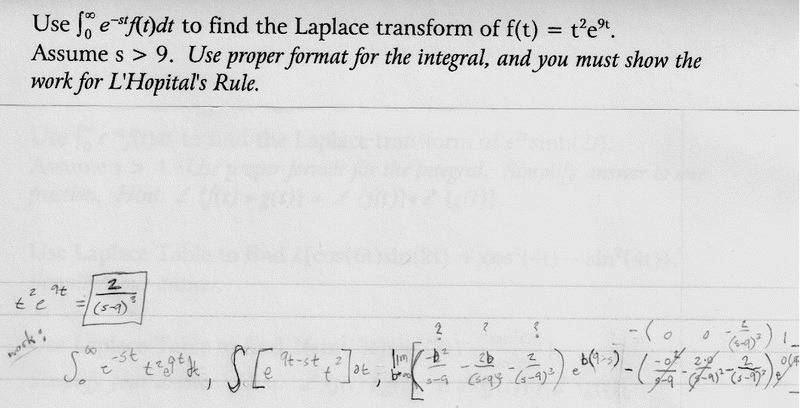
1. The limit as b approaches infinity always shows up as undefined on my calc so I don't know what to put for that section of the work.

2. What pat of the work is supposed to need L'hopital's rule? The integration?
KaaqCAP.jpg
 
Physics news on Phys.org
Jeff12341234 said:
1. The limit as b approaches infinity always shows up as undefined on my calc so I don't know what to put for that section of the work.

2. What pat of the work is supposed to need L'hopital's rule? The integration?

KaaqCAP.jpg

Same type of answer as with the other one. In e^(b(9-s)), 9-s is negative. That will go to zero as b->infinity. So will b*e^(b(9-s)) and b^2*e^(b(9-s)).
 
What about the 2nd question?
 
Jeff12341234 said:
What about the 2nd question?

About l'hospital's's? You can use it to prove something like b*exp(-kb) must go to zero as b->infinity if k>0. Write it as b/e^(kb) and use l'Hopital.
 
How does it specifically apply in this case? What am I supposed to need it for in this problem?
 
Jeff12341234 said:
How does it specifically apply in this case? What am I supposed to need it for in this problem?

You want to show things like -b^2*e^(b(9-s))/(9-s) actually do go to zero when s>9 and b goes to infinity.
 
Ok, so it's supposed to be needed when evaluating the limits of each term correct?
 
Jeff12341234 said:
Ok, so it's supposed to be needed when evaluating the limits of each term correct?

Yes, the parts you wrote '?' over. You'll want to show they actually do go to zero if s>9.
 
1CnPNon.jpg


Did I do the work right? I get 0 in the denominator.. what's wrong here?
 
  • #10
Jeff12341234 said:
1CnPNon.jpg


Did I do the work right? I get 0 in the denominator.. what's wrong here?

You can't use l'Hopital's rule on an expression unless it's indeterminate. Write it so it has the form 0/0 or infinity/infinity. Try b^2/e^b. That's infinity/infinity.
 
  • #11
ok. So for that specific term that I tried to do, the limit looks like it would instead be infinity right? Am I allowed to do the limit of just -b^2 over s-9 by itself, along with each other term by itself, and the e^b(9-s) by itself, or do I have to expand it out and then do each term like I started to do and do the limit that way?
 
  • #12
Jeff12341234 said:
ok. So for that specific term that I tried to do, the limit looks like it would instead be infinity right? Am I allowed to do the limit of just -b^2 over s-9 by itself, along with each other term by itself, and the e^b(9-s) by itself, or do I have to expand it out and then do each term like I started to do and do the limit that way?

No, it's not infinity. It's zero. Limit b^2/e^b is infinity/infinity. Do l'Hopital. 2b/e^b. Still infinity/infinity. Do l'Hopital once more. Now it's not infinity/infinity. What is it?
 

Similar threads

  • · Replies 1 ·
Replies
1
Views
1K
  • · Replies 2 ·
Replies
2
Views
2K
  • · Replies 10 ·
Replies
10
Views
3K
  • · Replies 7 ·
Replies
7
Views
2K
  • · Replies 4 ·
Replies
4
Views
3K
  • · Replies 23 ·
Replies
23
Views
2K
Replies
2
Views
2K
  • · Replies 4 ·
Replies
4
Views
3K
Replies
5
Views
2K
  • · Replies 9 ·
Replies
9
Views
3K