pavadrin
- 154
- 0
Hey,
Today I was given a problem to solve in class and was told to complete it for homework. This problem is as follows:
The line y=mx + c has a gradient m and cuts the y-axis at (0,c). Thus we can write the parametric vector equation of the line as:
[tex]r = cj +\lambda (i + mj)[/tex]
Using this fact show that that the perpendicular distance from point [tex]A(x_1 , y_1)[/tex] to y = mx + c is:
[tex]\mid(\frac{mx_{1} - y_{1} + c}{\sqrt{m^2 + 1}})\mid[/tex]
If y = mx + c is instead written as ax + by + d = 0 show that the perpendicular distance of point [tex]A(x_1 , y_1)[/tex] to as ax + by + d = 0 is given by:
[tex]\mid(\frac{ax_{1} - by_{1} + d}{\sqrt{a^2 + b^2}})\mid[/tex]
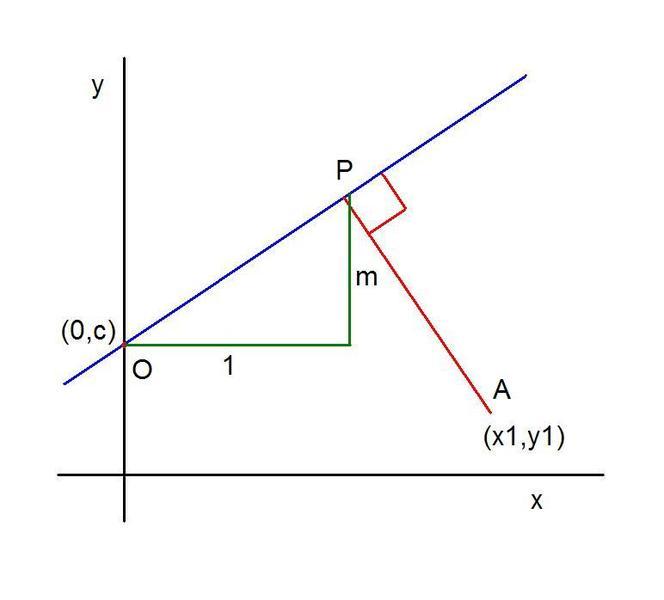
This diagram which I drew to help me may help:
______________________
I have tried solving this problem by using vectors:
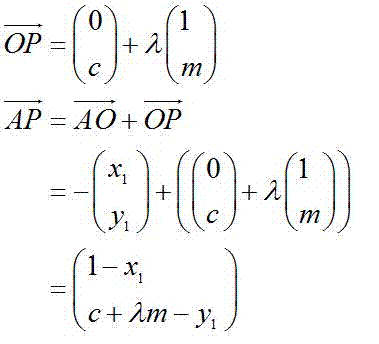
and I know that the dot product of [tex]( x_1 , y_1 )[/tex] and y = mx + c is equal to zero but from there onwards I am not sure on how to approach this problem. All help is appreciated,
thanks, Pavadrin
Today I was given a problem to solve in class and was told to complete it for homework. This problem is as follows:
The line y=mx + c has a gradient m and cuts the y-axis at (0,c). Thus we can write the parametric vector equation of the line as:
[tex]r = cj +\lambda (i + mj)[/tex]
Using this fact show that that the perpendicular distance from point [tex]A(x_1 , y_1)[/tex] to y = mx + c is:
[tex]\mid(\frac{mx_{1} - y_{1} + c}{\sqrt{m^2 + 1}})\mid[/tex]
If y = mx + c is instead written as ax + by + d = 0 show that the perpendicular distance of point [tex]A(x_1 , y_1)[/tex] to as ax + by + d = 0 is given by:
[tex]\mid(\frac{ax_{1} - by_{1} + d}{\sqrt{a^2 + b^2}})\mid[/tex]
This diagram which I drew to help me may help:
______________________
I have tried solving this problem by using vectors:
and I know that the dot product of [tex]( x_1 , y_1 )[/tex] and y = mx + c is equal to zero but from there onwards I am not sure on how to approach this problem. All help is appreciated,
thanks, Pavadrin