Solving the Missing Resistor Problem in a Parallel Circuit

  • Thread starter Thread starter Hazel Appraiasal
  • Start date Start date
  • Tags Tags
    Resistor
Join the discussion
Registration is free. Ask a follow-up in this thread, or start your own.
6 replies · 3K views
Hazel Appraiasal
Messages
19
Reaction score
2
Summary:: How de you find the missing resistor (R6) in this problem. I assume you take the current flow of the parallel circuit to find the resistance of R6 but I feel like there is still some missing information
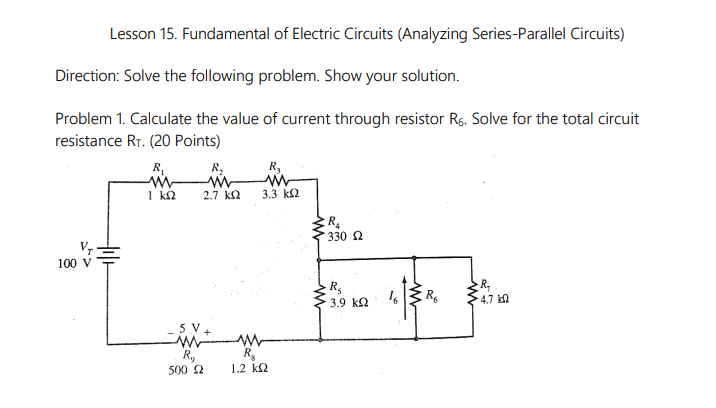
1641353436277.png
 
Physics news on Phys.org
Looks like a straightforward series-parallel resistor combination problem to me. Can you post your work?
 
Although the value of ##R_6## is not given, the voltage across ##R_9## is given. That additional information of the voltage drop should give enough facts to solve the problem.
 
  • Like
Likes   Reactions: DaveE
1641354816762.png

This is all I've done. I figure that if I add all of the resistances of the series circuit then find the current, I could then use that current to solve the parallel circuit. I got something around 0.01 amp so I figure that the total current of the parallel circuit must be 0.01 amp and then I could use that to find the resistance of R6
 
You can get the current in the main loop directly from the voltage drop at ##R_6##.
0.01 A is correct. I don't know any other way that you might have used.
Given that, can you write down an equation leaving ##R_6## undefined and solve for ##R_6##?
(You can combine all the series resisters in the main loop, combine the parallel ##R_5## and ##R_7## but leave ##R_6## as a variable. Then solve for ##R_6##)
 
FactChecker said:
You can get the current in the main loop directly from the voltage drop at ##R_6##.
0.01 A is correct. I don't know any other way that you might have used.
Given that, can you write down an equation leaving ##R_6## undefined and solve for ##R_6##?
(You can combine all the series resisters in the main loop, combine the parallel ##R_5## and ##R_7## but leave ##R_6## as a variable. Then solve for ##R_6##)
I don't think so because the total current of the parallel circuit must be 0.01 amps which if I calculated correctly results in a total resistance of the parallel circuit to be 10 000 and then I can subtract resistances from there.
 
Hazel Appraiasal said:
I don't think so because the total current of the parallel circuit must be 0.01 amps
Yes, you can get that directly from the 5-volt drop across the ##500 \Omega## ##R_9## resister.
Hazel Appraiasal said:
which if I calculated correctly results in a total resistance of the parallel circuit to be 10 000 and then I can subtract resistances from there.
You can not get a larger combined parallel resistance than the least of the individual parallel resisters. So that must be no more than ##3.9 k\Omega##
I guess that you mean the resistance of the entire circuit. I agree.
 
Last edited: