Discussion Overview
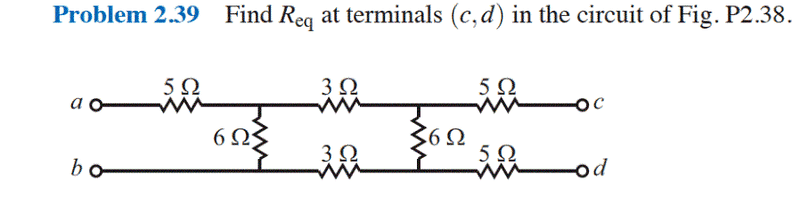
The discussion revolves around the proper approach to a resistor problem involving an imagined voltage source between points a and b. Participants explore the implications of this assumption on the configuration of resistors and the calculation of equivalent resistance, focusing on the relationships between different resistors in the circuit.
Discussion Character
- Debate/contested
- Technical explanation
- Mathematical reasoning
Main Points Raised
- One participant questions the validity of imagining a voltage source between a and b, suggesting that it may not be appropriate for determining the configuration of the resistors.
- Another participant clarifies that the focus should be on finding the equivalent resistance between points c and d, indicating that the 5 ohm and 6 ohm resistors are not in parallel as initially suggested.
- A different viewpoint proposes using a Thevenin equivalent circuit to analyze the resistors, providing formulas for calculating the Thevenin voltage and resistance.
- One participant raises a concern about the lack of information regarding whether points a and b are connected to anything, which could affect the solution approach.
- Another participant suggests that if a and b are open circuits, the 5 ohm resistor can be ignored, indicating that the proposed approach may be overly complex without a voltage source present.
Areas of Agreement / Disagreement
Participants express differing views on the appropriateness of imagining a voltage source between a and b, with some arguing it is not valid while others provide alternative methods for analysis. The discussion remains unresolved regarding the correct approach to the problem.
Contextual Notes
There are limitations regarding the assumptions about the connections at points a and b, which are not clearly defined in the problem statement. This ambiguity affects the applicability of various methods discussed.