Solving Tree Diagram Problem - Exam Missed

  • Thread starter Thread starter justinbaker
  • Start date Start date
  • Tags Tags
    Diagram Tree
Click For Summary
SUMMARY

The forum discussion centers on a tree diagram problem related to probability calculations in an exam context. The participant initially proposed the formula (95+8-N)/100000 to determine the probability of being bitten by a pet, where N represents the number of pet owners bitten by both their own and other pets. However, they later reconsidered and suggested that the correct probability should be calculated as 95/103, indicating a misunderstanding of conditional probabilities. This highlights the importance of accurately interpreting the problem's parameters and the relationships between events.

PREREQUISITES
  • Understanding of conditional probability
  • Familiarity with tree diagrams in probability
  • Basic knowledge of probability formulas
  • Experience with exam-style problem-solving techniques
NEXT STEPS
  • Study conditional probability and its applications
  • Learn how to construct and interpret tree diagrams
  • Practice solving exam-style probability problems
  • Review common pitfalls in probability calculations
USEFUL FOR

Students preparing for exams in statistics or probability, educators teaching probability concepts, and anyone looking to improve their problem-solving skills in mathematical contexts.

justinbaker
Messages
34
Reaction score
0
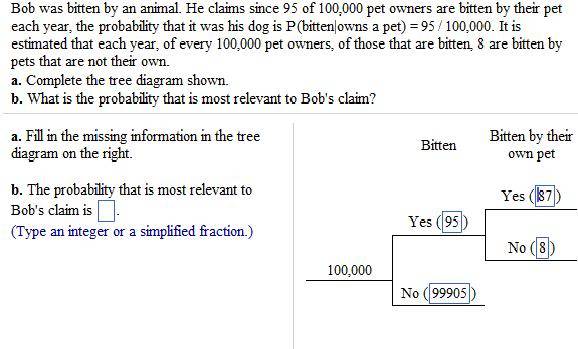
ok so what am i doing wrong here? this was the only question i missed on my exam, and its driving me crazy...
stats.jpg
 
Physics news on Phys.org
For (b) I'd have put (95+8-N)/100000 where N is the (unspecified) number of pet owners that are bitten by pets that are not their own and also bitten by their own pet.
 
I would have thought he would be after P(Bitten by own pet|Bitten) which would be 87/95
 
Sounds reasonable. But now I think the answer is 95/103.
 
If there are an infinite number of natural numbers, and an infinite number of fractions in between any two natural numbers, and an infinite number of fractions in between any two of those fractions, and an infinite number of fractions in between any two of those fractions, and an infinite number of fractions in between any two of those fractions, and... then that must mean that there are not only infinite infinities, but an infinite number of those infinities. and an infinite number of those...

Similar threads

  • · Replies 16 ·
Replies
16
Views
2K
  • · Replies 3 ·
Replies
3
Views
1K
Replies
4
Views
1K
  • · Replies 7 ·
Replies
7
Views
2K
  • · Replies 3 ·
Replies
3
Views
2K
  • · Replies 19 ·
Replies
19
Views
2K
  • · Replies 3 ·
Replies
3
Views
2K
  • · Replies 8 ·
Replies
8
Views
2K
  • · Replies 55 ·
2
Replies
55
Views
9K
  • · Replies 5 ·
Replies
5
Views
1K