Solving $\vec F = m\vec a$: How is $\vec F = -mkv$ Possible?

  • Thread starter Thread starter member 731016
  • Start date Start date
Join the discussion
Registration is free. Ask a follow-up in this thread, or start your own.
14 replies · 1K views
member 731016
Homework Statement
Please see below
Relevant Equations
Please see below
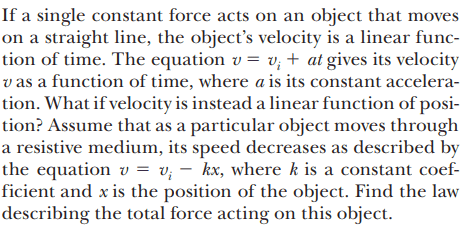
For this problem,
1676331350534.png

My working is

## \vec F = m\vec a##
## \vec F = \frac {m(v - v_i)}{\Delta t} ##
## \vec F = \frac {-mkx}{\Delta t} ##

However, the solution said ##\vec F = -mkv ##. I don't understand how this is possible since ## v ≠\frac {x}{\Delta t} ## since ##v =\frac {\Delta x}{\Delta t} ##?

Many thanks!
 
Physics news on Phys.org
Callumnc1 said:
Homework Statement:: Please see below
Relevant Equations:: Please see below

For this problem,
View attachment 322236
My working is

## \vec F = m\vec a##
## \vec F = \frac {m(v - v_i)}{\Delta t} ##
## \vec F = \frac {-mkx}{\Delta t} ##

However, the solution said ##\vec F = -mkv ##. I don't understand how this is possible since ## v ≠\frac {x}{\Delta t} ## since ##v =\frac {\Delta x}{\Delta t} ##?

Many thanks!
You do not take a finite difference, you take the derivative of v with respect to t to get acceleration.
 
Reply
  • Like
Likes   Reactions: member 731016
Frabjous said:
You do not divide by δt, you take the derivative of v with respect to t to get acceleration.
Thank you for your reply @Frabjous!

I was trying to solve this problem using the algebra definition of velocity only. It's possible to solve this problem without calculus right?

Many thanks!
 
Callumnc1 said:
It's possible to solve this problem without calculus right?
Yes, but you took the finite difference wrong. You want start with Δv/Δt.
Hint: Δvi=0 since it is a constant.
 
Reply
  • Like
Likes   Reactions: member 731016
Frabjous said:
Yes, but you took the finite difference wrong. You want start with Δv/Δt.
Hint: Δvi=0 since it is a constant.
Thank you for your reply @Frabjous !

I though ##\Delta v = v_f - v_i = v - v_i ## since they drop the ##f## for ##v##

Many thanks!
 
Callumnc1 said:
Thank you for your reply @Frabjous !

I though ##\Delta v = v_f - v_i = v - v_i ## since they drop the ##f## for ##v##

Many thanks!
vi is just a constant. It could have just as easily been labeled a. vf is not in the original problem.
Δv=Δvi-Δ(kx)
Since k is also a constant you can pull it outside the Δ.
 
Reply
  • Like
Likes   Reactions: member 731016
Callumnc1 said:
I was trying to solve this problem using the algebra definition of velocity
The "algebra definition" ##\frac{\Delta x}{\Delta t}## is for the average velocity over the time interval ##\Delta t##. You need to use the definitions of instantaneous velocity and instantaneous acceleration, which can only be expressed in calculus.
 
Reply
  • Like
Likes   Reactions: member 731016
Thank you for your replies @Frabjous, @kuruman and @haruspex !

I have figured out how solve to the problem using algebra. The calculus way as a lot faster thought!

## v_i = v(x_i) = v_i - kx_i ##
## v_f = v(x_f) = v_i - kx_f ##
## \Delta v = v_f - v_i= v_i - kx_f - (v_i - kx_i) = -kx_f + kx_i = k(x_i - x_f) = -k\Delta x ##

Then plug ##\Delta v## into Newton II to get their answer :)
 
Callumnc1 said:
Thank you for your replies @Frabjous, @kuruman and @haruspex !

I have figured out how solve to the problem using algebra. The calculus way as a lot faster thought!

## v_i = v(x_i) = v_i - kx_i ##
## v_f = v(x_f) = v_i - kx_f ##
## \Delta v = v_f - v_i= v_i - kx_f - (v_i - kx_i) = -kx_f + kx_i = k(x_i - x_f) = -k\Delta x ##

Then plug ##\Delta v## into Newton II to get their answer :)
I assume your final steps are
##\frac{ \Delta v }{\Delta t}= -k\frac{ \Delta x }{\Delta t}##
##a=-kv##
But as I pointed out, that doesn’t quite work because the final line above should read
##a_{avg}=-kv_{avg}##, where the averages are taken over the time interval.
To get the target answer you need to apply the calculus principle of letting the deltas tend to zero.
 
Reply
  • Like
Likes   Reactions: member 731016
haruspex said:
I assume your final steps are
##\frac{ \Delta v }{\Delta t}= -k\frac{ \Delta x }{\Delta t}##
##a=-kv##
But as I pointed out, that doesn’t quite work because the final line above should read
##a_{avg}=-kv_{avg}##, where the averages are taken over the time interval.
To get the target answer you need to apply the calculus principle of letting the deltas tend to zero.
Thank you for your reply @haruspex!

Your assumption of my finial steps is correct

I agree that I should has used average notation including ##F_{avg}##

However, would you please know why are looking for the instantaneous force not average force from the question?

Many thanks!
 
kuruman said:
My answer would be because Newton's law is not ##F_{avg}=ma_{avg}##. Perhaps @haruspex has some other answer.
Thank you for your reply @kuruman !
 
haruspex said:
Because the question does not specify average it should be taken as meaning instantaneous.
Thank you for your reply @haruspex !