Some one help.Continuous Functions.

  • Context: High School 
  • Thread starter Thread starter Charles007
  • Start date Start date
  • Tags Tags
    Functions
Click For Summary

Discussion Overview

The discussion revolves around the concepts of sequences and continuous functions, particularly focusing on the limits associated with these functions and the process of determining appropriate delta values in proofs. Participants explore the nuances of continuity, limits of squared functions, and the challenges of selecting delta values in various scenarios.

Discussion Character

  • Exploratory
  • Technical explanation
  • Debate/contested
  • Mathematical reasoning

Main Points Raised

  • One participant expresses confusion regarding the limits of sequences and continuous functions, questioning how to determine minimum and maximum values before attempting problems.
  • Another participant provides an example related to continuity, emphasizing that there are multiple solutions to the problem and discussing the process of estimating delta values based on the definitions of limits.
  • Several participants discuss the importance of ensuring that x remains positive when selecting delta values, suggesting that letting delta be less than or equal to x_0/2 is a practical approach.
  • There is a back-and-forth regarding the effectiveness of different delta choices, with one participant explaining why choosing delta less than x_0 does not yield satisfactory results in their proof.
  • Another participant highlights the iterative nature of mathematical proofs, noting that arriving at a solution often involves trial and error in selecting constants and bounds.

Areas of Agreement / Disagreement

Participants do not reach a consensus on the best approach for selecting delta values, with multiple competing views on the effectiveness of different strategies remaining evident throughout the discussion.

Contextual Notes

Participants reference specific mathematical inequalities and conditions that are not fully resolved, indicating a dependence on definitions and assumptions that may not be universally accepted or understood.

Charles007
Messages
21
Reaction score
0
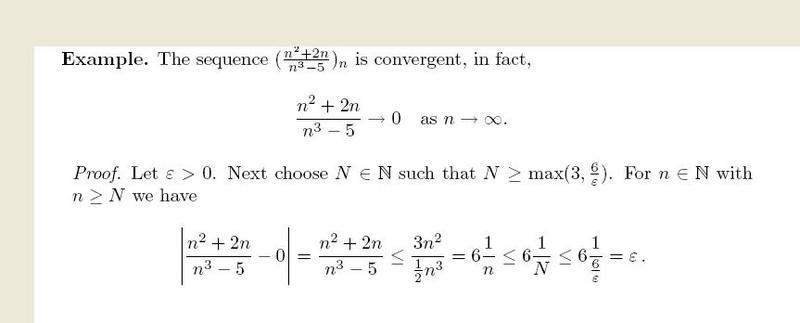
I am confused with sequence and continuous functions.

I am confued with their limit. how do they know the min and max before they attempt the question. and is that the only solution to the question?

Many thx.

Squence

未命1.jpg


Continuous Functions.

未命2.jpg
 
Last edited:
Physics news on Phys.org
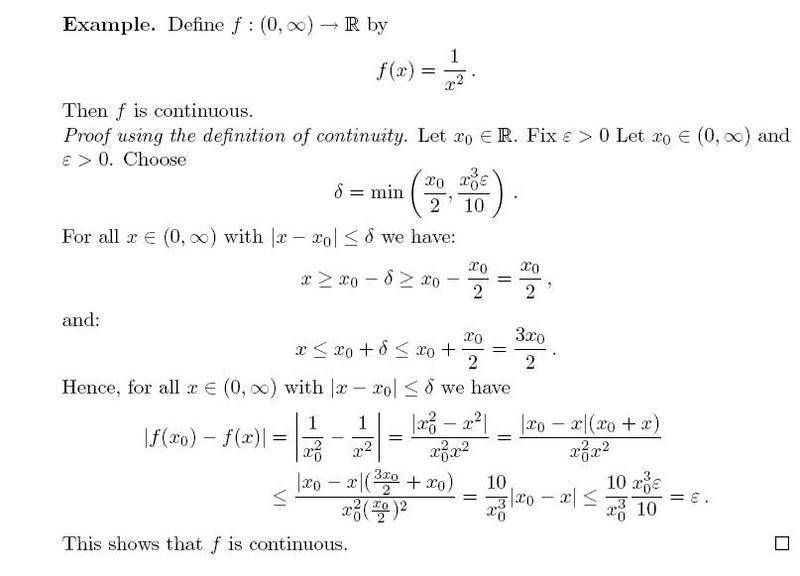
I'll help you with continuity example. First, that is not the only solution to the question. In some textbooks, you learn how to deal with limits of squared functions and limits of reciprocals and as long as you can keep your head straight, you can choose an appropriate delta by combining parts of the definitions of those two types of limits.

You don't know how to choose the delta beforehand. The best way is to start with the last step in the proof in the attachment. The only way to choose an appropriate delta is to estimate [tex]\left|f(x) - f(x_0)\right|[/tex] as follows:

[tex]\left|f(x) - f(x_0)\right| \leq \left|\frac{1}{x_0 ^2} - \frac{1}{x^2}\right| = \frac{\left|x_0 ^2 - x^2\right|}{\left|x_0 ^2 x^2\right|} = \frac{\left|x_0 - x\right|\cdot\left|x_0 + x\right|}{x_0 ^2 x^2}.[/tex]

We have control over [tex]\left|x_0 - x\right|,[/tex] so we need to estimate the other terms. On the one hand, [tex]\left|x - x_0 \right| < \delta[/tex] implies that [tex]x - x_0 > -\delta[/tex] or [tex]x > x_0 - \delta.[/tex] Since x_0 is positive, we might as well ensure that x is positive by letting [tex]\delta \leq \frac{x_0}{2}[/tex] (note we could choose [tex]\frac{x_0}{4}[/tex] or something similar, but half of x_0 is convenient). Hence [tex]x > \frac{x_0}{2},[/tex] and we have a bound for the term [tex]\frac{1}{x^2}[/tex] since
[tex]\frac{1}{x^2} < \frac{4}{x_0 ^2}[/tex](*).
On the other hand,
[tex]\left|x - x_0 \right| < \delta \leq \frac{x_0}{2} \Rightarrow x - x_0 < \frac{x_0}{2} \Rightarrow x < \frac{3x_0}{2}\mbox{ so }\left|x_0 + x\right| = x_0 + x < \frac{5x_0}{2}.[/tex] (**)
Consequently,

[tex]\frac{\left|x_0 - x\right|\cdot\left|x_0 + x\right|}{x_0 ^2 x^2} = \left|x_0 - x\right|\cdot\left|x_0 + x\right|\cdot\frac{1}{x_0 ^2}\cdot\frac{1}{x^2} \leq \left|x_0 - x\right|\cdot\frac{5x_0}{2}\cdot\frac{1}{x_0 ^2}\cdot{4}{x_0 ^2} = \frac{10}{x_0 ^3}\left|x_0 - x\right|,[/tex]

where the only inequality follows from (*) and (**). That's basically it, except you want delta to satisfy another inequality to ensure that the last expression is less than epsilon.
 
snipez90 said:
I'll help you with continuity example. First, that is not the only solution to the question. In some textbooks, you learn how to deal with limits of squared functions and limits of reciprocals and as long as you can keep your head straight, you can choose an appropriate delta by combining parts of the definitions of those two types of limits.

You don't know how to choose the delta beforehand. The best way is to start with the last step in the proof in the attachment. The only way to choose an appropriate delta is to estimate [tex]\left|f(x) - f(x_0)\right|[/tex] as follows:

[tex]\left|f(x) - f(x_0)\right| \leq \left|\frac{1}{x_0 ^2} - \frac{1}{x^2}\right| = \frac{\left|x_0 ^2 - x^2\right|}{\left|x_0 ^2 x^2\right|} = \frac{\left|x_0 - x\right|\cdot\left|x_0 + x\right|}{x_0 ^2 x^2}.[/tex]

We have control over [tex]\left|x_0 - x\right|,[/tex] so we need to estimate the other terms. On the one hand, [tex]\left|x - x_0 \right| < \delta[/tex] implies that [tex]x - x_0 > -\delta[/tex] or [tex]x > x_0 - \delta.[/tex] Since x_0 is positive, we might as well ensure that x is positive by letting [tex]\delta \leq \frac{x_0}{2}[/tex] (note we could choose [tex]\frac{x_0}{4}[/tex] or something similar, but half of x_0 is convenient). Hence [tex]x > \frac{x_0}{2},[/tex] and we have a bound for the term [tex]\frac{1}{x^2}[/tex] since
[tex]\frac{1}{x^2} < \frac{4}{x_0 ^2}[/tex](*).
On the other hand,
[tex]\left|x - x_0 \right| < \delta \leq \frac{x_0}{2} \Rightarrow x - x_0 < \frac{x_0}{2} \Rightarrow x < \frac{3x_0}{2}\mbox{ so }\left|x_0 + x\right| = x_0 + x < \frac{5x_0}{2}.[/tex] (**)
Consequently,

[tex]\frac{\left|x_0 - x\right|\cdot\left|x_0 + x\right|}{x_0 ^2 x^2} = \left|x_0 - x\right|\cdot\left|x_0 + x\right|\cdot\frac{1}{x_0 ^2}\cdot\frac{1}{x^2} \leq \left|x_0 - x\right|\cdot\frac{5x_0}{2}\cdot\frac{1}{x_0 ^2}\cdot{4}{x_0 ^2} = \frac{10}{x_0 ^3}\left|x_0 - x\right|,[/tex]

where the only inequality follows from (*) and (**). That's basically it, except you want delta to satisfy another inequality to ensure that the last expression is less than epsilon.

Since x_0 is positive, we might as well ensure that x is positive by letting [tex]\delta \leq \frac{x_0}{2}[/tex] (note we could choose [tex]\frac{x_0}{4}[/tex] or something similar, but half of x_0 is convenient). Hence [tex]x > \frac{x_0}{2},[/tex] and we have a bound for the term [tex]\frac{1}{x^2}[/tex] since
[tex]\frac{1}{x^2} < \frac{4}{x_0 ^2}[/tex](*).

X_0 is positive and x is positive. => letting [tex]\delta \leq \frac{x_0}{2}[/tex] why?:frown:
 
Charles007 said:
Since x_0 is positive, we might as well ensure that x is positive by letting [tex]\delta \leq \frac{x_0}{2}[/tex] (note we could choose [tex]\frac{x_0}{4}[/tex] or something similar, but half of x_0 is convenient). Hence [tex]x > \frac{x_0}{2},[/tex] and we have a bound for the term [tex]\frac{1}{x^2}[/tex] since
[tex]\frac{1}{x^2} < \frac{4}{x_0 ^2}[/tex](*).

X_0 is positive and x is positive. => letting [tex]\delta \leq \frac{x_0}{2}[/tex] why?:frown:
Because it works! The problem is just to get a small enough [itex]x_0[/itex]. You try, perhaps, [itex]\delta< 1[/itex] and see that it doesn't work if [itex]x_0[/itex] is too small. So you try [itex]\delta< x_0[/itex] and se that IT doesn't work. Then you try [itex]\delta< x_0/2[/itex] and are delighted to find that it works! So that is what you use when you write it up!
 
so we know [tex]x > 0[/tex], [tex]x - x_0 > -\delta[/tex] =〉 [tex]x_0 > delta[/tex] or [tex]x_0 - delta > 0[/tex]

U said IT doesn't work. what is IT.?

where can I put it in and verify it?
 
What I said, exactly, was, "So you try [itex]\delta< x_0[/itex] and see that IT doesn't work." The "IT" refers to [itex]\delta< x_0[/itex].
Suppose that [itex]\delta < x_0[/itex]. Then we need to say "if [itex]|x- x_0|< \delta< x_0[itex]then [itex]-x_0< x- x_0< x_0[/itex]" so, adding x_0 to both sides 0< x< 2x_0. But now we want to form 1/x and compare it to [itex]1/x_0[/itex]. Unfortunately, with that "0" on the left, that inverts into [itex]1/(2x_0)< 1/x< \infty[/itex] and that is not good enough.<br /> <br /> Using [itex]\delta< x_0/2[/itex] instead gives "if [itex]|x- x_0|< \delta< x_0/2[/itex] then [itex]-x_0/2< x- x_0< x_0/2[/itex] and now adding x_0 to both sides gives [itex](1/2)x_0/2< x< (3/2)x_0 so that [itex]2/(3x_0)< 1/x< 2x_0[/itex]. Now we can subtract [itex]1/x_0[/itex] from each part and say that [itex]-1/(3x_0)< 1/x- 1/x_0< x_0[/itex] so that [itex]|1/x- 1/x_0|< |1/x_0|.[/itex][/itex][/itex][/itex]
 
HallsofIvy said:
What I said, exactly, was, "So you try [itex]\delta< x_0[/itex] and see that IT doesn't work." The "IT" refers to [itex]\delta< x_0[/itex].
Suppose that [itex]\delta < x_0[/itex]. Then we need to say "if [itex]|x- x_0|< \delta< x_0[/itex] then [itex]-x_0< x- x_0< x_0[/itex]" so, adding [itex]x_0[/itex]to both sides [itex]0< x< 2x_0[/itex]. But now we want to form [itex]1/x[/itex] and compare it to [itex]1/x_0[/itex]. Unfortunately, with that "0" on the left, that inverts into [itex]1/(2x_0)< 1/x< \infty[/itex] and that is not good enough.

Using [itex]\delta< x_0/2[/itex] instead gives "if [itex]|x- x_0|< \delta< x_0/2[/itex] then [itex]-x_0/2< x- x_0< x_0/2[/itex] and now adding [itex]x_0[/itex] to both sides gives [itex](1/2)x_0/2< x< (3/2)x_0[/itex] so that [itex]2/(3x_0)< 1/x< 2x_0[/itex]. Now we can subtract [itex]1/x_0[/itex] from each part and say that [itex]-1/(3x_0)< 1/x- 1/x_0< x_0[/itex] so that [itex]|1/x- 1/x_0|< |1/x_0|[/itex].

Thank you very much, :approve: I am understand now.
 
Good. My point really is that what you see in a book is the "finished product". It didn't just pop into the writer's mind in exactly that form. Deciding exactly how to prove something, how to choose specific constants, etc., is often a matter of "trial and error".
 

Similar threads

  • · Replies 4 ·
Replies
4
Views
2K
  • · Replies 9 ·
Replies
9
Views
3K
  • · Replies 21 ·
Replies
21
Views
6K
  • · Replies 2 ·
Replies
2
Views
4K
  • · Replies 1 ·
Replies
1
Views
1K
  • · Replies 53 ·
2
Replies
53
Views
7K
  • · Replies 9 ·
Replies
9
Views
2K
  • · Replies 20 ·
Replies
20
Views
3K
  • · Replies 2 ·
Replies
2
Views
3K
  • · Replies 10 ·
Replies
10
Views
6K