Some questions about Noise and Power spectral Density

Click For Summary
SUMMARY

This discussion focuses on the characteristics of noise in electrical components, specifically addressing the use of noise voltage generated by resistors and its implications on power spectral density. The noise voltage is defined by the equation Vn = √(4KTBR), where K is Boltzmann's constant, T is temperature, B is bandwidth, and R is resistance. The conversation also clarifies the relationship between DC current and shot noise, emphasizing that reducing DC current decreases noise voltage, contrary to some interpretations. Additionally, the potential for energy extraction from noise voltage across resistors is explored, particularly in scenarios involving temperature differentials.

PREREQUISITES
  • Understanding of noise voltage and its calculation using Vn = √(4KTBR)
  • Familiarity with power spectral density and its application in electrical engineering
  • Knowledge of shot noise and its dependence on DC current
  • Basic concepts of thermal dynamics in electrical circuits
NEXT STEPS
  • Research the implications of noise voltage in resistor networks
  • Study the principles of power spectral density normalization in electrical circuits
  • Learn about shot noise and its relationship with DC current in detail
  • Explore methods for energy extraction from noise in thermoelectric systems
USEFUL FOR

Electrical engineers, physicists, and students studying noise characteristics in electronic components, as well as anyone interested in optimizing circuit performance and understanding noise effects in resistive networks.

baby_1
Messages
159
Reaction score
16
Hello
I've got confused about some features of noise.
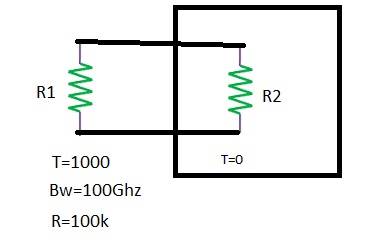
1)Can use noise a generator?
5162231000_1483604549.jpg

Well , if we have a noisy resistor and Ideal resistor why can't we use noise voltage according to noise voltage Vn=\sqrt(4KTBR)

2)why we divide power spectral density to RL( load) when we find power at RL?(it is a normalized voltage^2)?
3)for shot noise, it is better to decrease or increase DC current to reduce noise effect?because according to shot noise current I_{s}=\sqrt{2I_{dc}qBw} I understand we should reduce DC current to decrease noise current but in book text it has mentioned that we should reduce DC current to decrease noise voltage, which is correct and why?

Thanks in advance
 
Physics news on Phys.org
In your diagram there is heat flow from R1 into R2. (I'm also confused by noise)
 
Thanks Paul for your comment.
I have been confused so far:frown:
 
Part of the issue is I don't understand your question as worded. A noisy resistor is an ideal resistor with a series ideal voltage generator (i.e. the noise). The noisy resistor is (I assume) ##R1## since it is at ##T=1000K##. The noise voltage will appear divided across ##R1## and ##R2## where ##v1 = \frac{R1}{R1+R2}V_n## and ##v2=\frac{R2}{R1+R2}V_n##. Does this help?
 
Thanks Paul Colby for your explanation
Sorry if I explained my problem badly , As a matter of fact as you see we have a noise voltage across the R2 resistor that comes from R1 noise , So I want to know why we can't use this voltage to bias R2? for example if we change R2 with a transistor why It can't bias the transistor? (if we select a high resistor value or high bandwidth ?)

Thanks in advance
 
Well, in principle one could rectify the broadband noise at ##R2## supplied by ##R1## and extract energy. This is only possible because ##R2## is at a lower temperature than ##R1##. As I said, in this case there is heat flow. In this case power could be extracted. BTW this would be no different than running a photocell from the light of a fire. Only the transmission is through space rather than through a wire.

On the flip side. If the temperatures are the same, then the power flow is the same in both directions and no net power may be extracted.
 

Similar threads

  • · Replies 0 ·
Replies
0
Views
2K
  • · Replies 6 ·
Replies
6
Views
2K
  • · Replies 3 ·
Replies
3
Views
2K
  • · Replies 3 ·
Replies
3
Views
2K
  • · Replies 5 ·
Replies
5
Views
6K
  • · Replies 1 ·
Replies
1
Views
2K
  • · Replies 3 ·
Replies
3
Views
3K
  • · Replies 14 ·
Replies
14
Views
2K
  • · Replies 3 ·
Replies
3
Views
3K
  • · Replies 5 ·
Replies
5
Views
2K