Spacing between metal sheet and dielectric radome for best RCS

Click For Summary

SUMMARY

The discussion focuses on optimizing the spacing between a dielectric radome (relative permittivity εr = 3) and a copper sheet reflector to maximize Radar Cross Section (RCS) using HFSS simulations. It is established that the spacing for maximum RCS varies with the incident angle θ, following a periodicity of half-wavelength divided by cos(θ), due to constructive interference of obliquely incident waves. The radome is modeled as a thin square sheet (initially 3mm thick, later reduced to 0.1mm to minimize phase shift), and the copper sheet measures 432mm x 432mm with 3mm thickness. MATLAB scripts using transmission line analogies were used to calculate phase but did not match HFSS results, highlighting the complexity of phase analysis in HFSS plane wave excitation. The user aims for single-frequency operation and plans to study Salisbury screen absorbers as a comparative concept.

PREREQUISITES

  • HFSS (High Frequency Structure Simulator) electromagnetic simulation software
  • Radar Cross Section (RCS) theory and measurement principles
  • Electromagnetic wave propagation and oblique incidence phase calculation
  • Transmission line analogy for phase analysis in layered media

NEXT STEPS

  • Study Salisbury screen radar absorber design and its reflective properties
  • Analyze phase behavior of oblique incidence waves using analytical models beyond HFSS
  • Refine MATLAB transmission line scripts to better correlate with HFSS simulation outputs
  • Investigate impact of radome thickness and permittivity on phase shift and RCS peaks

USEFUL FOR

RF engineers, antenna designers, radar system developers, and researchers working on radome design, reflectarray optimization, and electromagnetic simulation validation.

Silvester
Messages
2
Reaction score
0
TL;DR
Determine the spacing between metal sheet and dielectric radome to achieve best RCS for various incident and reflection angle.
I'm working on a project about designing a radome for a reflector/scattering object like RIS or reflectarray. I run simulations on HFSS. For simplicity and the purpose of seeking regularity, i start with a dielectric radome(with relative permittivity = 3) and copper sheet.

Suppose that (1)large incident and reflection angle extends the length of propagation, and (2) higher RCS comes from the constructive interference. this problem should be easy to conquer after some simulations are done.

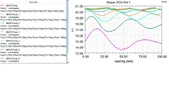
it turns out that as the incident angle increases, the spacing needed to have maximum RCS also increases, and peak or minimum RCS repeats with the period of half-wavelength/cos(theta) , corresponding to the wavelength of oblique angle.

but i can't figure out what spacing would the first peak show up.
i doubted it's about phase (constructive/destructive interference), but HFSS incident plane wave does not allow user to see the phase. i have written a MATLAB script to calculate the phase using transmission line analogy, the calculated phase does not match the HFSS result.
 
Physics news on Phys.org
Silvester said:
For simplicity and the purpose of seeking regularity, i start with a dielectric radome(with relative permittivity = 3) and copper sheet.
What is the shape of the "radome"? Is it a flat sheet of dielectric? If so, what is the sheet thickness?
Silvester said:
Suppose that (1)large incident and reflection angle extends the length of propagation,
What is meant by "extends the length of propagation"?
And does this reflector have to work at only one wavelength or is there a finite bandwidth?
Finally, are you familiar with "Salisbury screen" radar absorbers? These can be made into reflectors by altering the spacing of the components. The absorptive/reflective properties of such structures can be worked out with just pencil and paper, no finite-element simulators like HFSS required.
 
  • Like
Likes   Reactions: Silvester
renormalize said:
What is the shape of the "radome"? Is it a flat sheet of dielectric? If so, what is the sheet thickness?

What is meant by "extends the length of propagation"?
And does this reflector have to work at only one wavelength or is there a finite bandwidth?
Finally, are you familiar with "Salisbury screen" radar absorbers? These can be made into reflectors by altering the spacing of the components. The absorptive/reflective properties of such structures can be worked out with just pencil and paper, no finite-element simulators like HFSS required.
Hi, renormalizer:
It's glad to see your reply and i appreciate it. Also, i'm from Taiwan so English is not my mother tongue, i apologize for imprecise wording.

By saying length of propagation, when the distance between radome and copper sheet is fixed, noted as spacing (S), consider EM-Wave as rays. As these parallel rays incident with oblique angle theta, the length of the ray's path is no longer S but S/cos(theta), which is extended.

The shape of the radome is also a thin square sheet. The copper sheet is set 432mm x 432mm, 3mm thick, the radome side length is set 432+3.5*spacing so that no electromagnetic wave would touch the copper without passing through radome (i knew it's infeasible to implement, it's just for research).

As for the thickness, at first i use 3mm as thickness. However, i realized that 3mm is thick enough to provide about 30 degree phase shift, so i change the thickness to 0.1 mm.

My goal is not making it broadband, so single frequency/wavelength is fine. As for Salisbury Screen, i will spend some time to check it out.

Thanks.
 

Attachments

  • RCS vs Spacing.webp
    RCS vs Spacing.webp
    38.5 KB · Views: 6

Similar threads

  • · Replies 35 ·
2
Replies
35
Views
11K